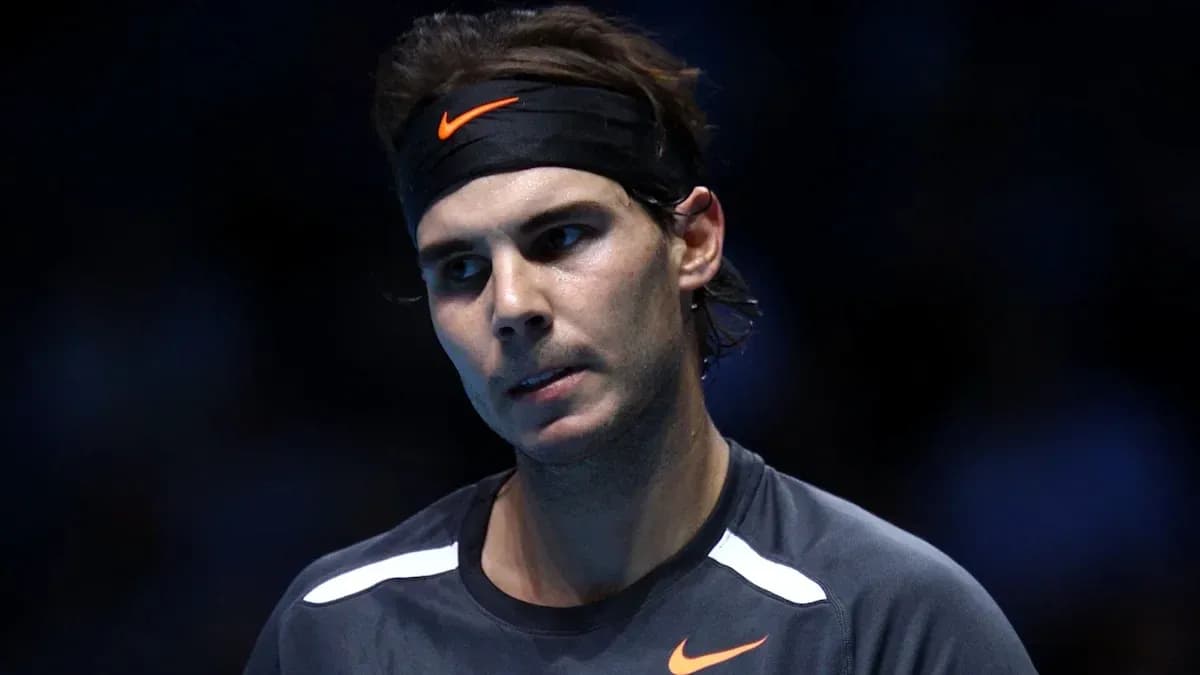
Rafael Nadal has lifted almost everything this sport can offer. Twenty-two Grand Slam titles, 36 Masters 1000 trophies, Olympic gold medals in both singles and doubles, years spent as world No. 1. His résumé sits comfortably in the pantheon.
Yet one week on the calendar always resisted him. The ATP Finals.
For all his dominance across clay courts and beyond, Nadal walked away from the season-ending showpiece without a single title. His great rivals Novak Djokovic and Roger Federer turned the event into a personal playground, amassing 13 trophies between them. Nadal, across a career that stretched over two decades at the top, never cracked that particular code.
A Stage That Never Quite Fit
Nadal qualified for the ATP Finals an extraordinary 17 times. That alone underlines his consistency. But injuries and scheduling meant he actually competed only 11 times. Each time, the same story: flashes of brilliance, deep runs, and ultimately, the trophy going elsewhere.
His first chance came in 2005, at the end of his breakout season. A foot injury ruled him out. The debut had to wait.
It finally arrived in 2006. The Mallorcan fought his way out of the group, beating Nikolay Davydenko and Tommy Robredo while slipping to defeat against James Blake. The reward for surviving the round-robin? Federer in full flow.
Nadal’s campaign ended in the semi-finals against the eventual champion. It would become a familiar pattern.
Federer, the Perennial Roadblock
If the ATP Finals became a riddle Nadal never solved, Federer often supplied the cruel punchline. No player beat Nadal more often at the event.
Four times the Swiss stopped him there, including in Nadal’s first final at the tournament in 2010. That match, a high-quality duel in London, felt like a chance for Nadal to finally add the missing piece. Instead, Federer cut him down 6-3, 3-6, 6-1.
Nadal reached only two finals at the ATP Finals in his career. The second came in 2013, when Djokovic stood across the net in the championship match and denied him again. Two finals, two defeats, and a lingering sense that the conditions were always tilting away from him.
The Harshest Week
The low point arrived in 2009. Nadal, usually the embodiment of competitive stubbornness, failed to win a single set in the round-robin stage. Three matches, three straight-set losses. For a player defined by his refusal to yield, it was a brutal week.
Years passed, generations shifted, but the story at the ATP Finals never truly changed. There were strong performances and deep runs, but never the coronation.
His final appearance came in 2022, by then as a veteran still capable of surging at the Slams. In Turin, the indoor hard courts once more blunted his edge. Losses to Felix Auger-Aliassime and Taylor Fritz in the group phase ended his campaign and, almost certainly, his relationship with the event.
Nadal’s Call for Change
Nadal never hid his view on why this particular stage proved so unforgiving. The surface.
Indoor hard courts have long been his least favourable conditions. The low, quick bounce, the controlled environment, the speed – all of it strips away some of the chaos and spin that underpin his game.
In 2013, he spoke openly about what he believed would be a fairer format for the ATP Finals, even knowing it would not benefit him personally.
"I know it's not going to happen for my generation," he said then. "I'm talking for the future generations, something that will be a little bit fairer for the players. And I think for the fans it will be interesting to change the surface every year to the surfaces we qualified on for the (ATP Finals).
"A good player has a chance to qualify for the (ATP Finals) four or five times in his career, so if during this four years you have a different surface every year, a minimum one time he will have the chance to play on his favourite surface."
It was a simple argument: if the ATP Finals is meant to crown the best of the best, why stage it year after year in conditions that favour only one type of player?
Tradition, Carpet, and Concrete
History offers some support for his case. For the first 26 years of the event, the ATP Finals were predominantly played on carpet, a fast indoor surface that produced its own specialists. In 1974, the tournament even ventured onto grass.
The modern era, though, has settled on one identity. Since 2007, the ATP Finals have been staged exclusively on indoor hard courts. The cities have changed, the branding has evolved, but the surface has not. Turin, the current host since 2021, shows no sign of breaking that pattern.
So Nadal’s suggestion remains just that – an idea on the record, a what-if for the future. A rotating surface. A year on clay, a year on grass, a year on hard. A genuine test of the complete player.
His career will close with that one conspicuous gap. The ATP Finals trophy never reached his hands. But the debate he sparked about what the season-ending event should represent may yet shape how the next generation fights for it.