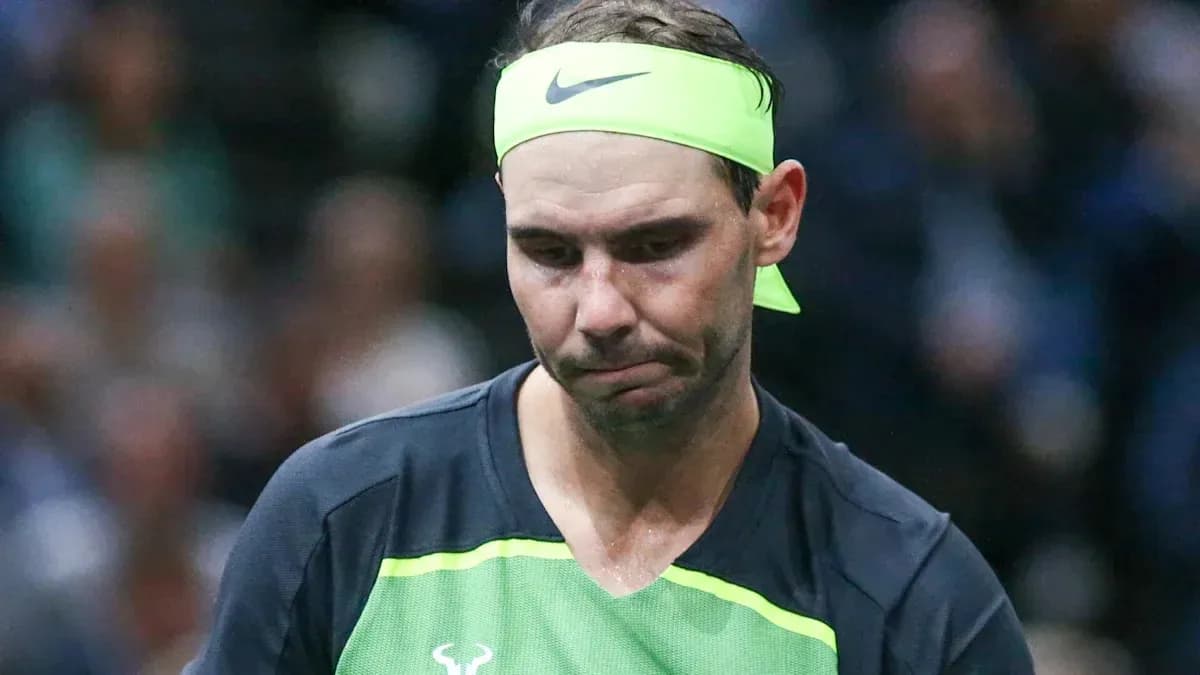
In a sport he helped redefine, Rafael Nadal walked away in 2024 with 22 Grand Slam titles, 36 Masters 1000 trophies and Olympic gold medals in both singles and doubles. His legend stretches across continents and surfaces, but its heart has always belonged to Paris.
Just not entirely.
For all the clay-court coronations at Roland Garros – 14 titles that may never be matched – Nadal never lifted the trophy at the other major event in the French capital, the Paris Masters. Same city, very different story.
A Final in His Debut, and a Shocking Beatdown
Nadal’s relationship with the Paris Masters began with a surge of promise. In his first appearance, he powered through the draw, dropping only one set on his way to the final. Indoors, under the lights, it looked like another stage he would quickly conquer.
Waiting for him there was David Nalbandian, unseeded but inspired. What followed stunned the arena: a brutal 6-4, 6-0 defeat for Nadal, a scoreline that felt almost out of place given the Spaniard’s form.
Nalbandian admitted his own surprise.
"All week I was playing great, and I don't know why the result was so easy," he said at the time. "After I broke him, I felt that I was playing better than him. I played more relaxed, started hitting winners almost from everywhere. That gave me confidence."
That night would remain Nadal’s only appearance in a Paris Masters final.
Injuries, Near Misses and Familiar Roadblocks
The following year, Nadal tried to build on that first run but Paris bit back. He reached the quarter-finals, only to stop abruptly. After losing the first set to Nikolay Davydenko, a right knee injury forced him to retire. The indoor season, always demanding on the body, was already beginning to extract its toll.
In 2009, he went a step further and reached the semi-finals. This time, Novak Djokovic stood in his way and dismissed him comfortably. The matchup, one of the defining rivalries of tennis, again tilted away from Nadal in conditions that suited the Serb’s precision and timing.
Then came a four-year absence from the tournament. When Nadal finally returned, the pattern repeated: strong run, harsh ending. He reached the semi-finals once more, only to fall to compatriot David Ferrer, a player who knew his game as well as anyone.
The list of names who stopped him in Paris reads like a roll call of elite ball-strikers. In 2015, Stan Wawrinka took him out in the quarter-finals, his heavy backhand cutting through the indoor court. Nadal’s next two campaigns ended not in defeat, but in physical breakdowns, as injuries again closed the door on a title run.
In 2020, the title felt within reach again. Nadal battled into the semi-finals, one match away from another shot at the trophy. Alexander Zverev denied him, adding another chapter to a story that kept looping back to the same conclusion: Nadal close, but not close enough.
Consistency Without the Crowning Moment
For years, Nadal’s record at the Paris Masters still looked imposing on paper. In each of his first eight appearances, he reached at least the quarter-finals. In a sport where a single bad day can wreck a week’s work, that level of consistency at a tricky late-season event underlined his competitive hunger.
But even that streak had an end.
In his ninth and final appearance at the tournament, Nadal did not make it past his opening match. Tommy Paul sent him out early, and with that loss, the long, uneven chapter of his Paris Masters story effectively closed.
He never returned to the event before retiring in 2024. For a player who collected almost every significant prize the sport can offer, the Paris Masters remained one of the few big trophies missing from his cabinet.
So Paris will always be split in two for Rafael Nadal. On one side, the clay of Roland Garros, where he built an empire. On the other, the indoor courts of the Paris Masters, where the king of Paris never quite claimed his second crown.