Rafael Nadal has spent a career mastering the big stage. Now Real Madrid are inviting him into a very different arena.
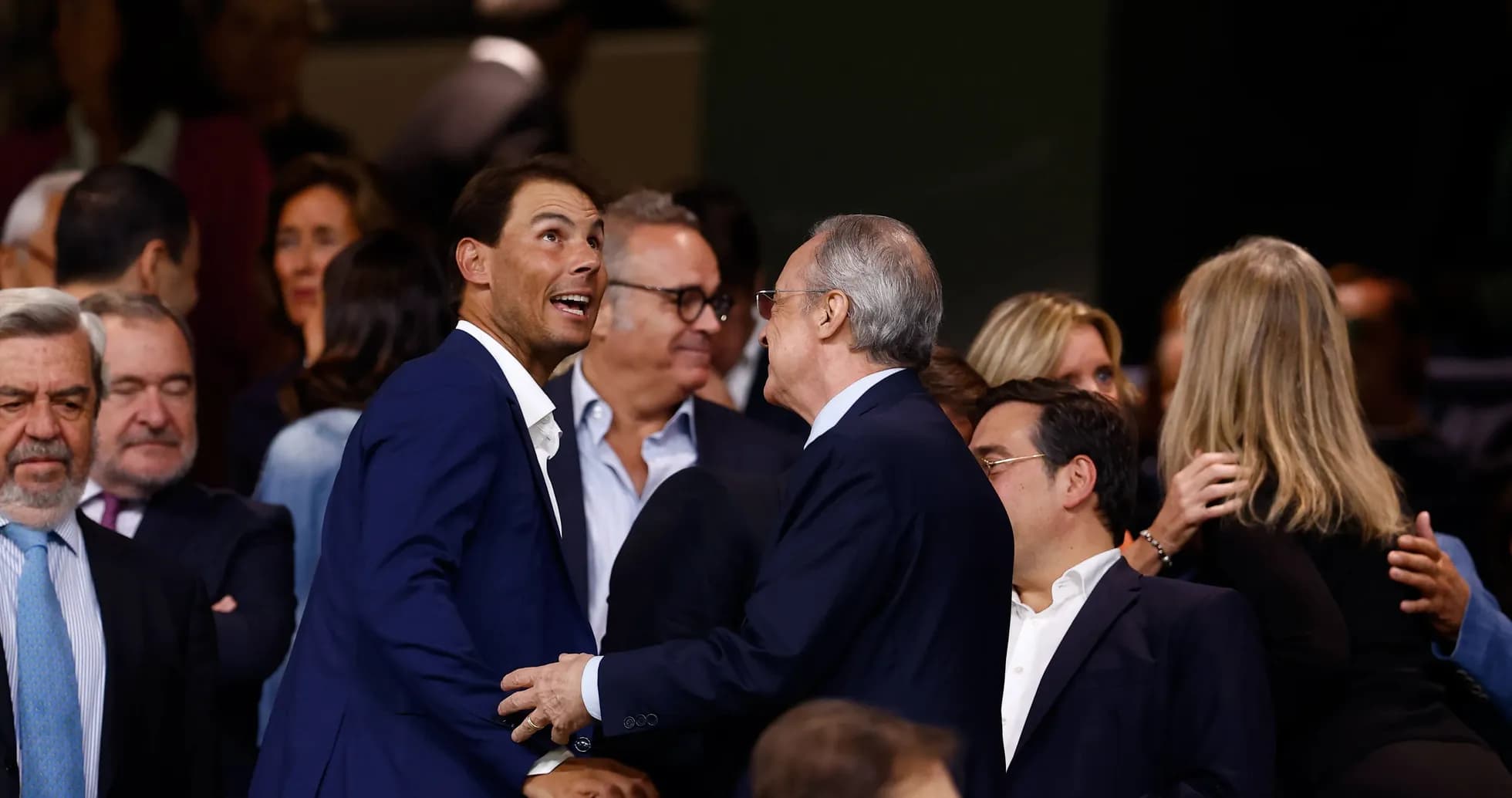
The 22-time Grand Slam champion is on the verge of taking a seat in the club’s boardroom, a move that feels far more strategic than symbolic. On 4 November, Real Madrid announced his nomination as a board member, with ratification scheduled for the general assembly on 21 November, as reported by Spanish newspaper Marca. If approved, it could be the quiet beginning of a journey that one day leads to the presidency and a succession to Florentino Pérez.
No one at the Bernabéu is saying that out loud. Nothing in this appointment guarantees Nadal will be the man to follow Pérez. But it does give him something he has never had at Madrid: a front-row view of how the club is run, and the time to build the administrative experience he lacks. He can learn, observe, influence — and keep any long-term plans locked firmly within his inner circle.
For a future presidential race, few names would land with more force. Nadal is not just a tennis icon; he is a global sporting symbol. Twenty-two Grand Slam titles, two Olympic gold medals, a career built on grit, resilience and an almost obsessive competitiveness. Add his lifelong bond with Real Madrid and the respect he commands at home and abroad, and the club is not just adding a board member. It is adding a powerful moral and media asset.
Real Madrid’s statement made that clear. The club highlighted his competitive spirit, his commitment and his respect for opponents as key reasons behind the nomination. Nadal himself has said that joining the board will allow him to understand the club’s inner workings more deeply and to play a genuine role in its management. This is not, in his eyes, a ceremonial chair.
People close to him back that up. According to Marca, those around Nadal insist he wants to contribute in a real way, to translate his sporting experience into decisions that can help shape the club’s future. For a man who has spent two decades living at the highest level of elite sport, the transition from court to boardroom feels less like a leap and more like a natural evolution.
The road to the presidency
The path to the top job at Real Madrid, though, is tightly controlled.
Article 40 of the club’s statutes sets out strict conditions for anyone seeking an administrative post. A presidential candidate must have been a club member for 20 consecutive years. The bar is slightly lower for other roles: 15 years for the vice-presidency and 10 for the rest of the board.
There is also a financial barrier. Any presidential hopeful must present a bank guarantee of at least 15% of the club’s budgeted expenses, secured against the personal assets of the board members. It is a system designed to ensure stability and seriousness — and to keep the field small.
Nadal has been an honorary member of Real Madrid since 2011, under number 67778. If that seniority counts fully, he would reach the 20-year requirement in 2031. Only then would he be eligible to run directly for the presidency under the normal rules.
His potential arrival on the board, though, opens a second, narrower door. The statutes state that if the presidency becomes permanently vacant, the board itself chooses one of its members to take over, with the decision then submitted to the general assembly for ratification. That mechanism does not erase the other conditions in the rulebook, but it does place any board member — including Nadal — much closer to the line of succession if circumstances change.
For now, this is all theory. Yet the theory suddenly feels more concrete.
Nadal keeps the door ajar
Nadal has never hidden how much the idea of leading Real Madrid appeals to him, even if he has been careful not to present it as an active objective.
Speaking to Ana Pastor on El Objetivo on La Sexta in 2024, he admitted: “Of course I would be happy with that, but it is not among my future plans.” It was a carefully balanced answer. No declaration of intent, no campaign message — but no denial either. The door stayed open, just a crack.
Two years earlier, in May 2026, he moved quickly to distance himself from reports linking him to Enrique Riquelme’s potential presidential bid. Nadal denied any involvement, underlined his respect for Florentino Pérez and stressed that his focus remained on his own projects. Again, he refused to close off future possibilities.
That is where the intrigue lies. A legend of one sport, stepping into the political and economic heart of another. A global figure whose presence on the board will instantly alter the club’s image, even if his role remains discreet at first.
What happens next depends on three things: the experience he gains inside the Bernabéu’s corridors of power, the evolution of his own ambitions, and whether he ultimately meets every requirement to stand as a candidate.
For now, Rafael Nadal is simply preparing to swap the players’ tunnel for the boardroom door. At Real Madrid, that single step can change everything.