Roger Federer has cried on some of the biggest stages in sport, but the first time the tears came, he had no idea why.
It was Wimbledon, 2001. Centre Court. His debut on the sport’s grandest patch of grass. Across the net: Pete Sampras, the king of that court, his childhood hero. Federer dropped to his knees after the win, shook Sampras’ hand, and suddenly felt a wave he couldn’t name.
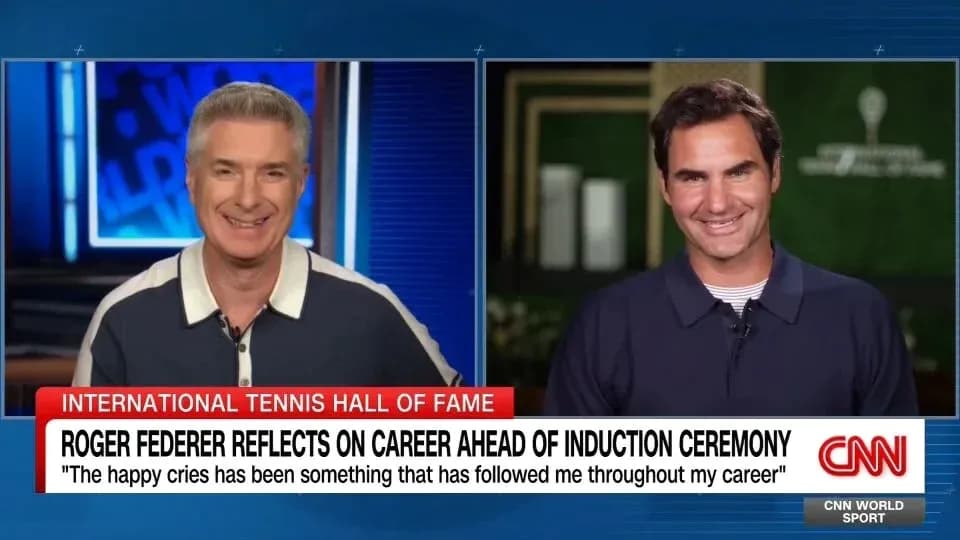
“I go to my knees, (then) I shake hands with Pete and he's my hero … and these emotions came all over me,” he told CNN Sports. “And I was like, 'What is going on?' This is not who I am normally."
From that afternoon against Sampras to his tear-soaked farewell in 2022, Federer built one of the defining careers in tennis history – and, almost by accident, became the sport’s most famous crier. The tears were never theatre. They were the overflow.
This weekend in Newport, Rhode Island, the emotions are likely to return. Federer is being inducted into the International Tennis Hall of Fame, and even he sounds wary of what might happen when he steps to the microphone.
"If I'm speaking about the game and all the gratitude that I have, and having my entire family there – from my parents to my wife to my four children and my whole team from coaching staff and physios, etc. I think it could hit home very hard," he said in the hours before the ceremony.
"If it happens, it will be more memorable for me personally, but I hope I get through the speech without too many hiccups. We'll see."
For most of the tennis world, this induction has felt inevitable for two decades. The destination was clear by 2004, the year Federer ripped through the tour, captured three of the four grand slam singles titles and climbed to world No. 1. Once he got there, he simply refused to leave, sitting on the throne for 237 consecutive weeks – a record that still stands.
He did not ease off.
In 2005, Federer won more than 95% of his matches. Then came 2006, the season many point to as his purest expression of dominance: three more majors, 12 titles in total, and a 92-5 win-loss record. That’s a 94.8% win rate across an entire year at the top of men’s tennis.
Sampras’ mark of 14 grand slam titles once looked untouchable. Federer did not just catch it; he surged past it on the lawns of Wimbledon in 2009 and kept going. The numbers became almost abstract.
What never did was the way he played.
Federer was adored for his movement, his timing, the way the ball seemed to glide off his strings. The grace and elegance on court matched the easy, almost disarming calm he projected off it. He turned brutality into ballet, and the sport into something that, to many, looked effortless.
That perception has always bothered him a little.
"It looked like I wasn't actually hitting the ball so hard," he recalled of how people saw him as a junior. "But it was kind of flying off of my racket with a lot of power. People always thought, like, 'It's so simple for you,' because it looked like elastic. But it wasn't the case. There was a lot of work and effort put into it.
"When I would lose, they say, 'Why don't you try harder?' And when you win, they would say, 'Oh my God, it's so easy for you!'"
Somewhere in that misunderstanding lies the root of all those post-match tears.
"The sacrifice was massive and I was holding a lot of pressure in."
The pressure is gone now. The sacrifice, too. Federer speaks like a man who has stepped away from the furnace and has no interest in walking back in.
He says he doesn’t miss the grind. There is no gaping void, no restless urge to chase again the same adrenaline and emotional spikes that defined his career.
"I'm actually really happy going through everyday life at a lower pace," he said.
Lower pace, but hardly idle. Life as a father of four, philanthropist, investor and businessman keeps him moving. He still travels, still lives out of suitcases often enough to feel familiar.
"I've always been a guy who loves being on the road."
Newport gives him a different kind of trip: back through his own history, into the company of the sport’s giants. His Hall of Fame induction lets him imagine what never was – a fantasy draw where eras blend and legends share the same court.
"I would have a little list," he said, before ticking through names that shaped tennis long before and just before his own rise: Rod Laver, Bjorn Borg, John McEnroe, Stefan Edberg, Boris Becker, and Sampras again. "I think these would be my favorite players to play against. I've always admired their personalities, what they have achieved, and what they represent in the game."
His once-record 20 grand slam singles titles have since been overtaken by Rafael Nadal and Novak Djokovic. The numbers game has moved on. The debate over the greatest of all time will roll forever.
Federer’s supporters rarely care about that ledger. For them, greatness is not only a count; it’s a feeling. A certain way a forehand whips, a way a champion carries himself, a way a man cries when the moment is too big to hold inside.
Asked what he’s good at now, with the racquets mostly put away, Federer turns the conversation away from trophies and towards life.
"I'm trying to get better at golf," he said. "I would love to start with an instrument again. I used to play the piano, so when I have more time, I'd like to dive into that because my four children and my wife play the piano.
"I hope I'm a good listener and a good decision-maker. Hopefully I'm a guy who people enjoy being around. I'm a big family guy. I love being surrounded by my friends – that's really the priority in my life."
In Newport, as his name joins the greats in bronze and stone, the image will be familiar: Federer, standing in the spotlight, fighting back the tears. This time, though, there is no opponent across the net, no ranking to defend, no pressure to swallow.
Just a career, a legacy, and a man finally moving at his own speed.