NEW YORK — On a damp, heavy night inside Arthur Ashe Stadium, Aryna Sabalenka walked back into her element and into yet another U.S. Open final.
She beat Jessica Pegula 7-5, 6-2, and it felt, at times, like she was swatting away not just an in-form world No. 3, but months of doubt and erratic form that had stalked her since spring. One more win and she will own a third straight title in New York, with Elena Rybakina — the woman who will take her No. 1 ranking on Monday — standing in the way.
A title defense at the hardest place to defend
The U.S. Open punishes tired legs and frayed minds. It sits at the back end of the calendar, when bodies ache, confidence flickers and the margins tighten. Defending it once is hard. Defending it twice is rare air.
For Sabalenka, doing it now would cut against the entire story of her last four months. She tore through the first quarter of the season, then turned suddenly mortal. Matches slipped, sometimes not because an opponent outplayed her, but because she unraveled in the very moments she had made her own over the last two years.
That version did not make the trip to New York.
Here, in her last chance at a Grand Slam this year, she has looked more like the force that bullied the tour into submission in 2023 and early 2024. A year ago, her frustration came from losing finals. This year, it came from not getting there.
Now she is back on the sport’s biggest stage, in the city that seems to plug directly into her personality.
“I feel confident and I feel mentally and physically really strong right now,” she said afterward, a simple sentence that carried the weight of a season.
New York, the court that fits and the city that feeds her
Sabalenka’s affection for this place is not a cliché. She named her cavalier King Charles spaniel “Ash” after the stadium. She talks about New York the way other players talk about home.
“I just love New York and I love being here, and I love the energy of the city,” she said. “I think that’s what drives me. That’s what really inspires me and pushes me to keep going.”
The court suits her, too. Hard courts are her natural habitat; this one, especially.
“Fast courts, but also bouncy a little bit,” she said. “That really gives me more possibilities of, like, pushing her back.”
She did exactly that to Pegula, point after point.
Pegula’s plan, Sabalenka’s answer
Pegula came in with a clear idea. Hit flat. Hit hard. Aim down the middle, take away the angles Sabalenka uses to drag opponents off the court and into chaos. It had worked on grass in Berlin, where Pegula handed Sabalenka a 6-0 set — a rare bagel that exposed Sabalenka’s discomfort bending down to low, skidding balls.
This was different. This was hard court Sabalenka.
The first set became a test of nerve and precision. Eleven straight holds. Short, vicious rallies. Sabalenka flared with the occasional error into the net, Pegula flashed winners when she could, but neither blinked on serve.
At 5-6, Pegula finally did.
Serving to reach a tiebreak, she felt the weight of Sabalenka’s power. Two errors under pressure. A double fault. On Sabalenka’s second set point, the defending champion went right at her, hammering the ball down the middle. Pegula’s reply died in the net.
Sabalenka had the set and, with it, control.
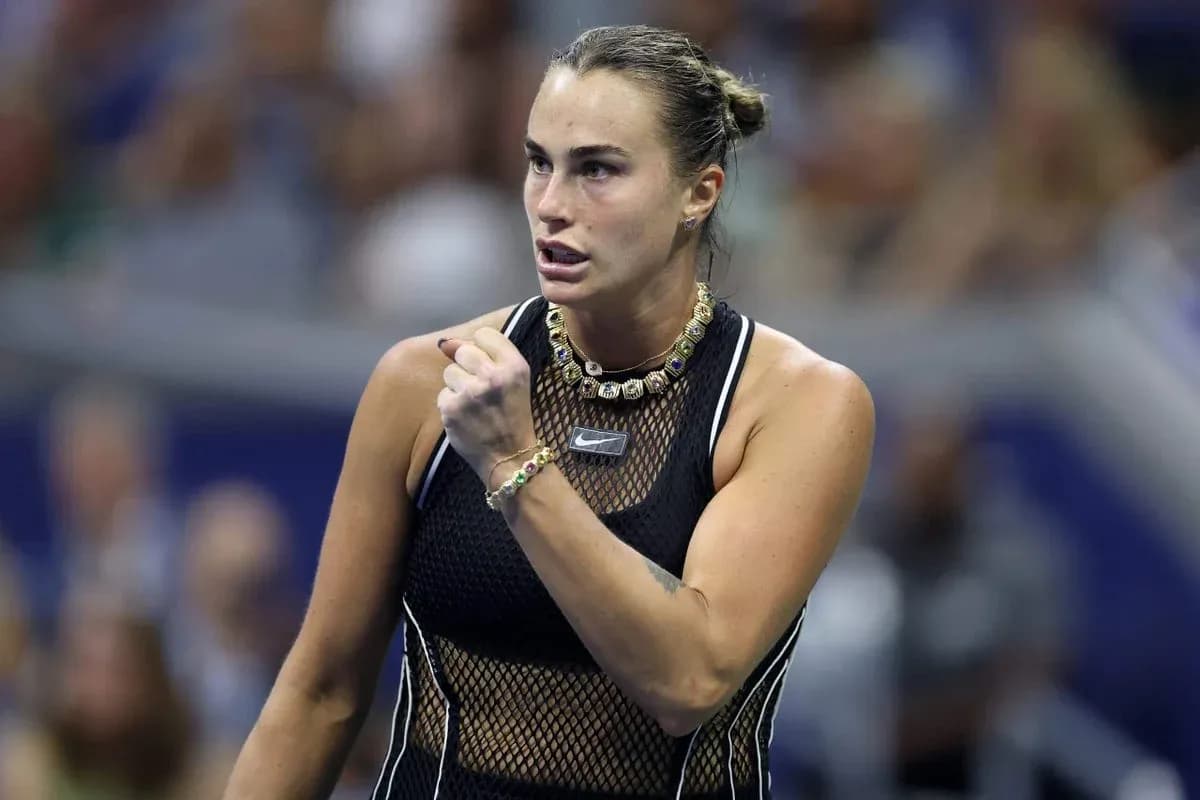
The second set was cleaner, more ruthless. Sabalenka didn’t roar, didn’t over-celebrate. A calm pump of the fist was enough. She knew what it meant: one set away from a fourth straight U.S. Open final, and a chance to three-peat in the city she loves more than any other stop on tour.
Pegula gets nothing for free
Pegula has been a near certainty deep into draws this summer — 22-5 since a first-round exit at Roland Garros — and she arrived in New York as one of the most reliable hard-court players in the world. She also owned recent success against Sabalenka.
None of that helped when Sabalenka found her groove on Pegula’s pace.
Sabalenka’s first-serve numbers were not eye-popping — 55 percent in — but the damage came on the second delivery. Those “nasty, twisting” second serves kicked and swerved just enough to keep Pegula off balance, and Sabalenka won two-thirds of those points. Every time Pegula looked up, the door she hoped might crack open slammed shut.
Afterward, Pegula could only acknowledge the reality of what she had faced. She and her team had joked with Sabalenka’s box about it.
“We’re like, ‘Do you like us?’ Like, we’re good people, we’re pretty nice to you guys. Do you think that maybe one day she could be maybe off a little bit, so I could just, like, get a chance?”
She never got that dip, that window.
Once Sabalenka locked onto Pegula’s flat, hard ball, the American felt boxed in.
“I’m not quite a Rybakina where I can serve myself out of trouble, and I’m not quite a Coco that can rely on insane athleticism,” she said, measuring herself against the two players Sabalenka could face in the final at the time she spoke.
“I do think the way she played tonight, I think she would have beaten anybody.”
One more night, one more giant across the net
Sabalenka will lose the No. 1 ranking on Monday no matter what happens in the final. She has made peace with that. The number next to her name is secondary this week. The trophy is not.
She has ruled the hard-court majors for four seasons now. This is her fourth straight U.S. Open final. She has already won two of them. In January, she reached a fourth consecutive Australian Open final and has taken that title twice as well. The third in Melbourne has slipped away from her twice in a row.
New York, she believes, can tell a different story.
Now comes Rybakina, the new No. 1, with a serve that can blast through any resistance. Sabalenka’s grip on this city, on this court, will face its fiercest test yet.
She has one night to prove that, ranking or not, the hard-court throne is still hers.