Four summers ago, Serena Williams told the world she was “evolving away from tennis.” Not retiring. She never liked that word. Just moving on.
The Vogue essay read like a goodbye all the same. The message beneath the glamour was blunt and familiar to millions of women: she wanted another child, and she knew she couldn’t chase that dream and still compete the way she demanded of herself. Something had to give.
Olympia got her little sister. And now, at nine years old, she’s nudging her mother back toward the arena Serena once left behind.
“You need to play with Auntie VeVe,” Olympia told her, Serena said this week on ABC’s Good Morning America. No drama. No big speech. Just a calm instruction from a child who has grown up with greatness at the kitchen table.
“When she does talk, you listen,” Serena said. So she did.
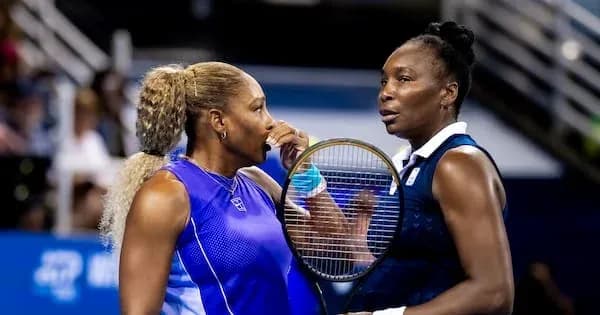
On Friday night at the US Open, under the lights of Arthur Ashe Stadium, Serena and Venus Williams will walk out together again as a doubles team for the first time in four years. Two icons, 44 and 46 years old, reuniting on the court where they once defined an era.
Venus, who finished a singles match at the brutal hour of 2am earlier this week, still sounded like a kid about it. “Super excited,” she said. After everything they’ve done, that simple phrase carried more weight than any grand declaration.
This is the tournament where their legends took root and then kept growing. Serena owns six singles titles here. Venus has two, including that 2001 win over her younger sister, a final that felt like a cultural moment as much as a sporting one. Serena hit back the following year, and the rivalry moved on, but that first Venus victory now sits a quarter-century in the past.
A quarter-century. Yet here they are again.
Around the grounds this week, the reaction has been a mix of nostalgia and awe. Fans know what time it is.
“I’m happy for them,” said Nonie Green, a longtime tennis fan from Arlington, Virginia, as she waited out a rain shower between matches. “Father Time is undefeated. But I’m happy for them, even if they don’t win.”
Winning, for once, feels almost secondary.
As a doubles team, the sisters have 14 Grand Slam titles, two of them in New York, in 1999 and 2009. They last played doubles together at the US Open in 2022, losing in the first round, just weeks after Serena’s Vogue essay signaled she was stepping away. This summer, a knee injury forced them to cancel a planned appearance at Wimbledon, but they tuned up in Cincinnati last month.
Now they return to Flushing Meadows not as a farewell act, but as something closer to a new chapter. Or maybe a reprise.
The tournament has responded in kind. Their match has been handed a prime-time stage: the night session in Arthur Ashe, complete with cocktails, a DJ, and the full US Open evening spectacle. The event knows what it has. So do the fans.
Across the net will be Maya Joint of Australia and Chan Hao-Ching of Taiwan. Joint recently beat Serena in singles at Wimbledon, a result that underscored how the sport has moved on, at least on paper. Yet when Serena and Venus step out together, the rankings and the seedings shrink. The story is bigger than the scoreboard.
For many, the point isn’t whether the sisters still have the sharpest reflexes or the heaviest groundstrokes. The point is that they are still here, still visible, still choosing to compete.
Green, 58, admitted that at their age she’d probably be on the sofa or in a commentary booth, not grinding through late-night matches. But she lit up recalling how happy Serena looked playing mixed doubles with Carlos Alcaraz earlier in the tournament. The joy mattered. So did the symbolism.
“They are good for women — and they are good for Black women,” Green said. She remembered a line from a former pastor: “Even the sky is not the limit. You can go beyond it.”
That sentiment tracks neatly with what Serena says she wants for her daughters now. Four years after deciding she couldn’t “have it all,” she is back on court, reshaping what “all” might look like at a different stage of life.
“I just really want my children to see me play at a different age,” she said on Good Morning America. Not in highlight clips. Not in old finals. In real time.
“I hope to show them that anything is possible. You can do anything at any age as long as you work hard and put some effort and dedication behind it.”
On Friday night, two little girls will watch their mother and their Auntie VeVe take center stage again, under the New York lights, chasing one more run together. Not as a farewell tour. As living proof that the story, against all sporting logic, still isn’t finished.