Serena Williams has spent a career forcing people to listen with a racket in her hand. Now she is demanding they listen to something far more urgent.
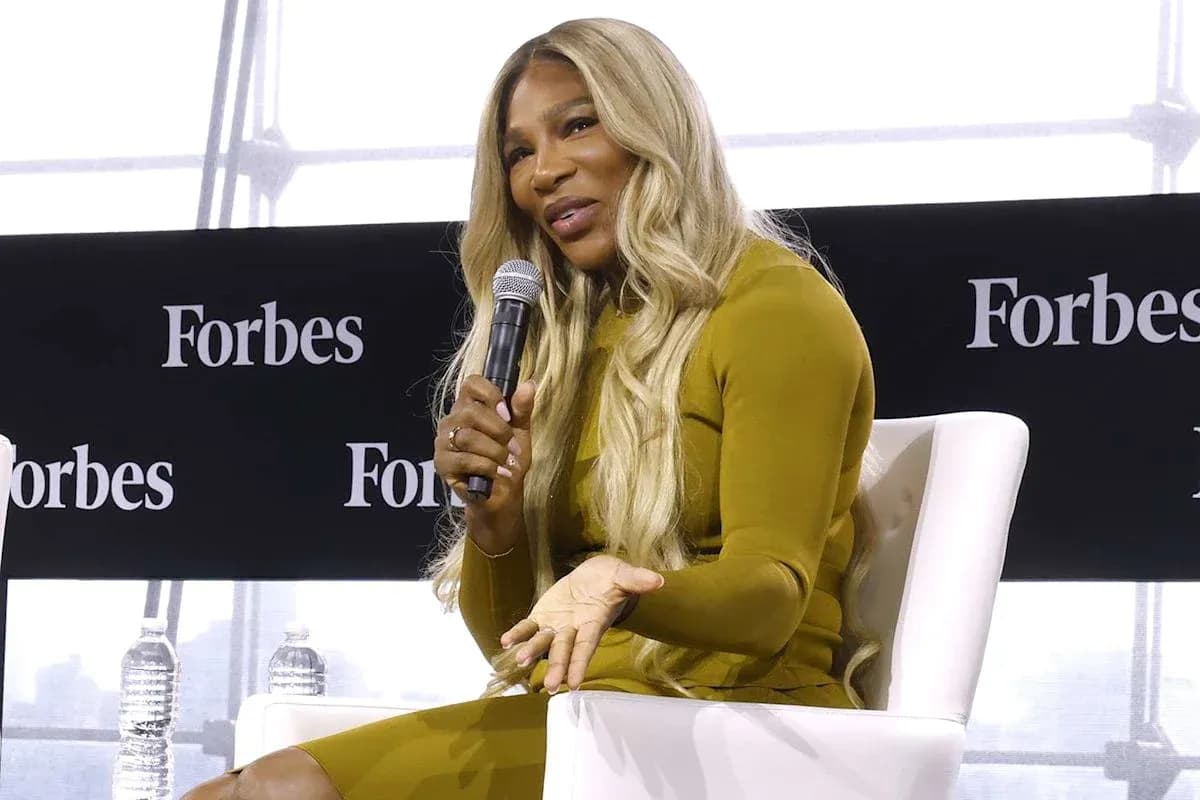
On Thursday in New York, at the Forbes Power Women's Summit 2026, the 23-time Grand Slam singles champion revisited the most frightening chapter of her life: the birth of her first daughter, and the cascade of medical emergencies that followed. The experience, she said, did more than nearly kill her. It exposed how dangerously fragile women’s health care can be, no matter their fame, wealth or status.
“When I told my story, I didn't realize how many people could relate,” Williams told the audience. At first, she admitted, she thought what she went through was “just a minority problem.” The more women she heard from, the clearer it became: “Then I realized it's a women's problem.”
The room quieted as she described what so many women had shared with her since she first went public with her ordeal. “So many women from every single background had a nightmare's tale of their birth, you know?” she said. The punchline that followed landed with a sting. “And then it boiled down to I thought, ‘Well, gosh, if men were giving birth, they would have sweets [and] like all kinds of medicines.’ So it wouldn't be the same problem at all.”
This was not theory for Williams. It was lived trauma.
In 2017, while delivering her first daughter, Alexis Olympia, with husband Alexis Ohanian, Williams was rushed into an emergency C-section. The danger didn’t end when the baby arrived. A coughing fit reopened her wound, and doctors discovered a large hematoma in her abdomen — a swelling of clotted blood that demanded urgent attention.
What followed was a six-day fight for her life. Williams battled a pulmonary embolism, a condition in which one or more arteries in the lungs becomes blocked by a blood clot. Multiple surgeries, constant monitoring, and the nagging fear that she might not make it home to her newborn defined that first week of motherhood.
“I knew something was wrong with me and it was super important that I was heard,” she said on Thursday. “Thankfully, my doctor listened to me. The nurses did, but I was so fortunate enough to have a doctor that did and literally saved my life.”
That word — “heard” — has become central to her mission. Her survival, she knows, hinged on a medical team that took her seriously. Too many women, she has learned, never get that chance.
The ordeal sharpened her focus. The champion who once stalked baselines now moves through boardrooms and summits with the same intent: to widen access to quality care, especially for women and underrepresented communities.
After giving birth, Williams stepped into a new role as the first entrepreneur-in-residence for the Reckitt Catalyst program, a global social impact and innovation initiative backing female and underrepresented entrepreneurs working on health, hygiene, water and sanitation solutions. For her, it was a natural extension of what she had lived through.
“What these women are doing is they're really letting us know that women's healthcare is so important, and healthcare in general,” she said, before underlining the ripple effect. Women, she pointed out, are often the ones holding families together. “Because also we're talking about women who take care of the kids, you know, I take care of my kids mostly.”
The work, as she describes it, is about more than grants and slogans. It’s about building pathways.
“With the program, we're able to actually solve a lot of issues, make, like I said, make those connections that are really vital, that are really important to open so many doors,” Williams explained. “Because every time we open a door, we're solving another problem that's closer to helping us all in this room and helping our kids.”
She has not kept her story confined to conference stages. In a 2018 opinion piece for CNN, Williams laid out the stark reality of maternal health and the simple measures that could save lives. “We know simple solutions exist, like access to midwives and functional health facilities, along with breastfeeding, skin-to-skin contact, clean water, basic drugs and good nutrition,” she wrote.
The frustration in that piece still echoes today. “Yet we are not doing our part. We are not rising to the challenge to help the women of the world,” she warned then, before pushing toward collective responsibility: “Together, we can make this change. Together, we can be the change.”
Her own life has moved into a new chapter since that essay. In August 2023, Williams and Ohanian welcomed their second daughter, Adira River Ohanian. Ohanian announced the news with a family photo and a message of relief and gratitude: a “happy & healthy newborn girl and happy & healthy mama.” He called Serena the “GMOAT” — the greatest mother of all time.
The nickname is playful, but the context is not. Twice now, Williams has walked into a delivery room. Once, she nearly did not walk back out. That contrast fuels her urgency.
On court, her dominance forced a sport to evolve. Off it, she is asking a harder question of a much larger arena: if one of the most recognizable athletes on the planet had to fight this hard to be heard, what chance do women without her platform have?