NEW YORK – Ready or not, Tory Burch has fully entered her power era.
Down in the Sunken Garden by Isamu Noguchi, beneath the bustle of downtown Manhattan, Burch turned the first official day of New York Fashion Week into a statement of intent. Not with bombast, but with control. With confidence. With a show that said: this is what American fashion looks like when it grows up without losing its nerve.
The crowd told its own story. Lauryn Hill arrived like a quiet earthquake, in oversized sunglasses, an olive-green cinched top and tiered skirt, a silk scarf floating over her head. Cameras snapped from every angle, but the detail that kept reappearing in every frame sat in her lap: Burch’s new Bunny Knot bag, in butter yellow, its dark knot detailing dotting the surface like a playful illusion of polka dots. The same bag perched on the arms of nearly everyone in the front row, a calculated chorus line of product and power.
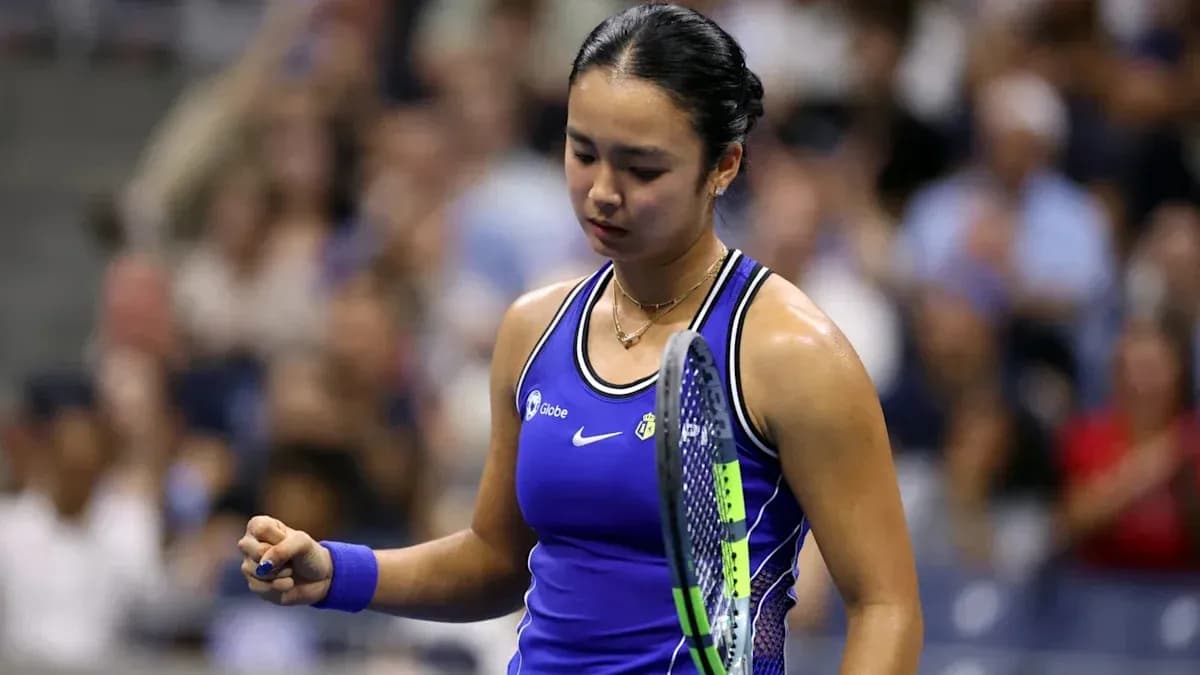
Hill sat flanked by daughter Sara Marley and niece Kymora Marley, a generational front row that felt perfectly timed. Amanda Seyfried, Chloe Fineman and Anna Wintour added their own gravitational pull, while Alex Eala – the young US Open breakout whose run ended at the hands of close friend Iva Jovic – slipped seamlessly into the mix alongside Ravyn Lenae, Padma Lakshmi and director Janicza Bravo. It wasn’t a random celebrity scatter; it was a curated ecosystem of culture, sport and style.
Then the music hit.
Burch, who has made a habit of soundtracking her shows with a wink (she blasted Dolly Parton’s “9 to 5” at her February fall/winter 2026 outing), opened this one with “Bad Moon Rising” by Creedence Clearwater Revival. A lean, ominous classic rock riff rolling through a sculptural, subterranean space. The mood shifted on a dime into Enya’s “Boadicea” – the haunting instrumental Hill and The Fugees sampled for “Ready or Not” on “The Score.” The reference was sharp, the timing almost eerie. An hour later, at a Chelsea venue, Public School sent models down the runway to that same track. On this night, “Boadicea” belonged to Burch.
She knows what these circular, sculptural spaces can do for her clothes. At the Gilder Center in the American Museum of Natural History last September, she effectively kicked off the so‑called Tory‑ssance, dragging the brand away from polite preppy territory and back into the conversation with an edgier, cooler sensibility. This show pushed that arc forward.
Spring florals, the most exhausted trope in the book, suddenly felt alive again. Not because they were loud, but because they were unexpected. Lavender crashed into teal. Aubergine met emerald green. Floral embroidery and garlands wrapped the body like gajra, those traditional flower strings, draped around the neck or clutched alongside a purse. The effect was ceremonial, but never stiff.
Color did a lot of the talking. Butter yellow sat next to deep gray, softening and sharpening it all at once. Kelly green locked in with eggplant purple. One standout: a golden brown textured jacket that looked less like outerwear and more like something in mid-bloom, a plant caught at the precise moment it opens to the light. The brand’s familiar draped bodices loosened into skirts that moved, not swished – there’s a difference – giving the models an ease that read as lived-in, not styled.
Emily Ratajkowski, one of Burch’s go-to runway presences, appeared in a look that distilled the collection’s tension between polish and ease: a slightly sheer navy tank traced with red detailing, a matching pleated navy midi skirt, and a brown medallion belt cinching it all with a clean, graphic line. Nothing screamed, but nothing faded away either.
Burch’s own words, tucked into the show notes, cut to the thesis: “Opulent femininity meets American pragmatism, seen through the collector’s eye.” She described the spring/summer 2027 collection as an exploration of “the psychology of how women pull things together. They want beauty, utility, and humor – the joy of getting dressed.”
That line – the joy of getting dressed – hung over the night as the models filed out and the crowd rose. In a fashion week often obsessed with viral moments and stunt casting, Burch chose something trickier: building a wardrobe that women might actually crave, piece by piece, morning after morning.
The Tory‑ssance isn’t a headline anymore. It’s a reality. The question now is how far she’s willing to push this new language of American luxury before everyone else starts speaking it too.