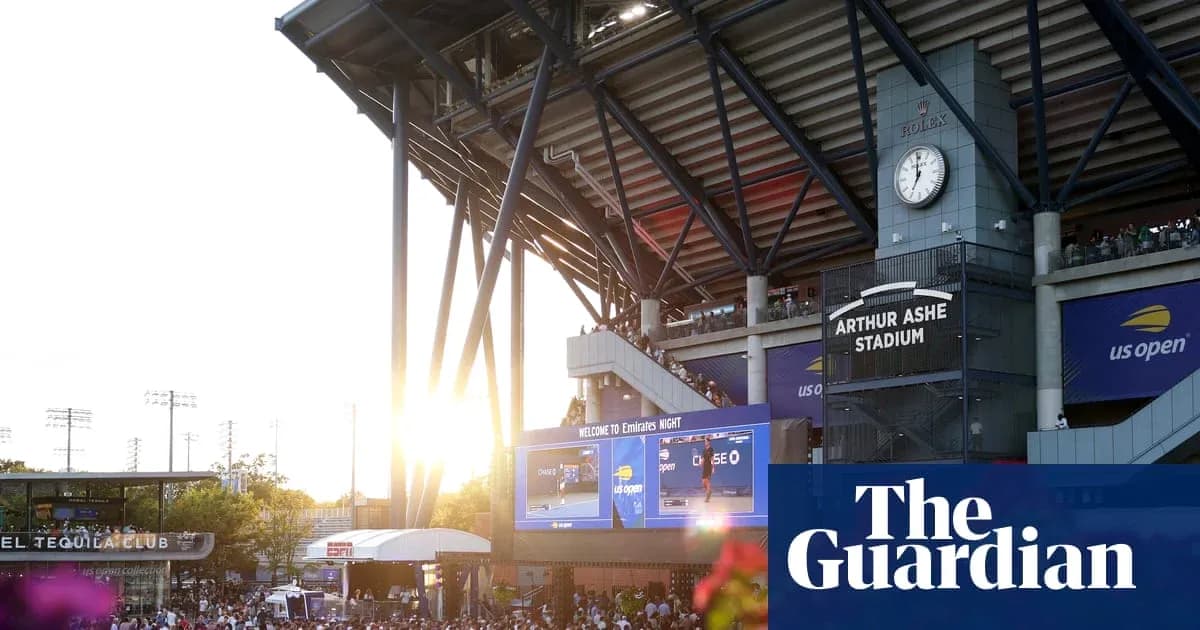
The year is 2041, and the USTA Liquid Death National Tennis Center no longer pretends to be just a tennis venue. It’s a theme park with lines, tiers, and VIP shortcuts — a neon, corporatized echo of the old Flushing Meadows that once smelled of sweat, sunscreen and Sabretts.
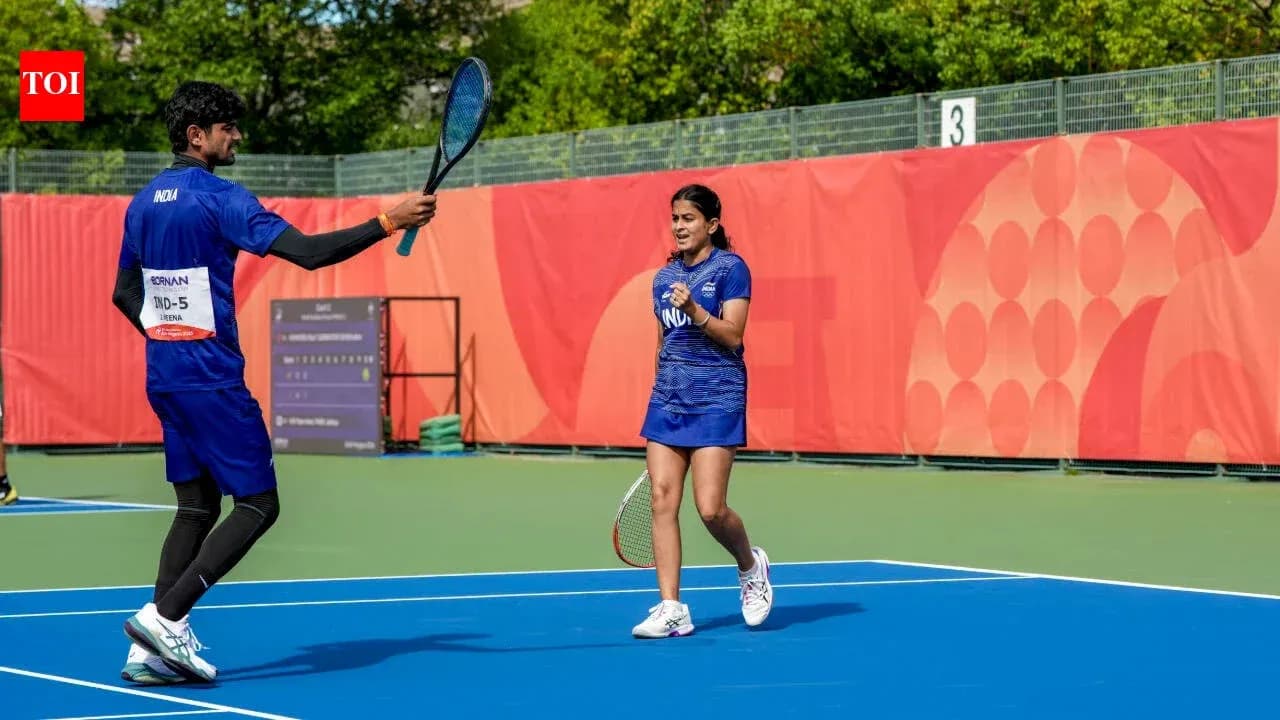
You clear security and step into the sprawl. On Practice Court 23, Myla Rose and Leo Federer are knocking off the rust before their first-round match in the US Open Mixed Doubles, now “presented by Botoxxify,” the tournament’s official neuromodulator partner. It’s a family tableau with a sponsorship tag.
Jake Paul, the 50th president of the United States, is a few hours away from sweeping in for opening night with first lady Jutta Leerdam-Paul and labor secretary Dana White. Venus Williams, still Venus Williams, has just accepted a wildcard into the women’s singles draw. You’re a couple of Klarna installments from finally paying off last year’s Honey Deuces.
Welcome to the Disneyland of tennis. Craig Tiley called it that back in 2026. He meant it as a dream. The regulars heard it as a threat.
From scruffy major to luxury product
When Tiley took over as chief executive of the United States Tennis Association in 2026, the phrase “Disneyland of tennis” sounded like marketing fluff. Longtime Open-goers were already muttering it under their breath during qualifying week, which was still free then, a last vestige of the tournament’s ragged charm.
Tiley’s blueprint was simple: more entertainment, more extracurriculars, more “experiences” for kids and adults. At a tournament where a basic grounds pass already went for hundreds on resale and chicken nuggets dusted with Petrossian caviar cost $100, the obvious question hung in the humid Queens air: more what?
Fifteen years on, the answer towers over the grounds in glass and LED. Layers of access. Premium seating. Branded activations. A slow, almost invisible erosion of value-for-money that feels familiar to anyone who has booked a flight in the United States since the Airline Deregulation Act of 1978.
Before you even step through the gates, the US Open Experience app prompts you to choose your class of customer: Grounds Pass, Grounds Pass Plus, Grounds Pass Platinum, or Grounds Pass Presented by FTX. They’re back, of course. Tennis itself is included only with Platinum. If you actually want to watch a match, you can buy a FastPass to skip the line for the escalator to the 300 level of Blackstone Court at Arthur Ashe Stadium. For an extra $85, the FastPass+ lets you briefly make eye contact with a player.
This is what “growth” looks like in 2041.
Hydration pavilions, viral food and $80 T-shirts
Thirsty? The Emirates Luxury Hydration Pavilion offers bottled water for $31. The consolation prize is a commemorative cap shaped like a miniature Anna Wintour in sunglasses. It’s a joke you pay for.
The Grey Goose Food Court has scaled up the Honey Deuce into the Mega Honey Deuce, a 96-ounce vodka lemonade in a souvenir fishbowl with six melon balls and one month of complimentary credit monitoring. The drink is less a cocktail than a lifestyle decision.
Food is content now. This year’s must-have item is the $55 chopped cheese sandwich by Hajji’s Blue Sky Deli, now under the Wonder umbrella. The lines form early and stay that way. For those still pretending to make healthy choices, there’s an Erewhon tucked beneath Mamdani Grandstand, in the space Lululemon vacated after collapsing in the Great Athleisure Correction of 2037.
Merch? That’s been a Fanatics Experience™ for years. You can buy the $80 T-shirt. You just might not want to risk putting it in a washing machine.
Fast4 tennis in a second-screen world
The sport itself has been resized to fit attention spans and content windows. All matches are now best-of-three Fast4 sets, a format born of market research that concluded fans wanted something “more digestible.”
If a final-set tiebreak feels oddly hollow without a bet riding on it, the tournament has you covered. The app offers a buffet of “prediction” options on everything from the next game to whether a 19-year-old qualifier ranked 746th in the world will double-fault at 30-all. The word “wagering” has been scrubbed. The impulse hasn’t.
Tiley saw this coming early. During his time running the Australian Open, he pushed that event into a partnership with an official betting company. William Hill’s logo flashed courtside for a brief, uncomfortable spell before disappearing under the weight of match-fixing concerns. The lesson wasn’t to pull back. It was to rebrand.
By 2026, the USTA had unveiled Kalshi as the US Open’s first Official Prediction Market Partner, hailing a new “generation of fan engagement” while flooding phones with push alerts. Fans sat courtside, faces lit by their screens, trading tiny markets as live tennis unfolded a few feet away.
In 2041, that marriage between markets and matches is complete. Every seat in Ashe now comes with a small Bloomberg terminal. Between points, the chair umpire pauses just long enough for spectators to adjust their positions. The players themselves remain barred from betting partnerships. Tennis, as the line goes, still has standards.
If you prefer your gambling old-school, the Hard Rock casino and sportsbook waits a short walk down the boardwalk past the No 7 subway station. Built by New York Mets owner and hedge-fund billionaire Steve Cohen, it offers the classic experience: your eight-leg parlay exploding in real time, no app required.
A calendar stretched, a crowd reshaped
The main draw starts on Saturday now. Once, the first round was a two-day blur: 64 matches a day, noon to midnight, chaos on every court. In 2025, the schedule stretched to three days with a Sunday start. Organizers liked what they saw. The shrinkflation kept going.
Any shock over ticket prices burned off years ago, not long after the nonprofit USTA handed ticketing operations to Ticketmaster and let the algorithm decide what the market would bear. Dynamic pricing and digital layaway are the only world most of today’s fans know.
The old US Open — the one that felt like it belonged to the city as much as to the sport — has mostly gone the way of Aqueduct and Jimmy’s Corner. But if you know where to look, you can still find scraps of that past.
Court 17, the sunken bullring in the corner of the grounds, remains the best seat in the house when you can get in. On Court 5, a determined grounds-pass holder can still watch three matches at once, head swiveling, scorelines blurring. A late-night doubles scrap on an outer court, mercifully free of influencers and ring lights, can still feel like the most important thing happening in New York.
Even in Ashe, there’s a faint echo of the old days. Around 400 non-premium seats survive, high above the swelling ranks of hospitality suites and Chase Sapphire lounges. From up there, if you squint past the corporate gloss, you can still make out a tennis match being played.
Enshittification or evolution?
Some call it enshittification. The industry term is premiumization. The USTA’s financial statements use a different word: growth.
Tournament director Morgan Riddle frames it as meeting fans where they are. Where they are, mostly, is on their phones, chasing experiences, juggling subscriptions, and willing to pay more for less if the packaging feels exclusive enough.
The US Open isn’t alone. Across American sports, ordinary seats are being ripped out and replaced by clubs, suites and hospitality zones. Wrigley Field, the Rose Bowl, Belmont Park — the story is the same. Corporations and wealthy fans will pay multiples of what the displaced once did. The numbers are too big to ignore.
Can you really blame the USTA for treating its crown jewel as the asset it is? One of the hottest tickets in American sport. A stage where a 37-year-old Coco Gauff can chase one last title and a storybook farewell. The demand is enormous. So is the money. The executives in charge are paid handsomely to find every last dollar, even as the organization’s charter still talks about getting more kids to pick up a racquet.
Maybe Tiley had it right back in 2026. Maybe the only way forward was to lean into the spectacle, build the suites, sell the activations, and accept that the US Open belongs just as much to the once-a-year visitor chasing a Honey Deuce selfie as it does to the diehards who used to roam qualifying week for free, hunting the next star on Court 12.
The old place had its era. It’s gone now, absorbed into a gleaming, monetized machine that still, somewhere beneath the logos and lounges, stages a tennis tournament. The question is no longer who owns the Open.
It’s who still feels at home in it.