The US Open is hitting its decisive phase in Queens, and the quarterfinals are stacked with storylines, star power, and a heavy American presence. From Aryna Sabalenka’s title charge to Carlos Alcaraz’s hunt for another crown, today’s schedule at the USTA Billie Jean King National Tennis Center is built for drama — and you don’t need a cable subscription to see any of it.
This is where the tournament starts to tighten, where reputations harden and nerves fray. It’s also where the viewing options open up.
Today’s Quarterfinal Lineup
Play begins at 11:30 a.m. ET, and the day session wastes no time.
On the women’s side, world No. 1 Aryna Sabalenka faces rising Czech talent Linda Noskova at 11:30 a.m. ET. Sabalenka’s power game has bulldozed many a hard court, but Noskova has made a habit of ignoring reputations. It’s the kind of matchup that can flip quickly if Sabalenka’s radar drifts.
At night, the focus swings to an all-American clash: Jessica Pegula vs. Emma Navarro at 7 p.m. ET. Pegula, seeded third, has carried the weight of expectation for the home crowd for several seasons now. Navarro brings the fearlessness of a player still writing the first chapters of her Grand Slam story. One plays with the polish of experience, the other with the freedom of a breakthrough season.
The men’s draw is just as loaded.
Frances Tiafoe, one of the most electric players in front of a New York crowd, meets fellow American Alex Michelsen at 11:30 a.m. ET. Tiafoe thrives on atmosphere; Michelsen is trying to build his own stage presence in real time. It’s a battle between established showman and emerging contender.
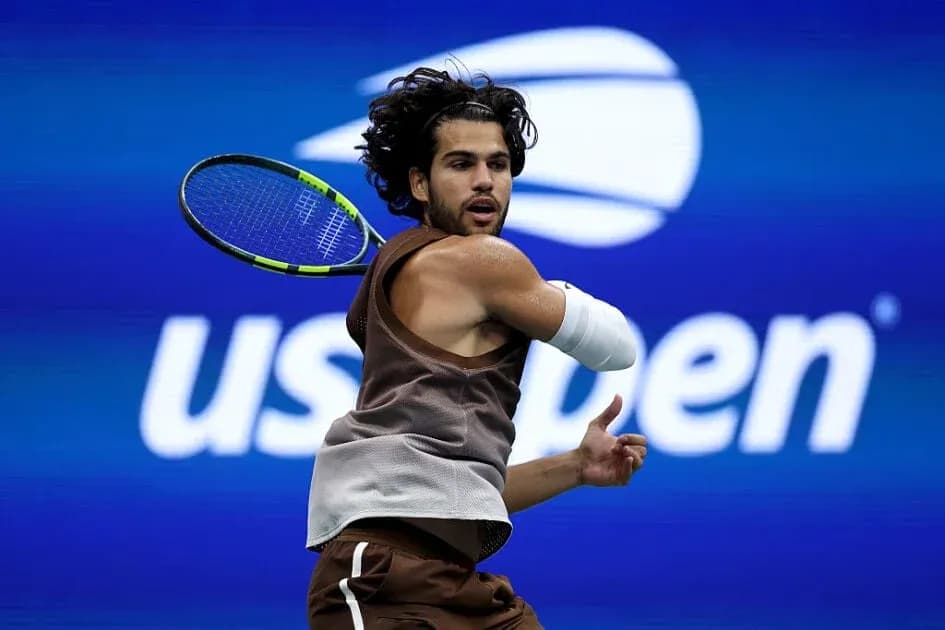
Then comes the headline act: Ben Shelton vs. Carlos Alcaraz at 7 p.m. ET. Shelton’s left-handed thunder against Alcaraz’s all-court brilliance. A booming serve against a generational returner. It has all the makings of a night-session classic under the lights in Arthur Ashe Stadium.
Around those marquee singles ties, the courts will stay busy with men’s and women’s doubles, plus mixed doubles and qualifying action. There’s barely a quiet corner in the complex.
How to Watch in the US
For American viewers, ESPN remains the home of the US Open, with select matches also airing on ABC and through the ESPN app. If you’ve cut the cord, you still have several ways in.
- DirecTV: The base streaming package starts at $59.99 for the first month and includes ABC and ESPN+.
- ESPN Unlimited: Offers live sports and archived ESPN programming starting at $29.99 per month.
- Fubo: Carries ABC, ESPN, and ESPN 2 in its Sports plan at $65.99 per month, with a quarterly payment option available.
- Sling: The Essentials plan includes ESPN and ESPN 2 for $19.99 per month. There’s also a Sling TV Day Pass at $4.99 if you only want to lock in for a single day of play.
- YouTube TV: Its Sports Plan provides ABC, ESPN, and ESPN 2 for $64.99 per month.
If you’re trying to keep costs down during the business end of the Slam, free trials are your best ally. DirecTV, FuboTV, and YouTube TV all offer trial periods that can cover key rounds if you time them right.
Watching for Free on 9Now With a VPN
Outside the US, the most intriguing option comes from Australia. Broadcaster 9Now is streaming the 2026 US Open for free, which opens a door for viewers willing to use a virtual private network (VPN).
A VPN lets you connect through a server in another country to access geo-restricted streams. ExpressVPN, which has servers around the world, is one of the go-to services for this kind of location shift.
To tap into the 9Now coverage from the US, UK, or elsewhere:
- Subscribe to a streaming-friendly VPN such as ExpressVPN.
- Download the VPN app on your device.
- Connect to a server located in Australia.
- Visit 9Now and start streaming the US Open.
Most of the top VPN services are paid, but many offer free trials for first-time users. Used smartly, that can turn the final stretch of the US Open into a free-viewing window.
However you watch, one small technical tweak can change how the sport looks in your living room. Turning on your TV’s motion-smoothing setting can make the ball easier to track during fast-paced rallies. Just remember to switch it off once the tennis ends, or you’ll be stuck with the overly glossy “soap opera” look for everything else.
The Shape of the 2026 US Open
This edition of the US Open stretches over three weeks, from Sunday, August 23, to Sunday, September 13, at the Billie Jean King National Tennis Center. The event’s spine is familiar, but the schedule remains packed from the opening ball toss.
Key dates:
- Qualifying events: August 24–27
- Men’s and women’s singles main draw: August 30–September 13
- Mixed doubles: August 24–26
- Men’s and women’s doubles: September 3–12
- Junior events: September 3–12
- Wheelchair events: September 8–12
The finals fall into place over a high-stakes closing weekend:
- Women’s Doubles Final: Friday, September 11
- Women’s Singles Final & Men’s Doubles Final: Saturday, September 12
- Men’s Singles Final: Sunday, September 13
First held in 1881, the US Open is the second-oldest of the four Grand Slams, behind only Wimbledon. The history is heavy, the hard courts unforgiving.
Who’s Chasing the Title?
This year’s field features 17 former Grand Slam singles champions, 10 of them past US Open winners. It’s a draw thick with experience, even with one notable absence.
On the men’s side, Jannik Sinner is out through injury, reshaping the top of the seedings. Alexander Zverev comes in as the No. 1 seed, Carlos Alcaraz as No. 2. With Sinner sidelined, the path to the trophy looks different, but not easier.
For the women, Aryna Sabalenka leads the field as top seed, with Elena Rybakina at No. 2 and Jessica Pegula at No. 3. Sabalenka’s power, Rybakina’s precision, and Pegula’s consistency give the draw a clear top tier — at least on paper.
No nation is better represented than the host. The United States sends 28 players into the main draw, the most of any country. Beyond Pegula, the home charge includes Emma Navarro, Coco Gauff, Frances Tiafoe, Alex Michelsen, and Ben Shelton, all still alive in singles.
The quarterfinals will tell us which of them can turn home support into something more substantial. Under the New York lights, with every point amplified and every service game a test of nerve, who will still be standing when the final weekend arrives?