The US Open is starting to bite now.
Round one is gone, the early nerves are out of the system, and Day 5 drops a slate of heavyweight clashes that feel far more like a second-week schedule than the middle of the first. Alexander Zverev, Coco Gauff, Naomi Osaka – all on court, all with something to prove in Queens.
And you don’t need cable to see a ball struck.
Where the US Open Lives on TV
In the United States, the tournament belongs to ESPN. That’s the anchor. Matches run across ESPN, ESPN2, the ESPN app, and selected windows on ABC, so any setup you choose has to reach those channels.
For cord-cutters, that means a streaming package with the right sports tier:
- DirecTV: The base streaming package starts at $59.99 for the first month and includes ABC and ESPN+.
- ESPN Unlimited: Direct access to ESPN content from $29.99 per month, with live sports and archived programming.
- Fubo: Carries ABC, ESPN, and ESPN2 in its Sports plan at $65.99 per month, with a quarterly option for those who prefer to pay in bigger chunks.
- Sling: The Essentials plan gives you ESPN and ESPN2 for $19.99 per month. There’s also a Sling TV Day Pass at $4.99 if you only want to drop in for a day of tennis.
- YouTube TV: Its Sports Plan includes ABC, ESPN, and ESPN2 at $64.99 per month.
Pick one, log in, and Flushing Meadows is in your living room.
How to Watch the US Open for Free in the US
If you’re not ready to commit to a full subscription, the free-trial route is the obvious play.
DirecTV, FuboTV, and YouTube TV all typically offer free trials to new users. Time it right, and you can ride through a crucial stretch of the tournament without paying a cent. Sign up, stream the action, and decide later whether to keep the service once the trial ends.
There’s another route, too, and it runs through Australia.
The 9Now Trick: Free Tennis from Australia
In 2026, Australian platform 9Now is streaming the US Open for free. For fans in the US, UK, or elsewhere, that opens a door – if you can virtually get yourself into Australia.
That’s where a VPN comes in.
Many VPN services allow you to connect to servers in different countries, unlocking content that’s otherwise geo-restricted. ExpressVPN, with its wide spread of global servers, is one such option often used for location spoofing.
The steps are simple:
- Subscribe to a streaming-friendly VPN service.
- Download the VPN app on your device.
- Connect to a server based in Australia.
- Go to 9Now and start streaming the US Open.
Most of the better VPNs are paid services, but plenty offer free trials or money-back windows. Use one of those, and you can watch the tournament on 9Now without adding a permanent bill to your monthly outgoings.
Setting Up Your Screen
Once you’re in, one small tweak can change how the game feels.
Many modern TVs have a motion-smoothing setting designed to make fast movement look cleaner. Turn it on for live tennis and you’ll often get a crisper, more fluid picture when Zverev unloads on a forehand or Gauff chases down a drop shot.
Just remember to turn it off afterwards. Leave it on for films and dramas, and you’ll get that glossy “soap opera” effect that directors hate and viewers rarely enjoy.
Today’s Key Matches – September 2
Play starts at 11 a.m. ET, but the real headline acts are scattered across the day and into the night session.
Women’s Singles – Round Two
- 11:30 a.m. ET – Naomi Osaka vs. Kateřina Siniaková Osaka steps back into the glare of a New York afternoon, facing a dangerous opponent with enough variety to disrupt rhythm if allowed to settle.
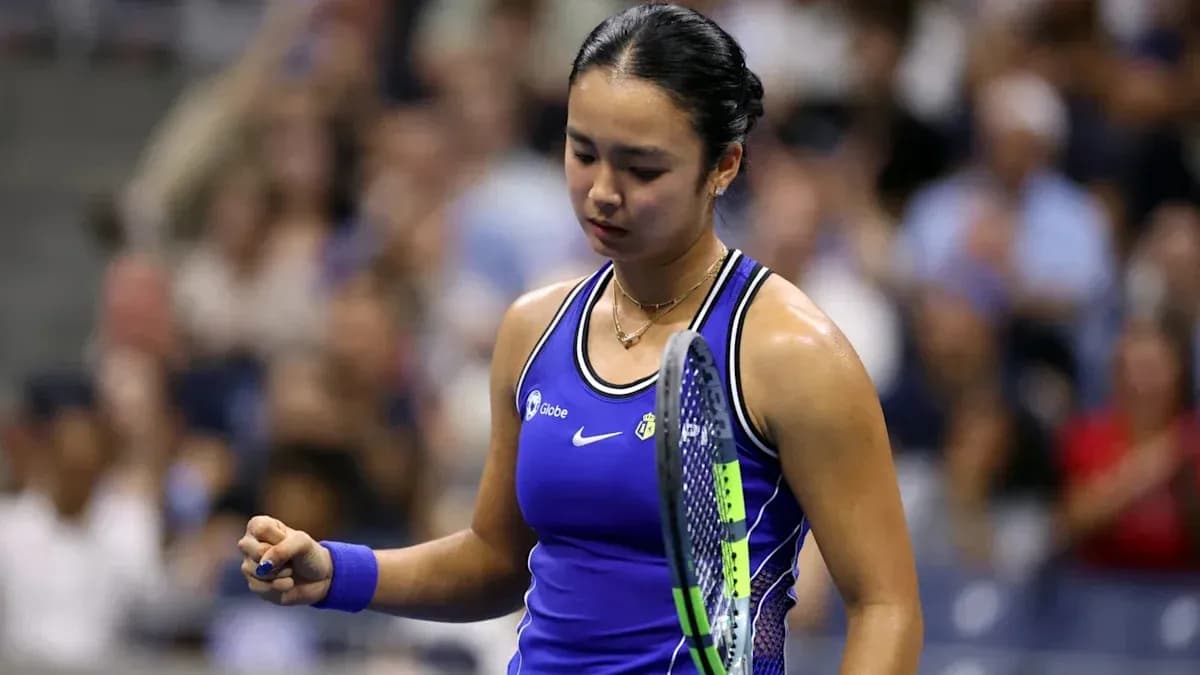
- 12:40 p.m. ET – Alex Eala vs. Oleksandra Oliynykova A chance to measure the next wave. Eala continues her push on one of the sport’s biggest stages.
- 7 p.m. ET – Coco Gauff vs. Paula Badosa Prime-time tennis under the lights. Gauff, the face of American women’s tennis, meets Badosa, a player with the weapons to turn this into a street fight from the baseline.
Men’s Singles – Round Two
- 11 a.m. ET – Félix Auger-Aliassime vs. Karen Khachanov A battle of heavy hitters to open the day. If the Canadian finds his serve early, this could be a statement match.
- 1 p.m. ET – Taylor Fritz vs. Mattia Bellucci Fritz carries home hopes and a searing hard-court game. Bellucci stands in his way as the American looks to plant a flag in week one.
- 7 p.m. ET – Learner Tien vs. Gael Monfils Youth against showmanship. Tien’s promise against Monfils’ flair, with the crowd almost certain to lean into every trick the Frenchman pulls out.
- 8:10 p.m. ET – Alexander Zverev vs. Quentin Halys The top seed in action. Zverev’s path to the latter stages starts here in earnest, with Halys tasked with trying to disrupt the rhythm of one of the game’s most imposing baseliners.
Miss one of these windows and you risk missing a turning point in the draw.
The Shape of the 2026 US Open
This is a long haul, not a sprint.
The 2026 US Open runs across three weeks at the USTA Billie Jean King National Tennis Center in Queens, New York, from Sunday, August 23, to Sunday, September 13.
The structure:
- Qualifying: August 24–27 – Men’s and women’s singles hopefuls fight through the outer courts for a place in the main draw.
- Mixed doubles: August 24–26 – Short, sharp, and always chaotic.
- Main-draw singles (men and women): August 30–September 13 – The heart of the tournament, from first-round nerves to the final Sunday.
- Men’s and women’s doubles: September 3–12 – Where chemistry and net play take over.
- Junior events: September 3–12 – The future of the sport on show.
- Wheelchair events: September 8–12 – High-level, elite competition that continues to grow in profile.
Finals weekend locks the spotlight:
- Women’s Doubles Final – Friday, September 11
- Women’s Singles Final & Men’s Doubles Final – Saturday, September 12
- Men’s Singles Final – Sunday, September 13
First played in 1881, the US Open is the second-oldest Grand Slam event, behind only Wimbledon. The history weighs on every night session, every tie-break that stretches past midnight.
Who’s Chasing the Title?
The 2026 field is loaded with pedigree.
Seventeen former Grand Slam singles champions are in the draw, ten of them past US Open winners. Experience is everywhere you look, from the top seeds to the veterans still capable of ripping through a section of the bracket.
On the men’s side, there’s a major absence: Jannik Sinner has been ruled out through injury. His withdrawal reshapes the top of the draw and clears space for others to push deeper.
The top three men’s seeds:
- 1. Alexander Zverev
- 2. Carlos Alcaraz
- 3. Félix Auger-Aliassime
Each arrives with different questions. Can Zverev carry the weight of the top seed? Will Alcaraz rediscover his New York magic? Is this the year Auger-Aliassime turns promise into a full Grand Slam run?
On the women’s side, the top three seeds bring power, precision, and home interest:
- 1. Aryna Sabalenka
- 2. Elena Rybakina
- 3. Jessica Pegula
Sabalenka’s aggression, Rybakina’s clean ball-striking, Pegula’s consistency – all three have the tools to own this surface.
The United States leads all nations with 28 players in the main draw. Beyond Pegula and Gauff, there is depth: Amanda Anisimova, Ben Shelton, Taylor Fritz, and Venus Williams all carry storylines of their own. From rising stars to legends, American tennis stretches across generations in this single tournament.
The stage is set. The seeds are in place. The schedule is packed.
Now it’s a question every Grand Slam eventually answers: who will still be standing when New York’s lights dim on the final Sunday night?