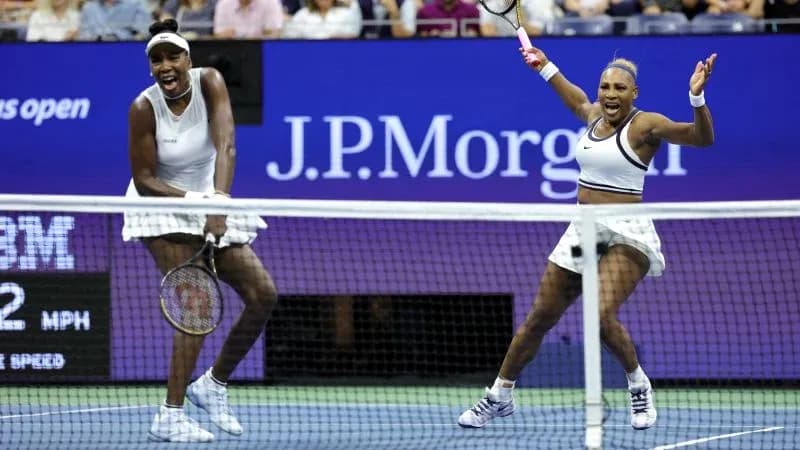
Under the lights of Arthur Ashe Stadium, with the New York night humming and the defending men’s champion watching from the treatment table, Serena and Venus Williams stepped back into a stage that has so often felt like theirs.
It felt like an occasion, not a routine first-round doubles match. The schedule confirmed it. A night-session slot in Ashe for opening-round doubles is almost unheard of. For the Williams sisters, it was simply a return to their natural habitat.
This time, though, the script turned cruel.
Facing Hao-Ching Chan and Maya Joint, Serena and Venus fought, clawed and very nearly pulled off the kind of escape that has defined so many of their shared nights in tennis. They surged back from 4-1 down in the deciding set, forced a 10-point match tiebreak and then raced to a 5-0 lead.
The stadium roared. The story seemed to write itself.
Then it slipped away.
Chan and Joint refused to fold, chipping away at the deficit as tension crept in on the other side of the net. The sisters, who had been so sharp late in the third set and early in the breaker, suddenly blinked. Both double-faulted in the tiebreak, errors that cut through the noise and the nostalgia. The momentum swung and never came back.
Chan and Joint completed the turnaround, winning 6-3, 6-7 (6), 7-6 (10-7) on Friday night, turning what had looked like a tribute act into a hard, modern result.
For the first time since 2022, Serena and Venus were back together at the US Open, the Grand Slam they have won twice as a team. They carried a 27-7 record into the night across their previous nine appearances here and had lifted the trophy in 1999 and 2009. This was their 10th campaign as a doubles pair in New York. It ended in the first round, and in brutal fashion.
Serena is 44 now, back on tour this year after stepping away in 2022 with 23 Grand Slam singles titles to her name. Venus, 46, has kept going, grinding through injuries and early exits, including a first-round singles loss at this tournament.
Age, rust, nerves — take your pick. The truth likely sits somewhere in the mix. Serena’s long layoff has been punctuated by sharp flashes and harsh lessons. She had already lost to Joint once this summer, in three sets at Wimbledon in her singles return. The sisters then withdrew from doubles there after Serena injured her knee, delaying their reunion on a Grand Slam court until New York.
Here, the reunion hurt. This was their second defeat of the summer in a match tiebreak, after another narrow loss at the Cincinnati Open.
The US Tennis Association said the sisters would not be available for comment. The silence only added to the sense of finality, even if no one around them is yet willing to call this the end.
For two decades, the Williams sisters were a force of nature in women’s doubles. Fourteen Grand Slam titles together. Olympic gold medals in 2000, 2008 and 2012. A shared run at No. 1 in the doubles rankings. For years, when they entered a draw, the question was not whether they could win it, but who could possibly stop them.
On this night, the answer was a steady Taiwanese-Australian pairing who refused to be overawed by the occasion, the names across the net or the noise inside Ashe.
They were not the only stars on the grounds.
Carlos Alcaraz, the men’s defending champion, had already done his part, sweeping past Wu Yibing 6-3, 6-4, 6-1 to book his place in the round of 16. Back at the US Open after missing four months with a right wrist injury, the two-time champion looked sharp and relaxed, sharp enough to plan his evening around the Williams show.
“I think there is no better plan (than) to watch the doubles, the Williamses once again, while getting a treatment,” he said after his win. “I’m going to be ready for that.”
On court, he was more than ready. The Spaniard controlled Wu from the baseline, tightened his grip as the match went on and closed in a rush. Next up is No. 20 seed Tommy Paul, who survived a five-set battle with No. 15 Alexander Bublik to reach the last 16.
“To be honest I’m better than I thought,” Alcaraz admitted, a warning shot to the rest of the field as his game and confidence grow with each round.
Aryna Sabalenka, chasing history of her own, had a different kind of night.
The world No. 1 and two-time defending champion finally had to dig. Kamilla Rakhimova pushed her in a second set that stretched to 54 minutes — one minute longer than Sabalenka’s entire previous match. Sabalenka still found a way, punching through 6-3, 6-4 to stay on course to become the first player since Serena Williams from 2012-14 to win three straight US Open titles.
There was another twist for the Belarusian: the smell of marijuana drifting across the court, an unwelcome distraction layered on top of Rakhimova’s resistance. Sabalenka rode out both challenges and moved on, setting up a round-of-16 clash with Taylor Townsend, whose bold, attacking game and home-crowd backing promise a very different kind of test.
So the present and future of tennis rolled forward, as they always do, with Alcaraz and Sabalenka back in stride and the second week coming into view.
The night, though, belonged to the past as much as the present. To two sisters who transformed the sport, who could still summon stretches of brilliance at 44 and 46, who led 5-0 in a deciding tiebreak under the Ashe lights and still walked off beaten.
If this was not the last time Serena and Venus Williams share a Grand Slam court, it felt close. And if they do return again, what exactly will be left for them to chase — and how much more can they demand of bodies that have already given the sport almost everything?