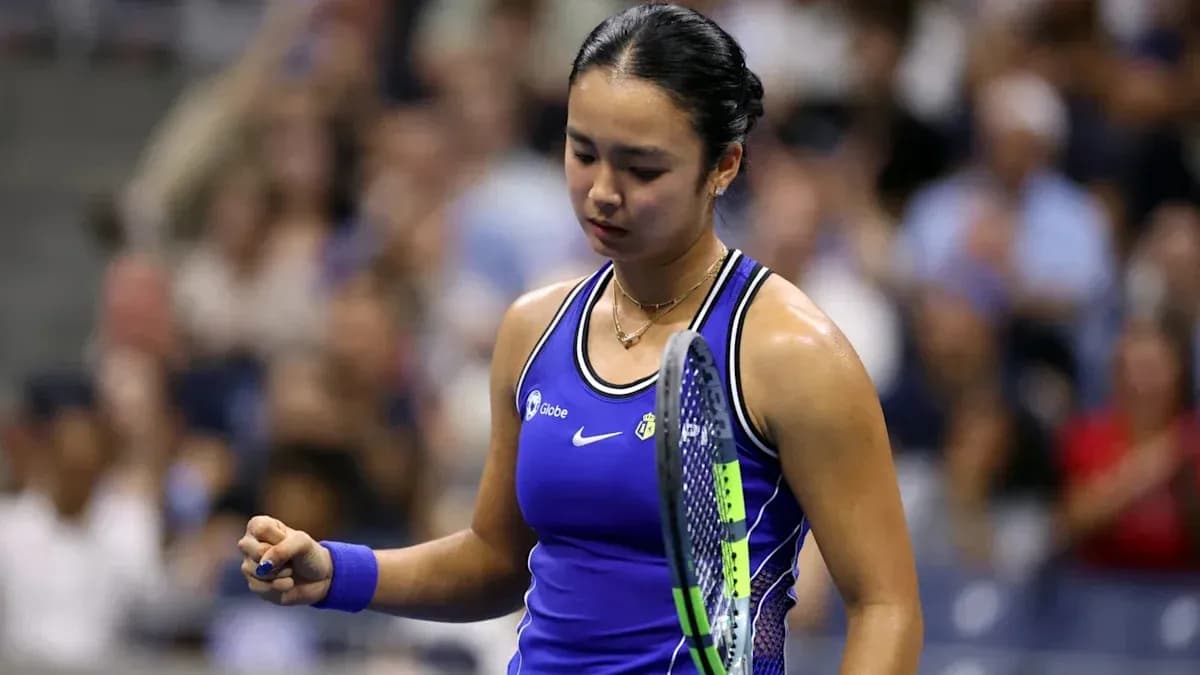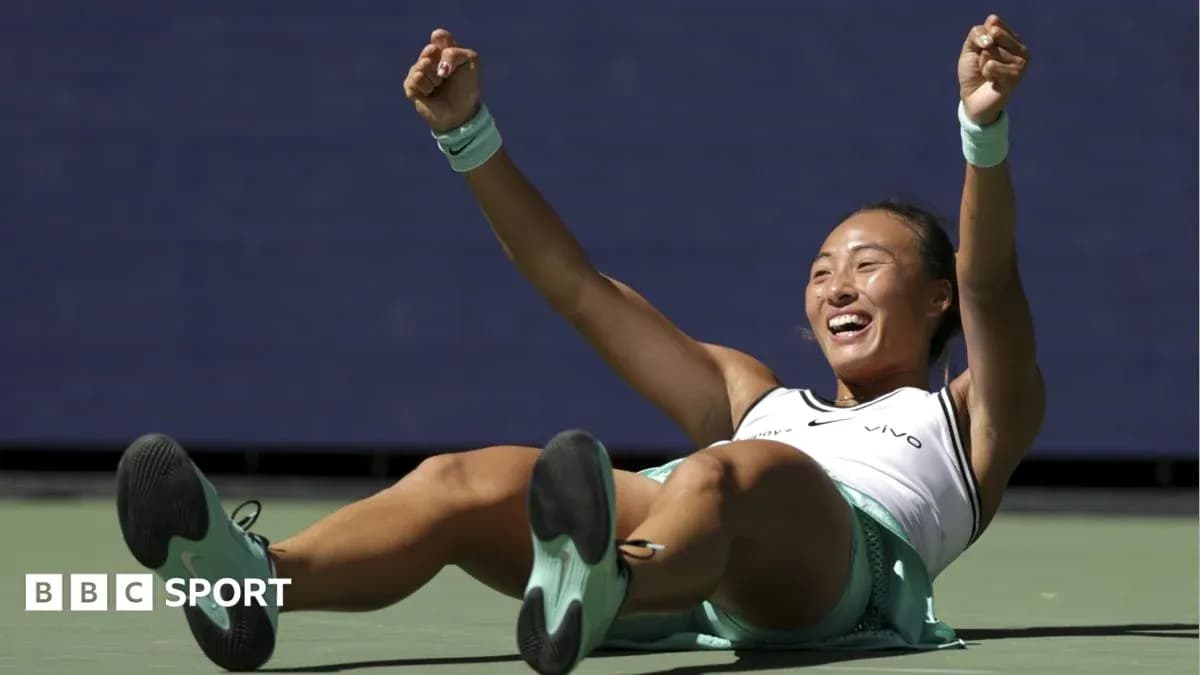
On Arthur Ashe Stadium, under the thick New York night, Zheng Qinwen did it again. Down 5-0 in a set. Again. Against Iga Swiatek this time, not just anyone. And again, she walked off the court the winner.
The Olympic champion, who only weeks ago was fighting to re-enter the top 100 after elbow surgery in July 2025, produced another outrageous comeback to beat the former US Open champion 7-5 6-3 and reach the quarter-finals.
From 5-0 down. Again.
Two days earlier, Zheng had stared at the scoreboard in disbelief against Madison Keys: 5-0 down in the deciding set, the American surging, the crowd ready to move on. Zheng responded with seven straight games, stealing the match and her place in round four.
You might call that a once-in-a-career escape. Zheng has turned it into a habit.
Against Swiatek, the hole was just as deep, only this time it came in the opening set. The eighth seed from Poland raced to a 5-0 lead, dictating rallies, punishing short balls, looking every bit the player who had arrived in New York on a surge of confidence after winning the WTA 1000 title in Toronto and reaching the semi-finals in Cincinnati.
Zheng refused to fold. The comeback started quietly, a hold to get on the board. Then another game. And another. The tension in Ashe shifted. Swiatek, once cruising, suddenly felt resistance.
Zheng won seven straight games to snatch the set 7-5. From 0-5 down. Against a four-time major champion who had not dropped a set all tournament.
The pressure finally told on Swiatek’s game. The clean, early control gave way to uncertainty, her patterns disrupted by Zheng’s heavy, fearless hitting. The Chinese player, 23 and playing with the freedom of a qualifier who has already torn up the script, began to swing with complete conviction.
A qualifier playing like a contender
This is not some bolt-from-the-blue run. Zheng is the reigning Olympic champion, a former world number four. Yet her ranking had slipped outside the top 100 earlier this year as she struggled to find rhythm and confidence after that elbow surgery.
New York has given it all back to her.
Three rounds of qualifying. Four main-draw wins. Seven victories in a row at Flushing Meadows, and now a place in the last eight that will haul her back towards the top 50.
Her performance against Swiatek was not just about the comeback in the first set. Once she had dragged herself level, Zheng took control of the match’s key moments. The second set stayed on serve until 3-3, both players trading from the baseline, neither willing to blink.
At 3-3, on Swiatek’s serve, Zheng pounced. A blistering backhand return winner ripped through the court, sealing a crucial break and bringing the crowd to its feet. It was the shot of a player who trusted her body again, who trusted her game.
Swiatek called for treatment on her left thigh when leading 2-1 in that second set, but even after the medical timeout she could not stem the tide. Zheng broke again two games after that first crack in the Swiatek serve and closed out the match 7-5 6-3 with authority, not nerves.
“The more matches I play, the more rhythm I have on court,” Zheng said afterwards. She talked of feeling “really pumped” when she arrived in New York, not tired despite the qualifying grind, intent on “trying to reach better levels” and soaking in the energy of Arthur Ashe.
Her tennis is now matching that mindset.
Swiatek’s major drought confirmed
For Swiatek, this defeat seals a jarring statistic. For the first time since 2021, she will finish a season without a Grand Slam title.
Her 2026 major campaign has been oddly flat. A quarter-final at the Australian Open was as far as she went. The French Open, her old stronghold, ended in the fourth round. Her Wimbledon title defence stopped in the third round. Now another fourth-round exit in New York.
This US Open had looked like a chance to reset the narrative. She arrived in form, with that Toronto title in her pocket and a Cincinnati semi-final on the way in. Through three rounds in New York she had not dropped a set, her game sharp, her movement crisp.
For a set and a half against Zheng, that level seemed intact. Then the match tilted, and Swiatek could not drag it back.
A familiar face, a familiar victim
Zheng’s win was not entirely out of nowhere in the context of this rivalry. She had beaten Swiatek before, in the semi-finals of the 2024 Olympics in Paris, a victory that helped propel her to singles gold.
Even so, that remained her only success in eight previous meetings. Swiatek had dominated the head-to-head, and on a hard court at the US Open, with the Pole seeded eighth and Zheng coming in as a qualifier, the script looked straightforward.
Zheng tore it up. Again.
Her shot-making grew bolder as the match went on. The backhand return that earned her the key break in the second set was emblematic of the shift: no hesitation, just clean, flat aggression. Swiatek, forced onto the back foot, never found a way to reassert her authority.
Echoes of Raducanu, and a new wave
Zheng’s surge from qualifying to the quarter-finals inevitably stirs memories of Emma Raducanu’s astonishing title run in 2021, the last time a women’s qualifier reached this stage in New York. The comparison is statistical, not stylistic, but it underlines how rare this kind of run is.
She is not alone in rewriting expectations for qualifiers in 2026. At Roland Garros, Maja Chwalinska started the French Open ranked 114 in the world and battled all the way to the final, where she lost to Russian teenager Mirra Andreeva.
Andreeva is here too, still marching. The French Open champion recovered from a set down to defeat Anastasia Potapova and reach her first US Open quarter-final, another teenager pushing deep into the second week.
The women’s game is being driven forward by this new wave. Zheng is right at the heart of it.
Osaka or Rybakina next
Zheng’s reward is a quarter-final against either Naomi Osaka, a former US Open champion, or second seed Elena Rybakina. The winner of that match will be confirmed later on Monday.
Whoever comes through will face a player who has already stared down elimination twice in New York and refused to accept it. A qualifier who has played herself into rhythm, into belief, and back towards the top of the sport.
She has already turned 0-5 into 7-5. Twice. In this kind of form, and on this kind of stage, who will dare assume she’s finished with comebacks yet?