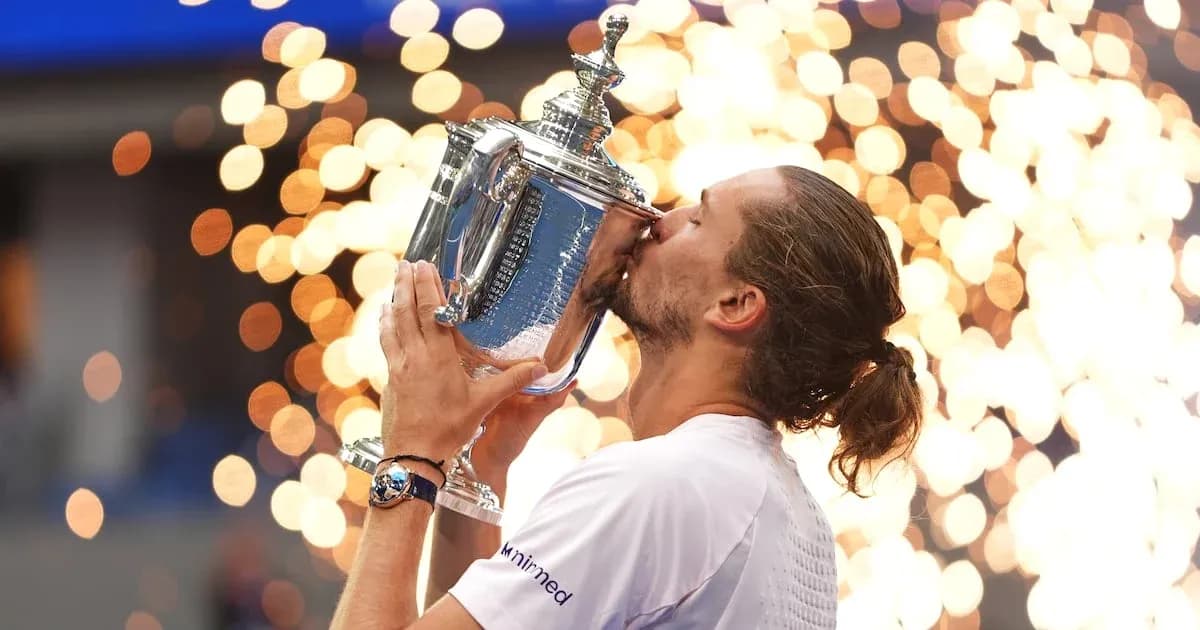
NEW YORK — The wait goes on for American men’s tennis. Alexander Zverev isn’t waiting for anything anymore.
On a thick, restless night at Flushing Meadows, the German walked into a stadium desperate for a homegrown champion and walked out with his second Grand Slam title, beating Ben Shelton 6-3, 7-6 (2), 5-7, 6-2 in the U.S. Open final on Sunday.
He silenced a crowd. He settled an old score. He underlined that this is now his era to seize.
Zverev’s redemption tour rolls on
Four years ago on this court, Zverev crumbled. Two sets up on Dominic Thiem, two points from the title, and then the match slipped through his fingers in a way that still felt raw every time 2020 was mentioned. He became the first man since 1949 to lose a U.S. Open final from two sets up.
Whatever lingered from that night is gone now.
Zverev arrived in New York this year already a different player, a different presence. He had finally broken through in Paris, lifting his first major at the French Open. At Wimbledon, he reached the final again, only to fall to Jannik Sinner. When Sinner’s knee injury forced him out of the U.S. Open, Zverev took the No. 1 seed and the weight that comes with it.
He carried it like it belonged to him.
Against Shelton, in the biggest American men’s final in more than two decades, Zverev played with the composure of a man who has seen the worst of a Grand Slam Sunday and survived it.
A nation’s hopes, a brutal start
Shelton entered the night as more than just the No. 8 seed. He was the face of a dream that has been building for 21 years, since Andy Roddick’s 2003 triumph here. He also stood on the brink of history as he tried to become the first Black man to win the U.S. Open since Arthur Ashe in 1968.
The crowd understood the stakes. They made it clear from the moment he stepped out of the tunnel. Fans rose to their feet, roaring, waving flags, leaning into the idea that this could finally be the night.
Then the match began, and the script turned quickly.
Serving first, Shelton lost the first two points, looked tight, and then handed over the opening game with a double fault. The noise dropped. The tension did not.
Zverev, sensing blood, locked in. He protected that early break with ruthless efficiency, his serve heavy and precise, his groundstrokes measured rather than flashy. Shelton never got that game back. Fittingly, the set ended the way it started for the American: with another double fault.
The scoreboard read 6-3, and the stadium felt uneasy. The occasion had found Shelton before he had found his game.
Silence as a weapon
If Shelton’s job was to feed off the crowd, Zverev’s was to starve it. He did that with something as simple and methodical as his serve routine.
Zverev’s deliberate style — the long pauses, the repeated ball bounces, sometimes 10, sometimes closer to 20 — stretched out the quiet. In tennis etiquette, fans are expected to hush as a player prepares to serve and stay silent until the point ends. Against a favorite son in a packed Arthur Ashe Stadium, that silence can be hard to enforce.
Zverev enforced it himself.
Every drawn-out pre-serve ritual gave him control of the tempo and denied Shelton the surging, rolling waves of noise that had powered his run. When fans tried to break the code by cheering missed first serves, the chair umpire stepped in with a warning. Zverev barely looked up. He had said before the final that he enjoyed hostile crowds. On this night, he turned them into background noise.
A tiebreak masterclass
Shelton slowly steadied his game in the second set. The serve began to land. The forehand found more depth. The points stretched out. The crowd, searching for any foothold, climbed back into the contest with him.
At 6-6, the set went to a tiebreak. This was Shelton’s chance to flip the match, to ignite the stadium, to drag Zverev into a dogfight.
Zverev slammed the door.
Shelton pushed Zverev’s first serve long on the opening point. Then came a brilliant passing shot from the German, a laser that flashed past Shelton and drew a gasp. Next, a 16-shot rally ended with Zverev on top, and suddenly it was 3-0. The tiebreak wasn’t just tilting his way; it was racing there.
Then came the serve. A 147 mph bomb. Then 124 mph. Both untouchable. Shelton clawed back to 5-2 and finally got a return into play, but Zverev took that point too, then finished the job with another huge delivery at 139 mph.
The tiebreak ended 7-2, almost clinical in its brutality. Shelton had been outgunned and outplayed in the biggest moments of the set. Zverev had one hand on the trophy.
Shelton’s surge and Zverev’s answer
The story could have ended there. It didn’t.
Shelton, 23 and fearless all fortnight, had not come this far to drift quietly out of his first major final. He had already taken out the defending champion Carlos Alcaraz in a five-set epic that finished at 3:33 a.m., the latest match in U.S. Open history. He had stared down big names and big moments and swung freely.
He found that version of himself again in the third set.
The serve grew more aggressive, the forehand heavier, the body language louder. The crowd responded instantly, sensing a shift. Every Shelton hold drew louder roars. Every half-chance on Zverev’s serve felt like a crack in the armor.
This time, Shelton broke through. He grabbed the third set 7-5, finally putting a dent in Zverev’s control and winning only his second set in six career meetings against the German. At 0-5 in the head-to-head coming in, he needed something to build on. He had it now.
For a moment, the match looked alive again. The idea of a full-scale comeback — the kind Zverev had suffered through in 2020 — lurked in the air.
Zverev refused to let history repeat.
He reset instantly in the fourth set, tightening his baseline game, cutting out errors, and once again using his serve as a hammer. The early break went his way, then another. The rallies shortened. Shelton’s resistance, and his energy, finally began to sag.
The set raced away from the American, 6-2, and with it went the last American hope of ending a 21-year Grand Slam drought on home soil.
A champion ascends, and a contender emerges
The numbers from this fortnight underline the scale of what Shelton attempted. He had already toppled the defending champion. He was trying to become the first man since 1975 to beat both the No. 1 and No. 2 seeds on the way to a U.S. Open title. He ran into the one player he still cannot solve.
Zverev now leads their rivalry 6-0. On this night, he allowed only a brief window of doubt before closing it with authority.
For Shelton, the defeat stings, but the trajectory is unmistakable. A first Grand Slam final at 23. A run that reignited belief in American men’s tennis. A game that clearly belongs on this stage and will almost certainly return to it.
For Zverev, the picture is sharper. French Open champion. Wimbledon finalist. U.S. Open champion. No. 1 seed and worthy of it. The player who once let this title slip from his grasp now owns it outright.
The American drought continues. Zverev’s surge does not. The question now is not whether he belongs at the top of the sport, but how far, and how fast, he intends to go from here.