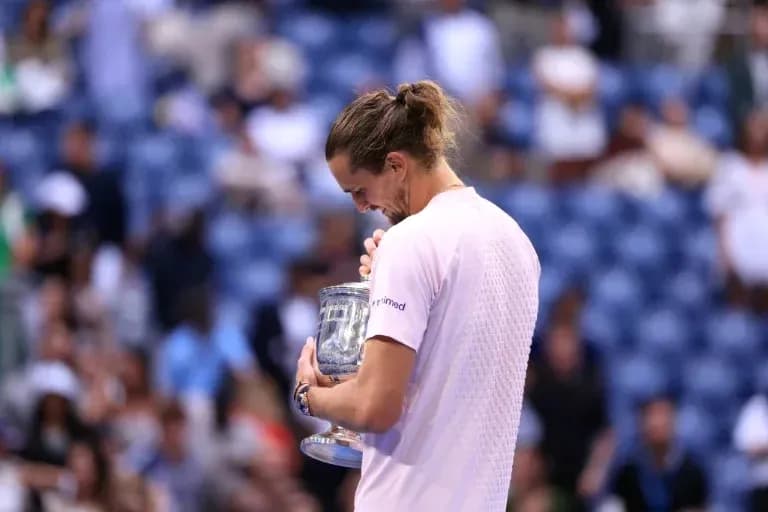
Alexander Zverev stood on the US Open podium on Sunday night not as a nearly man, not as the tragic figure of Flushing Meadows 2020, but as a two-time Grand Slam champion in the space of four months. After more than a decade of promise, missteps, injury and scrutiny, the dam has finally burst.
Four months ago in Paris, the 29-year-old German called his French Open triumph his “happy end.” It turns out that was only the start of a new chapter. In New York, he walked into his third consecutive major final, carried the scars of two recent defeats, and walked out having tamed rising American Ben Shelton to claim the US Open title and cement his place among the sport’s elite.
This is not a bolt from the blue. It is the payoff to a story that has been building since childhood.
Born for it, but never handed it
Zverev has lived with expectations for as long as he has held a racket. The 6-foot-6 (1.98m) right-hander grew up in a tennis household, with both parents playing at a high level in the former Soviet Union before guiding their sons through the junior ranks.
"For me, my family is everything and I owe them a lot for helping me to become the tennis player that I am today," he has said. That line has followed him for years, but it carries a different weight now that the trophies match the talent.
He was tipped early as the heir apparent, the player who would one day take over from the generation he idolized. Roger Federer was the poster on his wall; the tour, in time, became his workplace. Yet the path that looked so straight from the outside bent sharply more than once.
Zverev has built his career while managing diabetes, a condition that demands daily discipline on top of the grind of the tour. Then came the physical blow that almost changed everything: a gruesome ankle injury at Roland Garros in 2022, when he tore ligaments during his semi-final against Rafael Nadal and left the court in a wheelchair. Surgery followed. So did doubts.
Shadows off the court
His rise has also unfolded under a darker cloud.
Two former partners, Olga Sharypova and Brenda Patea, have accused him of domestic violence, allegations he has consistently and strenuously denied. The ATP Tour investigated one of the claims and announced it had found insufficient evidence to impose a punishment.
The case involving Patea, the mother of his daughter, moved into the German legal system and led to a penalty order and fine in 2023. Zverev appealed, and the matter ended in a settlement reached in June 2024 — just hours before he stepped on court for his French Open semi-final.
Those off-court issues have shadowed every achievement, ensuring that Zverev’s name rarely appears without context or debate. His wins have never existed in a vacuum.
From heartbreak to hard edge
On court, the turning point everyone remembers came in New York as well, but in a very different light.
In 2020, Zverev played his first Grand Slam final at the US Open and led Dominic Thiem by two sets to love. The title was in his hands. It slipped away in five. He later admitted that the serve, his most important weapon, had become a source of fear.
"That was exactly the time when I had real struggles with my serve and my second serve," he said of that match. "I knew that my serve could break down at any moment. That's one difference that I do feel now, luckily for me."
The mental fragility tag stuck. Every double fault, every tight tiebreak, fed the narrative that Zverev would always find a way to falter when the stakes were highest.
Then came the ankle injury, the long rehab, the slow rebuild. When he returned in January 2023, there was rust, but also a harder edge. He collected his 20th career title in Hamburg, a home win that felt more like a statement than a routine trophy.
The real surge arrived in 2024. Zverev powered through to the French Open final and climbed to world number two, dismantling the idea that he would forever be a nearly man. The results suggested a player who had stopped flinching at the big moments and started owning them.
"In the life of a professional athlete, you will have the highest highs and the lowest lows," he said. "Getting caught up in the lows is the biggest mistake that you can make.
"You shouldn't try to evaluate everything when times are tough, you should try to find ways to get better when you're on a high."
Setbacks, then the breakthrough run
The highs did not come in a straight line. In Melbourne this year, Zverev walked into his third major final at the Australian Open and was swept aside in straight sets by Jannik Sinner. Another chance gone. Another scar.
He still had his moments of brilliance: a gold medal at the Tokyo Olympics in 2021, when he stunned Novak Djokovic and then beat Karen Khachanov for the title, remains one of the defining achievements of his career. Yet even that glittering week did not silence the central question: could he win a Slam?
As Sinner and Carlos Alcaraz carved up the sport’s biggest prizes, collecting nine straight majors between them, Zverev’s window looked like it might be closing. Younger, fearless rivals were taking over the stage that was once supposed to be his.
He refused to accept that storyline.
"I believed in it. I believed that it's possible," he told reporters in New York. Then, with a laugh, he added: "I think not many of you guys did."
The last four months have swung the argument firmly his way. First Paris, now New York. Three consecutive Grand Slam finals, two titles, and a runner-up finish at Wimbledon in between. The numbers now match the talent that coaches and peers have spoken about for years.
The Grand Slam floodgates, long jammed by nerves, misfortune and missteps, are finally open. The question for men’s tennis now is simple: with Zverev no longer on the outside looking in, how much more can he take from this era he was once supposed to inherit?