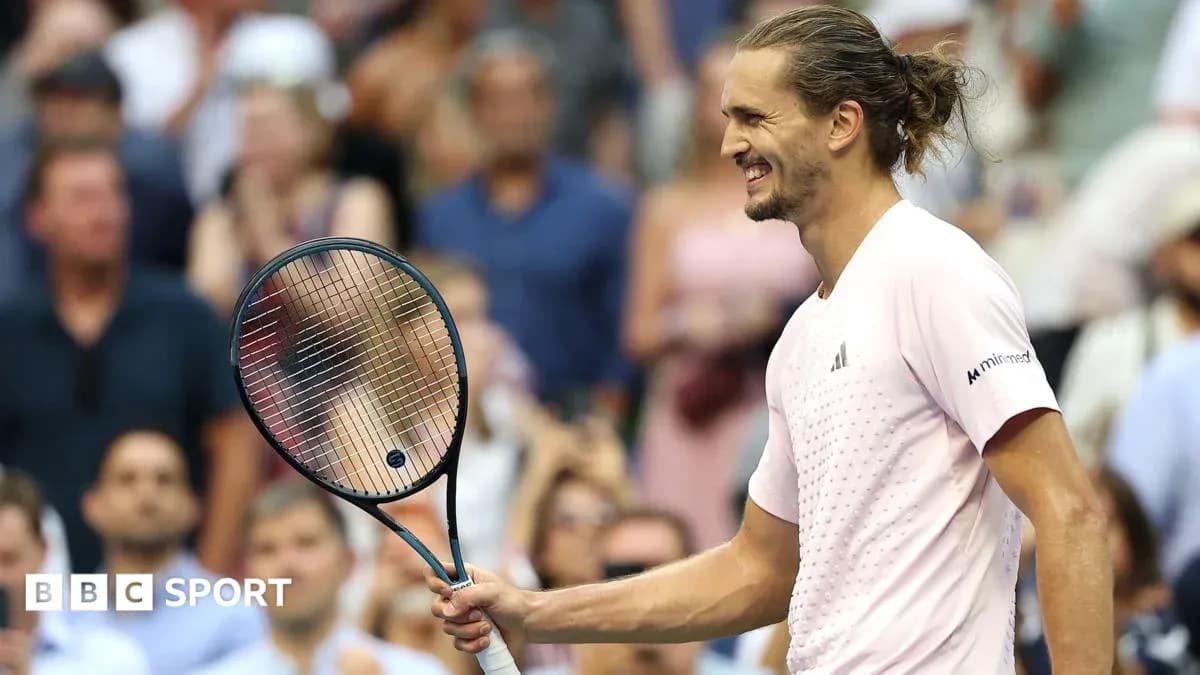
Alexander Zverev walked into Arthur Ashe Stadium looking like a man in form. He walked out one step from the US Open title.
The German overpowered Karen Khachanov 6-3 7-6 (9-7) 7-6 (8-6), a straight-sets scoreline that barely hints at the tension that crackled through the night, especially in two knife-edge tie-breaks where Khachanov repeatedly had the door ajar and never quite forced it open.
Zverev’s serve told the story. It wasn’t flawless. It was brutal.
He finished with six double faults, twice as many as Khachanov’s three, but the risk came with a heavy reward: 15 aces to the Russian’s six and an average second-serve speed of 112mph, almost 20mph quicker than his opponent. That raw pace dragged him out of trouble time and again and framed the match on his terms.
“Where did that come from?” gasped former British number one Annabel Croft on BBC Radio 5 Sports Extra as Zverev unloaded his 15th and final ace at a pivotal moment. “The way Zverev has been serving has been enormous but what a moment to come out with that.”
It was the defining pattern of the evening. Khachanov probed, pushed, and often led. Zverev slammed the door with a serve.
Tie-break Tension and Missed Chances
For long spells, Khachanov matched Zverev from the back of the court and, at times, outplayed him. He attacked with conviction, especially in the third set, when he strode forward and dominated at the net, winning 13 of 14 points there. When he did come in, he came in with purpose.
From the baseline he struck heavy, fearless forehands into the corners, one huge strike in the third-set tie-break drawing a roar and a celebration “like a nonchalant gladiator to the baying crowd,” as the radio commentary put it. The match, much like the second set, truly ignited once the tie-break arrived.
At 6-6 in that third-set breaker, Khachanov had already led 4-2, then 5-3. He stood two points from taking the contest into a fourth set. Zverev, by contrast, looked tight, his footwork heavy, his shots suddenly cautious.
“He is playing like a man under pressure,” came the call as Zverev dumped a ball into the net to fall behind 2-5, while Khachanov swung freely, seemingly unburdened.
Then the momentum snapped.
Forced back by an attempted lob, Zverev lashed a stunning cross-court winner, his 37th of the match, to claw back to 3-5. Khachanov pushed a ball wide for 4-5. The Russian still had two points on his own serve. Win them both, and a fourth set beckoned.
He couldn’t. Zverev tightened, Khachanov blinked, and the German surged across the line, the final ace sealing not just the breaker but the night.
On another day, with a little more ruthlessness in those key moments, Khachanov could easily have dragged this deep into a deciding set. He led in the tie-breaks of both the second and third sets and will know he let big chances slip. Yet this run to the last four will still rocket him back up the rankings, a reward for a campaign in which he often looked dangerous and assured.
From Locker-Room Laughter to a Grand Slam Shot
Zverev’s composure under fire has not always been a given at major level. He has lost tight matches, lost leads, lost belief on the biggest stages. This fortnight has felt different.
“Zverev has just got better and better the more the tournament has gone on,” Croft observed. “His wobbles were at the beginning of the tournament and since then he has got better. Today every time he faced questions and problems he really stepped up to the plate and served spectacularly.”
Zverev himself painted a revealing picture of where his head was just a few days ago.
“After the second round, at about 3am I was sitting with my team in the locker room and we were laughing at how bad I was playing, and that sense of humour helped me,” he said on court after the win. “In practice I started feeling the ball better, and then moving forward I was playing much better tennis. I obviously have improved a bit otherwise I would not be in the US Open final.”
He has known frustration at the majors, as he freely admitted.
“Sometimes things just go your way, I have had a lot of struggles at the major level and I was so close so many times – and maybe this year God has said this is going to be my year and to enjoy my time on the court. I am enjoying it, I love playing these big finals and I can't wait for Sunday.”
Eyeing the American Dream – to Ruin It
Waiting for him on Sunday will be an American – either Frances Tiafoe or Ben Shelton – and a partisan New York crowd that has already taken both to its heart.
“I think it will be incredibly special, these two guys are crowd favourites and everyone loves them,” Zverev said, looking ahead to the final. “Tonight will be an epic semi-final and I am looking forward to watching it. Hopefully I can not make their American dream come true.”
He smiled as he said it, but the intent was clear. He has ridden the storm, found his serve, and played his way into another Grand Slam final. The stage will be loud, the support one-sided, the occasion huge.
Zverev has been here before. The question now is whether this time, with that ferocious serve and a harder edge in the tightest moments, he finishes the job.