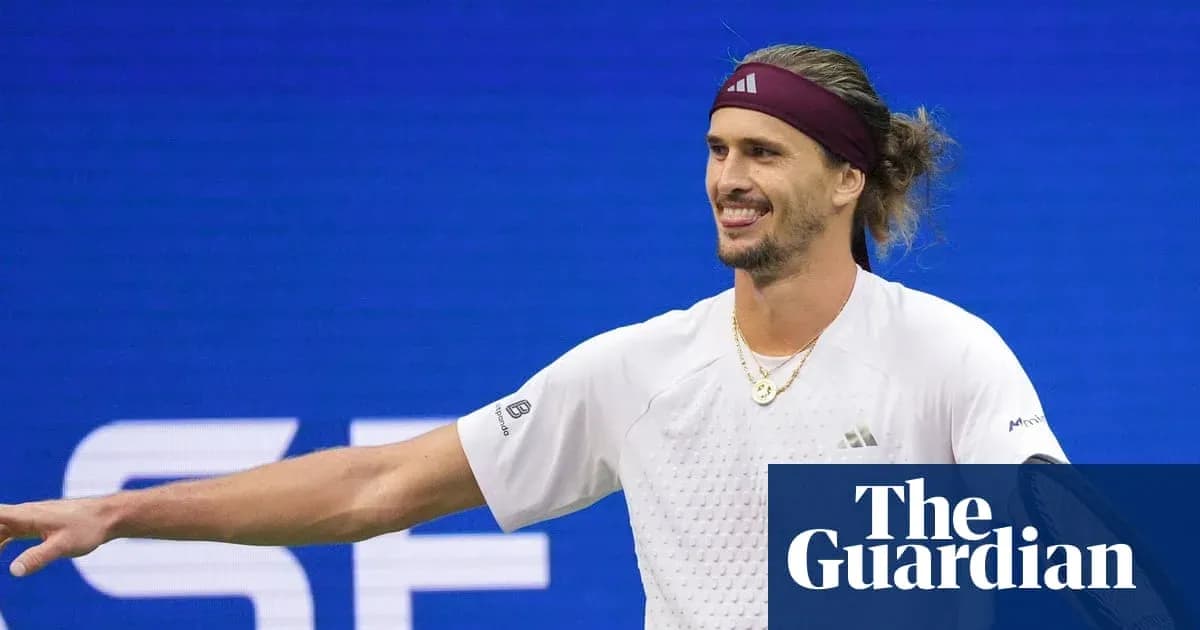
By the time a ripple of tension finally ran through Arthur Ashe Stadium, they had been out there for almost 107 minutes. For most of the afternoon, Alexander Zverev’s US Open semi-final against Karen Khachanov had felt like a formality, a one-sided appointment with history rather than a contest. Then Khachanov, staring down the barrel, swung freely and dragged the match into the kind of tiebreak that can turn a tournament on its head.
Serving at 5-6 in that second-set breaker, already a set and a break down, Khachanov ripped a fearless forehand winner to erase Zverev’s first set point. At 6-7, he went bigger still, threading a screaming backhand pass and letting out a roar that finally pierced the quiet of a half-interested crowd. For a brief moment, it felt like the afternoon might twist.
Not this Zverev. Not this season.
The German, who has spent the year hardening his reputation in the biggest matches, shut the door with the coolness of a man who has been here often and plans to return. He reset, steadied his serve, and played the big points with a clarity Khachanov could not match, closing out another tight tiebreak and then a third to win 6-3, 7-6 (7), 7-6 (6) and move to within one match of a second grand slam title in his last three majors.
This is uncharted consistency for Zverev. The 27-year-old has now reached three consecutive grand slam finals for the first time in his career, backing up his maiden major at Roland Garros with a first Wimbledon final and now another shot at the US Open crown. The setting is familiar: it was in New York in 2020, in front of empty stands and Covid-era protocols, that he played his first slam final, losing from two sets up to Dominic Thiem and serving for the title before it slipped away.
Four years on, he returns to the same stage with a heavier résumé and a harder edge. The final here will be his sixth at this level.
Khachanov arrived as the underdog on paper, but not a walkover. His current ranking of No 50 hides a career that has brushed against the sport’s top tier. A former world No 8, an Olympic silver medallist behind Zverev in Tokyo and a Paris Masters champion in 2018, the 30-year-old Russian has long carried the weapons to bother the elite. He also came in with more wins over Zverev than the other two semi-finalists combined; Zverev led their head-to-head 6-3, but Khachanov had beaten him as recently as last year in Canada.
That history never quite translated into sustained menace. Zverev’s serve set the terms from the start, hammering down first deliveries and giving him constant scoreboard control. From the back of the court he was relentless, driving his backhand with depth, taking time away, refusing to offer the kind of loose patches that have haunted his earlier career.
Khachanov, by contrast, watched his forehand unravel at the worst possible times. The shot that should have been his release valve leaked errors, especially deep in the second and third sets when the match tightened. Each time he nudged close, the forehand betrayed him, feeding Zverev the breathing space he needed.
The pattern echoed Zverev’s run at Roland Garros. There, the men’s draw cracked open early: Jannik Sinner’s shock second-round exit, Carlos Alcaraz’s injury absence, Novak Djokovic’s late-career struggles. The question that hovered over Paris was simple: could anyone stop Zverev if he kept his nerve?
In New York, the path has looked strikingly similar. Again the German has sat in the softer half of the draw. His highest-ranked opponents on the way to the final have been No 22 Luciano Darderi and No 28 Alejandro Tabilo. If he lifts the trophy on Sunday, his first two grand slam titles will have come without facing a single top-eight player.
It is an asterisk some will seize on. It is also the brutal truth of tournament tennis: you beat who stands across the net. After grinding through two tense five-setters in his opening two rounds, Zverev has not dropped a set since. He has played himself into a rhythm and, crucially, into a calm.
Whoever emerges from the all-American semi-final between Ben Shelton and Frances Tiafoe will know the numbers are stacked against them. Zverev owns a combined 15-1 record against the pair, with his only loss to Tiafoe coming nine years ago, long before either man grew into his current version. The matchup, on paper, leans heavily his way.
The irony is that while Zverev marches towards a potentially era-defining stretch, the occasion around him has felt oddly muted. Despite his status as the world No 2 and Khachanov’s pedigree as a former semi-finalist here, this was one of the quietest men’s grand slam semi-finals in recent memory in terms of buzz and anticipation.
Part of that is the backdrop. The US Open’s ticket resale market has become a flashpoint, with prices for many sessions spiralling to eye-watering levels on secondary sites. There was no such frenzy for this one. Before the players walked on court, seats for the session were selling for as little as $21 (£15.50) on StubHub, a bargain-basement tag for a match that sent one of the sport’s central figures back to another final.
Zverev walked off Arthur Ashe with barely a fist pump, businesslike, job done. The noise will grow louder on Sunday. The question now is simple: in a men’s game still searching for its next dominant champion, is this the moment he finally slams the door and claims the stage as his own?