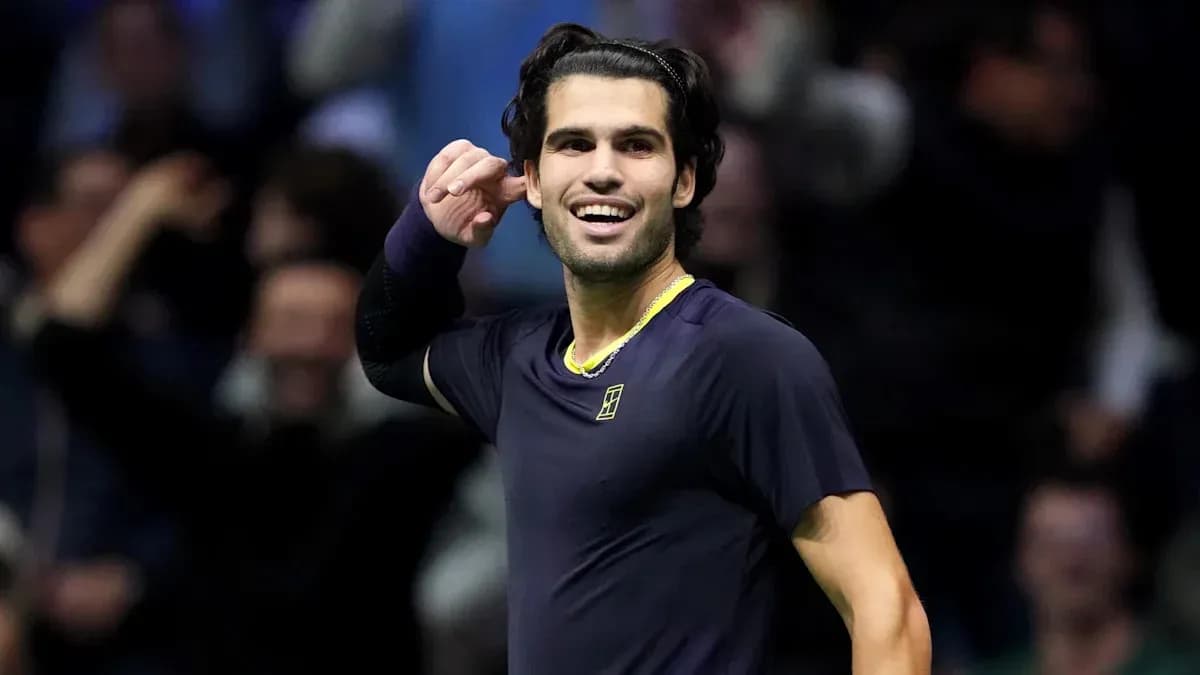
Alexander Zverev used to be the cautionary tale. The talent who couldn’t quite break through. The best man never to have won a Grand Slam.
He will finish 2026 as a two-time major champion and the world number one. Not a placeholder. A fully earned, fully formed number one – and, at 29, the oldest man in more than half a century to reach the summit for the first time.
His route there has been anything but straightforward.
From nearly man to major winner
For years, Zverev’s résumé looked complete everywhere but where it mattered most. Olympic champion. Two ATP Finals titles. Former world number two. Three Grand Slam finals.
And one of them still stung.
In the 2020 US Open final, he led Dominic Thiem by two sets to love and still lost, folding in a fifth-set tie-break, his arm tightening, his serve deserting him, double faults arriving just as Thiem’s legs began to cramp. The match became shorthand for his problem: the inability to play with the same freedom and aggression on the biggest stages that he routinely unleashed on the ATP Tour.
This year, he vowed to tear that version of himself up.
He would hit bigger. Live with the errors. Accept the risk. Mix the patterns. If he was going to fall short again, it would be on his terms.
The turning point came in Mallorca in July 2025, during 10 days that doubled as a reset and a reckoning. Zverev went to see Rafael Nadal and Toni Nadal, not for nostalgia but for blunt truth.
"I wanted to see and then hear a new vision of what tennis in their mind looks like – and how my tennis, in their mind, looks like," he said later. Nadal had spent a decade on the other side of the net, feeling the weight of Zverev’s serve, reading his patterns, sensing when he tensed. Now he watched from the other side of the fence.
As Zverev put it: "Rafa, for example, played against me for 10 years. So now, as a spectator and also as an opponent, he can probably give you the best advice anybody can, because he knows what it's like to be on the court with me."
The message was clear: trust your weapons, even when the air gets thin.
Paris, New York and a new version of Zverev
The new mindset didn’t erase nerves. It never does at this level.
In June’s French Open final against Flavio Cobolli, Zverev’s body threatened another betrayal. Cramp crept in. The tension was visible. Old scars resurfaced in the collective memory.
This time, he didn’t blink.
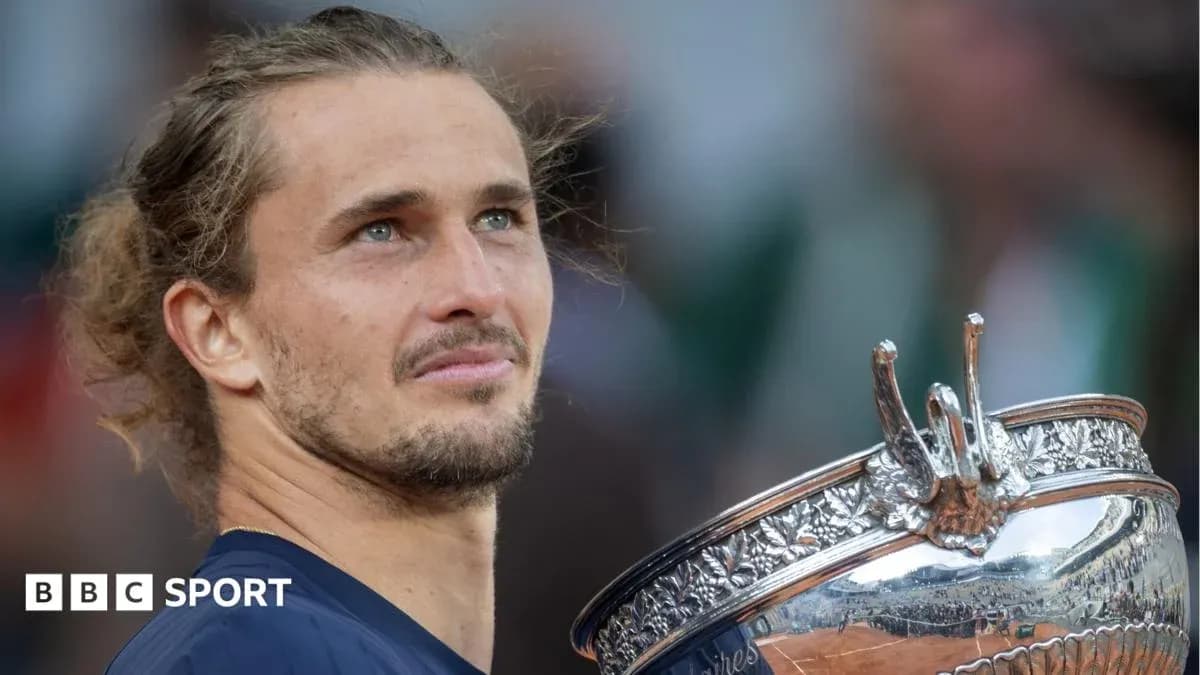
He surged through the deciding set 6-1, turning what could have become another psychological scar into the long-awaited first major trophy. The dam finally broke on Court Philippe-Chatrier.
The breakthrough in Paris set up the season. By the time he lifted the US Open trophy, the narrative had flipped: Zverev was no longer the nearly man. He was the standard-bearer.
His year on grass underlined that transformation. At Wimbledon, he finished runner-up but played what he himself could call his most complete tennis of the season, taking the game to Jannik Sinner on Centre Court in an aggressive four-set defeat. The scoreline went against him, the intent did not.
He will need that same audacity again. The numbers are stark: Zverev has lost 10 straight matches to Sinner. Carlos Alcaraz stands on the other side of the draw, just as hungry. If both are fit at the start of 2027, the German’s task is obvious – turn the tour’s hierarchy into a genuine three-man fight for the sport’s biggest prizes.
Built by family, sharpened by struggle
Zverev’s rise has always been framed as a family project. His father, Alex Sr, has been a near-permanent figure in the coaching box, the calm, familiar silhouette in the background. His older brother Mischa, who once shared practice courts with a young Andy Murray while Alexander watched on as a toddler, now sits alongside their father as part of the team.
The dynamic is unusual, and Zverev has never hidden that distance is part of what makes it work.
He has said his relationship with his father functions best because they spend "zero time together" away from the court. The boundaries are clear; the roles defined.
"The big difference with my parents is that they never forced me to do anything," he once recalled. "They wanted me to play different sports so they didn't have to coach me. They always told me 'why don't you play football, or field hockey?' as that was the sport I loved.
"They are very smart. They've been through it. They've been tennis players themselves."
That foundation underpinned a life in elite sport that began under very different circumstances. Diagnosed with type 1 diabetes at the age of four, Zverev has had to manage a chronic condition alongside the demands of a global tennis career. His eventual breakthrough at the majors felt, to many, like the delayed reward for years of meticulous self-discipline and work.
The allegations that won’t disappear
His ascent, though, runs alongside a far more uncomfortable storyline. The new world number one is also a player whose name has been repeatedly linked with serious allegations of abuse and misconduct away from the court.
In October 2020, ex-partner Olga Sharypova accused him of physical violence and controlling behaviour. Zverev denied the allegations from the outset, calling them baseless. No legal proceedings followed, but the ATP Tour launched a major independent investigation, handled by third-party investigators.
After interviews and evidence-gathering, the ATP announced in January 2023 that there was "insufficient evidence to substantiate published allegations of abuse".
"Based on a lack of reliable evidence and eyewitness reports, in addition to conflicting statements by Sharypova, Zverev and other interviewees, the investigation was unable to substantiate the allegations of abuse," the statement read.
The fallout reshaped the sport’s approach. The ATP appointed a director of safeguarding and, this year, rolled out a new safeguarding programme designed to establish a clear global framework for preventing and responding to abuse, including harassment, bullying, domestic violence and other forms of misconduct.
Zverev’s legal issues did not end there.
In October 2023, a German court issued him with a penalty order and fined him 450,000 euros (£392,000) for bodily harm against another ex-girlfriend, Brenda Patea. He denied the accusations and challenged the order, triggering a public trial in Berlin in May 2024.
A week into the proceedings, the case ended abruptly. The court terminated the trial before any verdict and confirmed there had been a settlement between Zverev and Patea.
"The decision is not a verdict and it is not a decision about guilt or innocence," the court said. "One decisive factor for the court decision was that the witness [Zverev's ex-partner] has expressed her wish to end the trial."
The timing was striking. On the day the settlement was announced, Zverev reached the French Open final. Earlier in the tournament he had framed the trial as a chance to prove his innocence. When that opportunity vanished with the settlement, he was asked whether he regretted not seeing the process through.
"That's what dropping the case is. That is innocence," he argued. "They're not going to drop the case if you're guilty at the end of the day. I don't know what translations you have, but that's what it means.
"Done. We move on. I never ever want to hear another question about the subject again. That goes out to everybody."
Patea has not commented publicly on the settlement.
The court of public opinion, though, has not closed as neatly. In 2025, Zverev was heckled by spectators at the Australian Open and the Munich Open over the allegations, a reminder that for some fans, the questions remain unresolved regardless of legal outcomes.
Temper, bans and a sport taking stock
Zverev’s disciplinary record on court has also drawn scrutiny.
In 2022, at the Mexican Open in Acapulco, he erupted after a line call in a doubles match alongside Marcelo Melo. Furious at a decision in the deciding tie-break, he smashed his racquet into umpire Alessandro Germani’s chair four times, one swing coming perilously close to the official’s foot. He swore at the umpire and accused him of destroying the match.
Tournament officials disqualified him for unsportsmanlike conduct. The ATP later handed him an eight-week suspended ban after finding him guilty of a "major offence". The sanction hung over him: any further instances of disrespectful or aggressive behaviour, or verbal or physical abuse, within 12 months would have activated it.
Zverev apologised, calling it "difficult to put into words" how much he regretted his actions. He steered clear of further violations, and the ban was never enforced.
The pattern is hard to ignore. On one side, a driven, complex competitor who has reshaped his game, conquered his nerves and climbed to the top of the sport. On the other, a player whose off-court life and flashes of on-court rage have forced tennis to confront how it deals with allegations, safeguarding and conduct.
Zverev now stands as the world number one, French Open and US Open champion, and Wimbledon runner-up. Sinner and Alcaraz are circling, ready to test whether this new, bolder version of the German can hold his ground in a rivalry era that is only just beginning.
The numbers say he is the man to beat. The noise around him says his reign will be scrutinised like few others before it.
What happens when the sport’s most consistent player also becomes its most complicated figure to embrace?