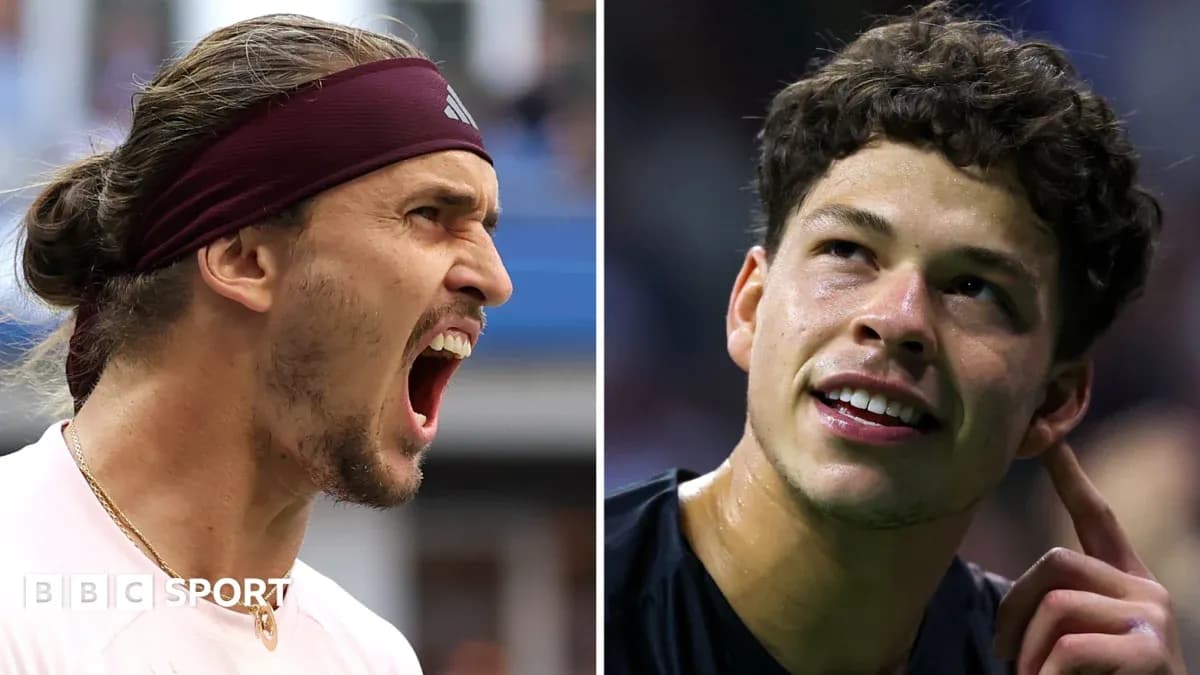
Alexander Zverev and Ben Shelton walk into Sunday’s US Open final from very different roads, but with the same quiet truth in their pockets: 2026 has already changed their careers.
For Zverev, this season has dragged him out from under the long shadow of Jannik Sinner and Carlos Alcaraz and finally into the light of Grand Slam fulfilment. For Shelton, it has answered a blunt question that hovered around him for two years: can he really live with the very best when it matters most?
On Sunday night in New York, they meet at the crossroads of those stories.
Zverev, at last, where he always thought he belonged
At the start of the year, the idea of Alexander Zverev ending 2026 with multiple Grand Slam titles felt fanciful. He had a reputation for getting close, then flinching. Three major finals, three defeats. A brutal collapse from two sets up against Dominic Thiem in the 2020 US Open final that left a scar he carried for seasons.
He looked like a man who doubted his own time would ever come.
That picture has been ripped up. The German, now 29, owns the French Open title that many assumed would never sit next to his name. He followed that breakthrough by reaching the Wimbledon final, losing only to Sinner, and now he stands in his third straight major final.
This is not the tentative Zverev of old. This is a player who believed in a year that very few outside his team saw coming.
Asked if he thought he could outstrip Sinner and Alcaraz in Slam titles this season, he didn’t hesitate. “I believed in it. I believed that it's possible. I think not many of you guys did,” he said. The narrative all year had been about “Sincaraz” – the duo who swept all four majors in 2024 and 2025 and seemed ready to turn tennis into a two-man show.
The injuries that sidelined Alcaraz from Roland Garros and Wimbledon, and Sinner from this US Open, cracked that door open. Zverev has walked straight through it.
His route in New York has not been flawless. Far from it. He trudged through the opening rounds in a haze of late-night finishes, often below his best, grinding rather than soaring. He has not faced a top-20 opponent across the fortnight.
Yet he has grown into the tournament. The serve has sharpened, the backhand started to bite, the shoulders loosened. The French Open title seemed to clear something in his head; the Roland Garros final win over Flavio Cobolli felt like an exorcism as much as a victory. The old doubts about closing on the biggest stages have been pushed aside, if not erased.
On Sunday, he starts as a slight favourite to beat Shelton and double his career major tally in a single season. For a man once defined by missed chances, that alone tells you how far he has come.
Shelton, the noise, and the weight of history
Across the net will be a 23-year-old who has spent two weeks turning potential into proof.
Ben Shelton has always had the raw tools: the lefty cannon of a serve that has regularly cracked 140mph at this US Open, the swagger, the athleticism. But this season he has added the less glamorous parts – a sturdier backhand, a willingness to suffer in rallies, a defensive resilience that lets his explosiveness matter deeper into matches.
“Ben has been trending in the right direction throughout this year. I think four titles on different surfaces is evidence of it,” said his father and coach, Bryan Shelton. Dallas on indoor hard. Munich on clay. Stuttgart on grass. The Canadian Open on outdoor hard. That’s not a hot streak, that’s a portfolio.
The real watershed came in New York. Shelton had never beaten a top-three player before he walked into an epic quarter-final against Alcaraz, the seven-time Grand Slam champion returning after almost five months out. The match finished at 3:34am, with Shelton the last man standing.
That win changed the way the locker room looks at him. It also changed the way he looks at himself.
“For me, this whole tournament has been uncharted territory,” Shelton said. “I'm in positions I've never been in before. I've beaten guys I've never beaten before.”
Now he stands on the brink of something far bigger than a personal breakthrough. No American man has won a Grand Slam singles title since Andy Roddick lifted the US Open trophy in 2003. No black American man has won any singles major since Arthur Ashe in 1975.
Shelton can end both waits in one night.
He shrugged off the history talk with a grin after beating Frances Tiafoe in the semi-finals. When a reporter suggested there was “a lot of history” on the line, he replied, smiling: “Is there?” The lightness is real, but so is the moment.
Former world number four James Blake spelled out what it could mean.
“Having another black American in the final leaves you wondering how many kids and adults are watching that maybe wouldn't have been otherwise,” he told BBC Sport. “They are going to be inspired to hear Ben's story and see someone that looks like them out there playing and competing in a sport that has historically been dominated by the sense of a country club white sport.”
On Sunday, 24,000 fans in Arthur Ashe Stadium will roar for him. A partisan, restless New York crowd, desperate to claim a homegrown champion again, will try to lift him over the line.
A final built on belief
There is one problem for Shelton. It is a big one. He has never beaten Alexander Zverev.
Five meetings, five defeats.
To become the first American man in 23 years to win a Grand Slam singles title, he must overturn that record and handle a stage he has never stood on before. Like Cobolli in Paris, he faces an opponent who has carried the scars of previous failures and finally learned how to live with them.
Zverev’s path has been eased by the absence of Sinner and Alcaraz. Shelton’s has been defined by going straight through one of them. One man carries the weight of expectation that has followed him for a decade; the other carries the noise and hope of a country, and a wider community, that sees itself in him.
Shelton calls this “uncharted territory”. Zverev once stood here and watched a US Open final slip from his grasp. One of them leaves on Sunday night as a two-time Grand Slam champion. The other, if it is Shelton, walks out as the new face of American men’s tennis and a landmark figure in its history.
The stage is set. Now it’s a question of whose belief holds when the lights hit hardest.