Alexander Zverev used to carry one of the heaviest labels in tennis: the best man never to win a Grand Slam.
He will close 2026 as a two-time major champion and the sport’s new – and fully merited – world number one.
At 29, Zverev has become the oldest player in more than half a century to climb to the top of the rankings for the first time. His coronation did not arrive by stealth. It was driven by a brutal, public rebrand of his tennis, crowned at Roland Garros and then in New York, and framed by a complicated life away from the baseline.
From nearly man to serial champion
The raw materials were always there. Olympic gold. Two ATP Finals titles. A former world number two with three Grand Slam finals on his record before this season.
The scar, though, was the 2020 US Open final. Two sets up on Dominic Thiem, the trophy within touching distance, he tightened. Double faults in the fifth-set tie-break, an opponent cramping on the other side of the net, and still he let it slip. That night followed him for years.
The pattern became familiar. Zverev, so bold and explosive on the ATP Tour, would arrive at the business end of majors and retreat into caution. The serve slowed, the forehand rolled, the rallies dragged. When the stage grew, his game shrank.
He decided 2026 would not follow that script. He would swing harder, live with the errors, and force the issue in rallies. Less fear, more bite.
The turning point came a year earlier, far from the roar of a Grand Slam crowd.
Ten days with Nadal
In July 2025, Zverev spent 10 days in Mallorca with Rafael Nadal and his uncle Toni. It was part tennis clinic, part intervention.
“I wanted to see and then hear a new vision of what tennis in their mind looks like – and how my tennis, in their mind, looks like,” he said. Nadal had faced him for a decade. Now, as a retired great and former rival, he could dissect Zverev’s game from both sides of the net.
The message was clear: his weapons were being underused. If he wanted different results in finals, he had to play a different brand of tennis to get there.
The change did not erase the nerves. In the French Open final against Flavio Cobolli this June, Zverev’s body rebelled again. Cramp. Flashbacks. The sense that another opportunity might slide away.
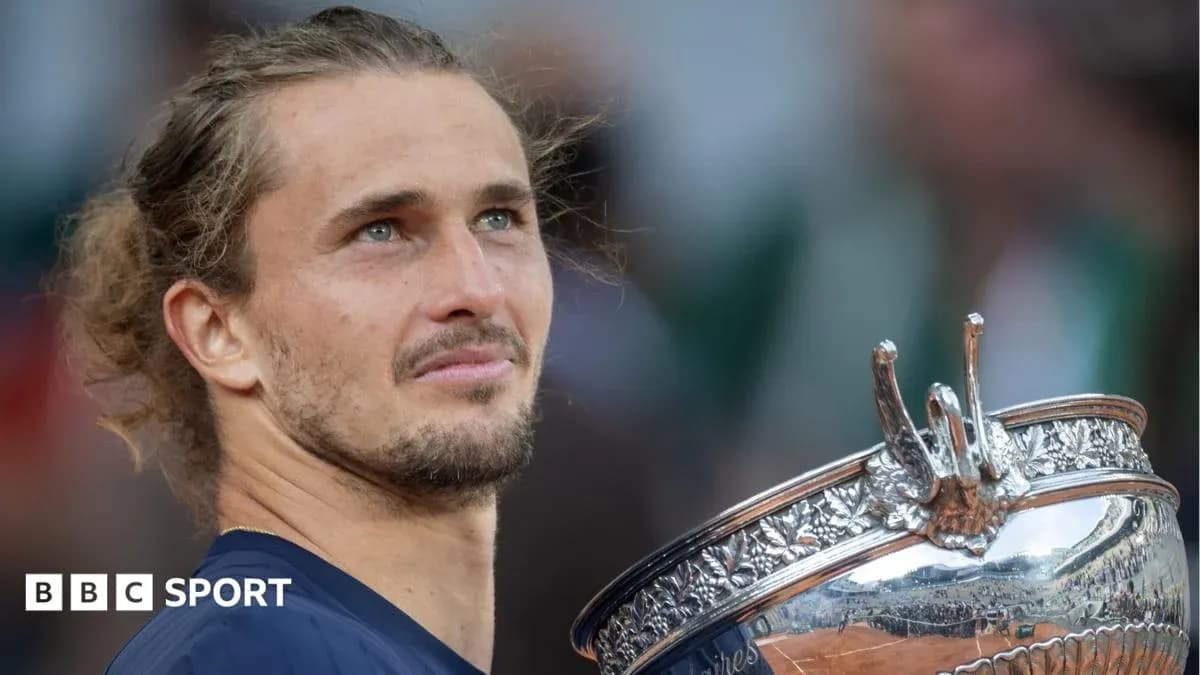
This time, he refused to flinch. He ripped through the deciding set 6-1, claiming the first major title that had hovered just out of reach for so long. The relief was obvious; the symbolism even louder. The nearly man had finally crossed the line.
Family business
Zverev’s rise has always felt like a family project. His father, Alex Sr, has been a constant in his coaching box, his silhouette as familiar on TV shots as his son’s service motion. His older brother, Mischa, joined the team after retiring, closing a circle that began with a toddler Zverev watching Mischa practise with Andy Murray.
The dynamic is unusual, and Zverev has never pretended otherwise. He has joked that his relationship with his father works because they spend “zero time together” away from the court.
What they did share was a deliberate, almost counterintuitive approach to his early years.
“The big difference with my parents is that they never forced me to do anything,” he once recalled. They nudged him towards other sports – football, field hockey – anything that meant they didn’t have to coach him. “They are very smart. They’ve been through it. They’ve been tennis players themselves.”
That experience has underpinned his career-long management of type 1 diabetes, diagnosed when he was four. Training, diet, match days – all of it layered with an extra level of planning and discipline. The Grand Slam breakthrough, when it finally arrived, felt like the pay-off for years of that unseen work.
Wimbledon sting, Sinner wall
The French Open title did not soften him. It sharpened him.
At Wimbledon, Zverev produced what he himself considered his best tennis of the year. He attacked, he took the ball early, he accepted the risk. It still wasn’t enough. Jannik Sinner beat him in four sets on Centre Court, and the head-to-head told its own story: 10 consecutive defeats to the Italian.
That run is now the great tactical and psychological puzzle of his late 20s. To turn 2027 into a genuine three-way rivalry with Sinner and Carlos Alcaraz, he has to crack it. The template is there in patches of that Wimbledon performance – aggression, variety, conviction – but the execution has to hold over five sets, not flicker in and out.
Zverev leaves this season as French Open and US Open champion and Wimbledon runner-up. The CV finally matches the talent. The question is whether he can keep Sinner and Alcaraz from turning the next era into a two-man show.
Allegations, investigations and an uneasy spotlight
Zverev’s ascent has unfolded under a darker, more uncomfortable glare.
In October 2020, former partner Olga Sharypova accused him of physical violence and controlling behaviour. Zverev denied the claims, calling them baseless. There were no legal proceedings, but the ATP commissioned an independent investigation led by third-party investigators.
In January 2023, the ATP announced it had found “insufficient evidence to substantiate published allegations of abuse”. The report cited a lack of reliable evidence and eyewitness accounts, and noted conflicting statements from Sharypova, Zverev and other interviewees. The case closed without sanctions, but the sport itself did not move on so easily.
The ATP created a director of safeguarding role and, this year, rolled out a new safeguarding programme, setting out a global framework for preventing and responding to abuse, including harassment, bullying, domestic violence and other misconduct. Zverev’s case became a catalyst for institutional change, even as his name was cleared within that specific process.
Then came another legal storm.
In October 2023, a German court issued Zverev with a penalty order and a €450,000 fine for bodily harm against another ex-partner, Brenda Patea. Zverev denied the allegation and contested the order, triggering a public trial in Berlin in May 2024.
A week into the proceedings, the court halted the case. It said there had been a settlement between Zverev and Patea and stressed that the decision was not a verdict and not a ruling on guilt or innocence. One decisive factor, the court added, was Patea’s wish to end the trial. She has not publicly commented on the settlement.
The timing was striking. News of the settlement broke on the day Zverev reached the French Open final. Earlier in the tournament he had framed the trial as a chance to prove his innocence. Asked afterwards whether he regretted settling, he was blunt.
“That’s what dropping the case is. That is innocence,” he argued, insisting authorities would not abandon proceedings if he were guilty. “Done. We move on. I never ever want to hear another question about the subject again. That goes out to everybody.”
The public, though, has not always obliged. Zverev has been heckled at tournaments, including the 2025 Australian Open and Munich Open, the allegations trailing him from continent to continent. He continues to deny wrongdoing.
Temper, lines and a suspended ban
Questions around Zverev’s conduct are not confined to his private life. His temper has flared on court in ways that shook even a sport accustomed to racket-smashing outbursts.
In Acapulco in 2022, after a doubles defeat at the Mexican Open, Zverev lost control. Furious over a line call in the deciding tie-break, he swore at umpire Alessandro Germani and accused him of ruining the match. Then he took his racket to the umpire’s chair, swinging four times, one blow landing perilously close to Germani’s foot.
The tournament disqualified him on the spot for unsportsmanlike conduct. The ATP later handed him an eight-week suspended ban for a “major offence”, warning that any further incidents of disrespectful or aggressive behaviour, or verbal or physical abuse, within 12 months could activate the suspension.
Zverev apologised, saying it was “difficult to put into words” how much he regretted the outburst. He served the probationary period without triggering the ban, but the footage from Acapulco remains part of the collage when people talk about him.
A complicated number one
So tennis has its new standard-bearer, and he is anything but uncomplicated.
On court, Alexander Zverev has rewritten his story: from fragile in finals to a two-time major champion, from nearly man to world number one. Off it, allegations, investigations and one of the sport’s most notorious meltdowns sit alongside his achievements, shaping how he is viewed, cheered and judged.
He will walk into 2027 at the top of the rankings, with Sinner and Alcaraz in his sights and a new generation chasing from behind. The numbers say he is the man to beat.
The noise around him suggests his reign will be about far more than just the tennis.