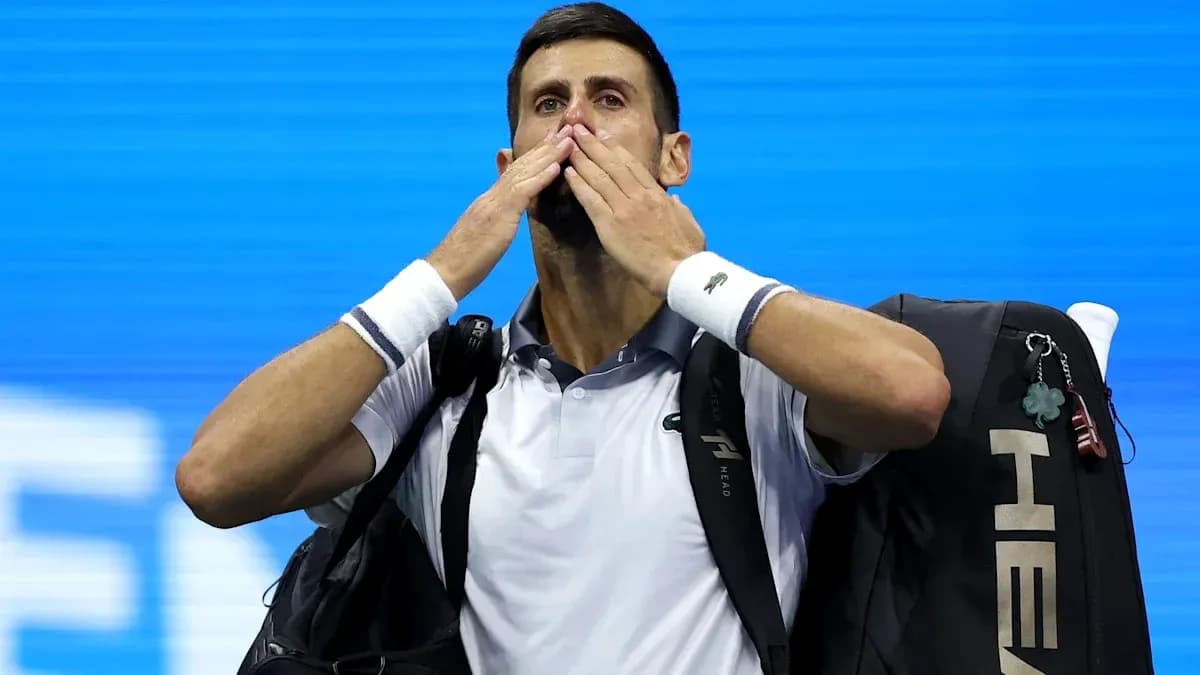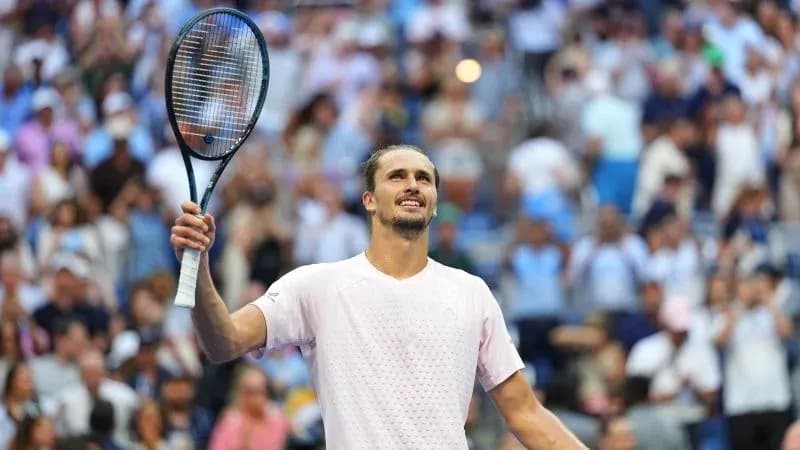
Alexander Zverev walked off Arthur Ashe Stadium on Friday with a straight-sets win and a face that told a different story. This was no stroll into a second US Open final. Karen Khachanov made sure of that.
The No. 1 seed prevailed 6-3, 7-6 (7), 7-6 (6), a clean line on the scoreboard that barely captures the grind underneath. At 29, Zverev is now back in the Flushing Meadows title match, four years after his heartbreak in the 2020 final, and riding the momentum of three consecutive grand slam finals and a first major crown at Roland Garros in June.
Fast start, heavy fire
For a set, it looked like a mismatch.
Zverev settled instantly, serving with authority, taking the ball early, and dictating the baseline exchanges. Khachanov, unseeded at 30, sprayed errors under the early pressure, finishing the opener with almost twice as many unforced mistakes as the German. The 6-3 scoreline felt about right. Zverev looked in control, Khachanov still searching for his range.
But the Russian refused to fold.
He steadied his game in the second set, tightened his forehand, and began to match Zverev blow for blow from the back of the court. The rallies grew longer, the margins thinner. Service holds became arm-wrestles rather than formalities, and Khachanov’s body language shifted from survival to belief.
The reward: a tiebreak. The problem: Zverev in full competitive snarl.
The top seed edged the breaker 7-6 (7), playing the bigger points with just enough clarity and composure. Khachanov had pushed him to the brink of dropping a set, but Zverev slammed that door shut and walked away with a two-set lead that felt far more fragile than it looked.
Sun, glare, and a restless crowd
The third set turned into a tug-of-war.
Games traded. Nerves tightened. Zverev’s serve, so solid early, began to wobble under the weight of the occasion and a new irritation: the glare.
At 6-5, trying to serve out the match and avoid another tiebreak, Zverev stopped to complain to the chair umpire about the sunlight reflecting off the glass on the suite doors high above the court. According to the ESPN broadcast, the glare came when those doors were opened, sending a piercing flash into the players’ line of sight.
The crowd did not appreciate the interruption. Boos rumbled around Arthur Ashe as Zverev argued his case. He lost the game, and with it the chance to close the door on Khachanov without more drama.
The second tiebreak of the afternoon loomed, and the tension spiked.
A hole, a rally, and a ruthless finish
The glare didn’t go away. Neither did Khachanov.
Zverev stumbled badly at the start of the third-set tiebreak, dropping behind 4-1 as the Russian sensed a lifeline. For the first time all match, the upset felt genuinely possible. The top seed looked unsettled, the arena edgy, the contest suddenly wide open.
That was the moment Zverev snapped back.
He clawed his way to 6-6, saving two set points along the way, refusing to allow this semifinal to spill into a fourth set. Each point grew heavier, each rally more desperate. Khachanov swung freely, but Zverev’s defense and shot selection tightened at precisely the right time.
On match point, Zverev finally broke through, closing the door on Khachanov’s resistance and booking his return to the US Open final. A straight-sets win, yes. Anything but simple.
Now comes the part he has been waiting for since 2020: a chance at redemption in New York.
A final with history – and a hostile crowd?
Sunday’s final will be Zverev’s third grand slam title match in a row, a run that confirms his status at the top of the men’s game. Yet this one carries a different emotional weight. He lost his first US Open final in agonizing fashion four years ago. This time, he arrives as a major champion, with scars and steel in equal measure.
He also knows he will almost certainly walk into a partisan storm.
Waiting for him will be the winner of an all-American semifinal between No. 8 seed Ben Shelton and No. 11 seed Frances Tiafoe, a matchup dripping with significance on and off the court.
Both Shelton and Tiafoe are chasing a first grand slam final. Whoever emerges will become the first American man to reach the US Open title match since Taylor Fritz did it in 2024, and will have a shot at becoming the first US men’s champion in New York since Andy Roddick in 2003.
The stakes stretch even deeper into the sport’s history.
For the first time ever, two Black American men meet in a US Open men’s singles semifinal. Whichever one advances will be the first Black American man to play in the final here since Arthur Ashe’s last appearance in 1972. On a somber day in the United States, that image – a Black American man walking into a US Open final – will resonate far beyond the lines of the court.
Zverev knows what that means inside Arthur Ashe Stadium: noise, energy, and nearly every neutral voice raised against him.
“I think it’s going to be incredibly special,” he told ESPN, acknowledging the pull of Shelton and Tiafoe. “Especially these two guys, Frances and Ben, crowd favorites here in New York. Everybody loves them. … Hopefully I can not make the American dream.”
At 2 p.m. ET on Sunday, the script will be simple and brutal. One man chasing a first US Open title, the other chasing a nation’s longing and a slice of history. Zverev has his shot at revenge. America has its shot at a new champion.