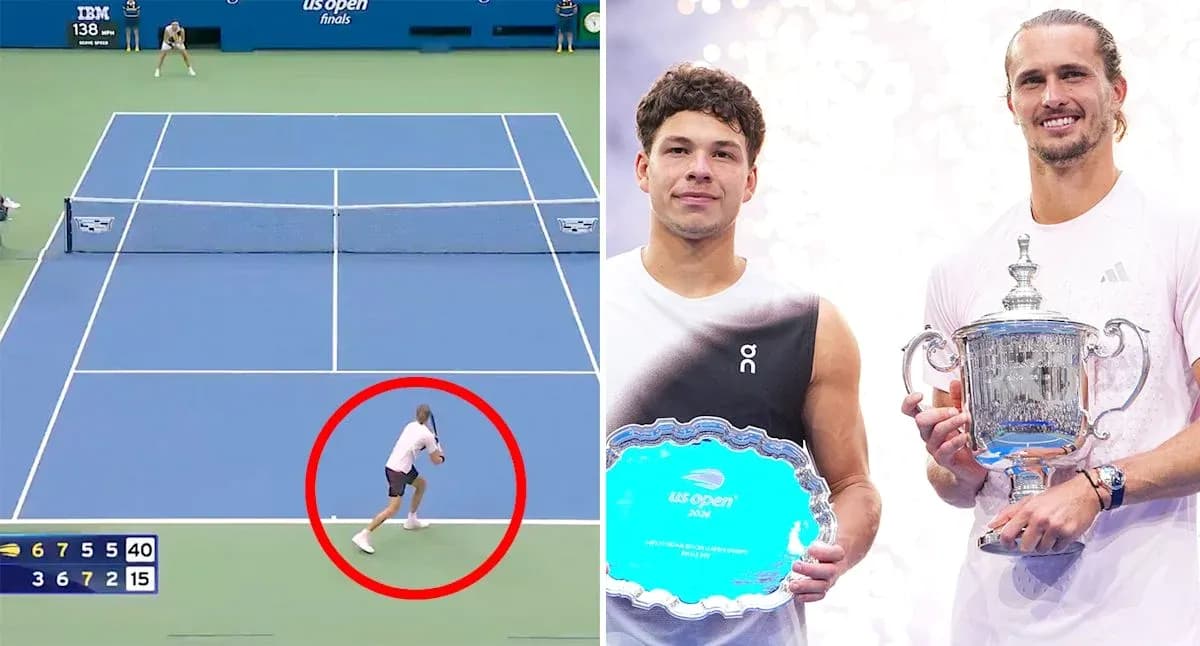
Alexander Zverev walked away with another grand slam trophy in New York. He left behind a rule-book debate that is only getting louder.
The German claimed his second major in succession with a 6-3 7-6 (7-2) 5-7 6-2 win over Ben Shelton in the US Open final, but the tennis itself shared the stage with a familiar subplot: time. Or more precisely, how long Zverev spent before actually hitting the ball.
Under current rules, players have 25 seconds from the end of the previous point to start the next one. That countdown, though, effectively stops once the first serve is struck. Miss it, and the second serve lives in a grey area. The only guideline is that it must be taken “without delay”, a phrase that leaves power in the umpire’s chair and plenty of room for frustration.
Zverev pushed that space to its limit. Again.
He collected time violations in both his semi-final and the final, repeatedly bouncing the ball and pausing, stretching the patience of the crowd and commentators as much as the clock. The chair umpires could do little once he had complied with the initial 25-second rule. On second serves, their hands were almost completely tied.
By Sunday night, the discontent had spilled well beyond the stands.
Shelton joins the chorus
Shelton, playing in his first major final, did not hide his feelings. Asked afterward about the endless delays between Zverev’s serves, the American went straight to the heart of the rulebook.
“There should be a separate shot clock between first and second serves,” he said. For him, the current setup is lopsided.
“For a first serve you should be able to do whatever you want and use the full 25 seconds every time,” Shelton argued. The problem comes after the miss. “There should be some sort of rule limiting time on second serves. There shouldn’t be unlimited time. It’s tough to be sitting there for that long for the next action to happen.”
Shelton is 21, still new to the biggest stages, but he is not alone. His view echoes a growing sentiment from some of the sport’s most respected voices.
Roddick: ‘The rules should change’
Andy Roddick has been banging this drum for a while. On his “Served” podcast, the former US Open champion laid it out in blunt terms.
“The rules should change,” Roddick said. As long as Zverev stays inside the 25-second window before the first serve, “yeah, what are you going to say?” That, he believes, is exactly the problem. The current framework gives players too much room to drag out the point once the first delivery is gone.
“There needs to be a shot clock for the second serve,” Roddick insisted. He pointed to the extreme ball-bouncing routines and the late-night finishes that now feel routine at majors.
“You cannot bounce the ball 20-something times between first and second serve. And then act shocked when we finish at 3 in the morning. Like, we just can’t do it.”
It was not a technical critique. It was a plea for the sport to catch up with its own realities.
McEnroe targets the toss
From the commentary box, John McEnroe went after a different wrinkle of the same issue. The American great watched Zverev repeatedly toss the ball, abort, reset, and edge closer to the end of the 25-second count.
For McEnroe, that has to carry a cost.
“This should be over the serve clock. It was at two (seconds left) when he tossed it. Should be a fault,” he said on ESPN, arguing that a bad toss cannot become a get-out-of-jail-free card when the clock is about to expire.
Patrick McEnroe, alongside him, focused on the other side of the net. When a server drags out the routine, he said, the returner should not be a hostage.
“As a returner, when a guy’s doing this (bouncing the ball so many times) you should be able to step away, just before he serves,” Patrick McEnroe suggested. Give the returner some power to reset, not just the server.
Different angles, same conclusion: the balance between server and returner has tilted too far.
Khachanov: ‘It takes so much time’
Within the locker room, the irritation is real, even if the language stays measured.
After losing to Zverev in the semi-final, Karen Khachanov admitted the German’s ritual on serve grates on him and others.
“His bouncing annoys not only me but other players on tour,” the Russian said. “It takes so much time.”
Khachanov, though, also underlined why nothing changes. Zverev is operating inside the rules as they stand.
“At the end of the day, if it’s within the rules with the time between points, I cannot say anything against that,” he said. “If he extends the time, then he gets a time violation, so it’s as simple as that.”
Simple, and yet clearly unsatisfactory for a growing group of players, pundits and fans.
The sport has already taken one big step by introducing the 25-second shot clock between points. Now the pressure is building for the next one: a defined limit between first and second serves, and perhaps a harsher stance on aborted tosses.
Zverev will leave New York with another slam and no obligation to change a routine that works for him. The question is whether tennis’s rule-makers are prepared to change it for him.