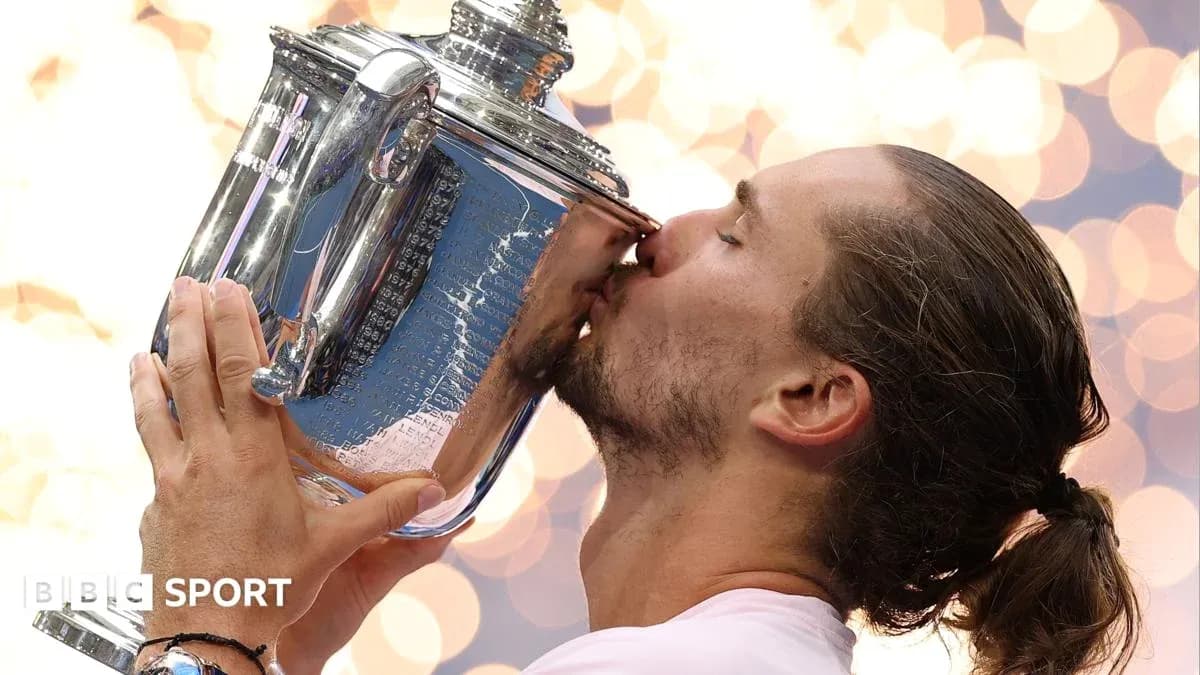
Alexander Zverev walked to the baseline with history on his shoulder.
Six years earlier on this same stage, he had served for the US Open title and watched it slip through his fingers, a two-set lead against Dominic Thiem dissolving into one of the most painful defeats of his career. The memory has followed him ever since, a scar and a reference point.
This time, it was different.
Not just because the opponent was Ben Shelton, the electric American playing in front of a roaring home crowd of 24,000. Not just because Zverev is no longer the nearly man of men’s tennis, but a Grand Slam champion after his breakthrough at Roland Garros in June.
Different because of what happened on match point.
He sent down one more booming serve, another that Shelton couldn’t touch, and turned calmly back to the baseline, bouncing the ball, ready to serve again. Only when his team shouted from the box did the reality cut through the silence he’d created in his own head.
The match was over. The US Open was his. The scoreline – 6-3 7-6 (7-2) 5-7 6-2 – finally meant something.
“In that moment I was in the zone a lot. I didn't hear noise at all,” Zverev said later. Tennis coaches always preach the cliché: play the next point, forget the score. Zverev did exactly that. He genuinely forgot.
The delayed realisation produced a rare, unguarded scene. For a second he looked almost puzzled, then the truth landed. A broad, slightly disbelieving smile spread across his face. Arms raised. Not the collapse we saw in 2020, when he stood on this court in tears and admitted: “I wish one day I can bring the trophy home.”
Now, he has.
“We went 30 years without winning a Grand Slam title and now we've won two in three months,” he said, a nod to the long German wait that once weighed on him and now feels like a closed chapter. “2026 is the outcome of all the years that happened before.”
The journey has not been purely about tennis.
His parents missed that first US Open final in 2020. This time, his father and coach, Alexander Zverev Sr, sat courtside, watching his son complete a circle that began long before Flushing Meadows. Zverev made a point of thanking both his parents, but lingered on his mother’s role after his childhood diagnosis with type 1 diabetes.
“When doctors tell you that life and sports will be very limited for that child, it takes a very strong mother to say: ‘my son will be whatever he wants to be’,” he said. “My mother is the most important and strongest person I know.”
That steel has bled into his tennis.
World number two Zverev is putting together the season of his life: semi-finals at the Australian Open, final at Wimbledon, titles at the French Open and now the US Open. The landscape has helped – injuries to Jannik Sinner and Carlos Alcaraz have loosened the grip of the young duo who dominated the majors over the past two years – but Zverev has rammed his shoulder into the opening.
Former Wimbledon champion Marion Bartoli summed up the physical transformation on BBC Radio 5 Live: “There is no-one as fit as Zverev, he is right up there. You can argue about Alcaraz and Sinner, and Novak [Djokovic] and Rafa [Nadal] when they were in their prime physically, but Zverev is right up there as one of the best athletes to play the sport.”
The numbers in New York back that up. He went to five sets in each of his first two matches, both finishing in the early hours. He stood two points from defeat in the opening round, survived, then gradually tightened the screws on the tournament. From the third round through to the final, he did not drop a set.
Shelton, backed by a partisan crowd desperate for an American champion, tried to blow the doors off the match. The atmosphere could have dragged Zverev back into the doubts of 2020. It didn’t. He stayed deliberately calm, almost cold. Even when he lost the third set and the stadium sensed a shift, he never let the contest spin out of his control.
Former British number one Annabel Croft admired the composure. “I'm so admiring of his strength of character and the zen-like state he's been in since the very beginning of the match,” she said. What came next, though, stunned even her. “The most extraordinary thing was – and I don't think I've ever witnessed it – was that he didn't realise he had won. It was so bizarre, but it was like he was in a trance-like state while he was playing.”
That trance, that tunnel vision, is what separated this Zverev from the one who crumbled six years ago.
Back then, he left Arthur Ashe Stadium with a broken voice and a wish. Now he leaves it with two majors in his bag, his country’s drought ended, and a game and body that look built to last.
The question no longer hangs over whether Alexander Zverev can win a Grand Slam. It’s how many this version of him intends to take.