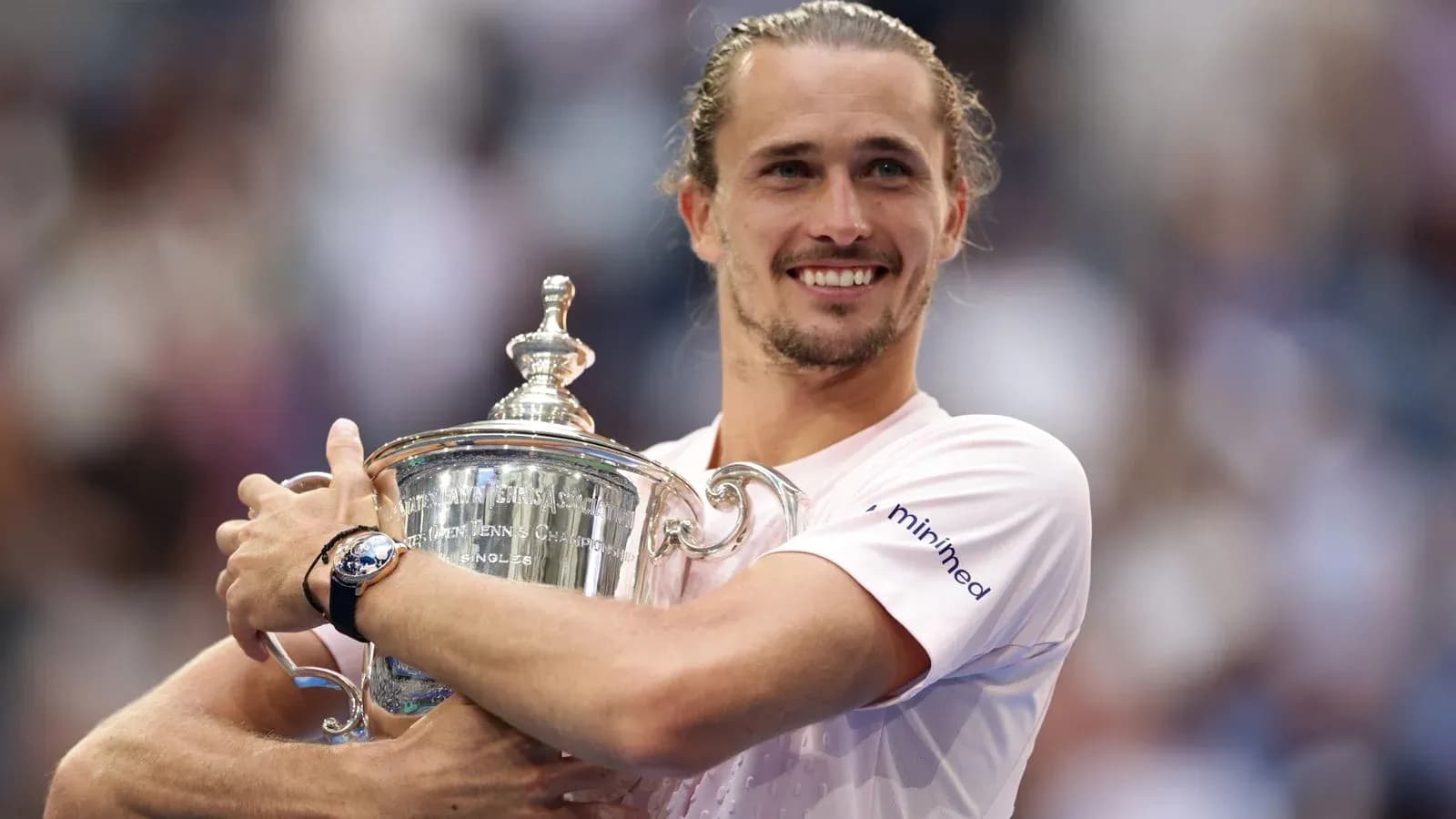
Alexander Zverev stood alone on the baseline, bouncing the ball as he had for more than three weeks in New York. Ben Shelton’s final return drifted long. The stadium roared. Zverev… kept hitting.
For a few surreal seconds, the new US Open champion didn’t know he was the new US Open champion.
Only when he glanced up at the Arthur Ashe Stadium scoreboard did reality land. The top seed had beaten the home hope 6-3 7-6 (7-2) 5-7 6-2, sealing his first title in New York, his second Grand Slam of the year, and a story that has turned from frustration to fulfilment in a matter of months.
Zverev’s year of suffering turns to dominance
“Everything is going perfectly. I am unbelievably happy,” Zverev told Sky Sports Tennis, the emotion cutting through the usual post-match polish. For a family that has carried so much scar tissue from the majors, this felt like a release as much as a coronation.
Three months ago, he said, if someone had offered him one Grand Slam title in his entire career, he would have “signed the paper straight away.” Now he has two in one season – Roland Garros and the US Open – and the conversation around him has flipped.
The old tag, the one that followed him for years – the best player never to win a major – has gone. In its place is a 29-year-old who has rebuilt his game and his belief, and now owns hard evidence that he can close the biggest matches on the biggest courts.
That didn’t stop him from losing the score completely on championship point.
“I thought the score was 5-1,” he admitted. “I knew that I had broken him twice, but I thought he only held once. I was thinking: ‘Okay, I'm going to have a relaxed service game here and then I'll get tight on the next one.’ It was lucky for me!
“Teachers in tennis say play each point and forget about the score. Well I forgot about the score and it helped me!”
A nation’s hope, and a brutal start
Shelton walked out into a wall of noise. The 23,000 inside Ashe, in the stadium named after Arthur Ashe himself, were desperate to see an American man finally lift a Grand Slam singles trophy for the first time since Andy Roddick in 2003. They were watching a player trying to become only the second black man to win a major after Ashe in 1975.
The occasion swallowed his first game whole.
Shelton won the toss, chose to serve, and then handed Zverev an immediate break with a missed routine shot and a double fault at 30-30. The German, who had already spent 19 hours and 38 minutes on court this fortnight – the fourth-longest run to a Slam final since 1991 – looked fresher, sharper, more certain.
He broke again on set point to take the opener 6-3. Shelton didn’t see a single break point in the first two sets. Zverev’s serve, heavy and relentlessly accurate, shut the door every time the American tried to lean on the crowd.
The cameras panned across a star-studded Ashe: Brad Pitt, Rami Malek, Pierce Brosnan catching a cheeky shot from the director with the match clock on 0:07. But the real show belonged to Zverev, who played the second-set tie-break like a man who had finally decided he was done leaving majors behind.
He dominated it 7-2, stepping inside the baseline, taking the ball early, hitting with the aggression that Tim Henman says has transformed his career.
“The perseverance and the way Zverev's game has improved over the last 12 months,” Henman said on Sky Sports Tennis. “I was looking back at his Grand Slam results, and his game was going backwards. But he has transformed himself to be more aggressive.”
Against a player he had already beaten five times, Zverev looked completely in control.
Shelton’s surge, and the decisive break
Shelton, though, has built his young career on refusing to accept the script. He arrived in New York having never beaten Stefanos Tsitsipas or Carlos Alcaraz. He left those streaks in pieces over the course of this fortnight.
Down two sets and struggling to touch Zverev’s serve, he dug in again.
At last, in the third set, the German’s delivery wobbled. Shelton pounced, carving out three break – and set – points. The noise inside Ashe swelled, the crowd sensing the match might finally ignite. When Shelton converted the second of those chances, he had a foothold and a lifeline.
He took the third set 7-5. For a moment, it felt like the night might turn.
Marion Bartoli, watching from the Sky Sports Tennis studio, thought the difference in experience still loomed large.
“The difference in their experience was absolutely massive,” the former Wimbledon champion said. She pointed straight back to that first game of the match: “Ben Shelton won the toss, elected to serve, fell to 30-30, missed an easy shot and then double faulted to give away the first break straight away.”
In the fourth, Zverev slammed that door shut again. He broke in the opening game and never really let Shelton breathe. That early punch “settled Zverev down and gave him more energy,” Henman noted. From there, he said, the German “coasted to the line.”
The statistics behind Zverev’s serving routine became a running joke during the fortnight – around three hours of his more than 23 hours on court spent bouncing the ball between serves. In the final, it finally earned him a time violation. It didn’t knock him off stride.
He closed out the match 6-2 in the fourth, after three hours and 33 minutes, then paused on the baseline, almost stunned, before the delayed celebrations began.
A mother’s decision, a son’s career
When the trophy was in his hands, Zverev’s thoughts went home.
He reserved his deepest thanks for his mother Irina, herself a former professional, and the person he credits with refusing to let type 1 diabetes define his life.
“When your four-year-old son is diagnosed with diabetes and doctors in the office tell you that life and sports will be very limited for that child, it takes a very strong mother to say ‘my son will be whatever he wants to be’,” Zverev said.
“If he wants to be a tennis player, he'll be a tennis player. If he wants to do something else, he'll do something else but this illness will not define us.
“I'm happy that we worked through it and we're doing things that we're doing right now. My mother is the most important and strongest person I know because it takes an unbelievably strong woman to do what she did.”
On a night when he stepped into a new tier of the sport, he made it clear he sees that journey as a family project, not a solo act.
Respect for Shelton, and a warning to the field
Zverev’s words for Shelton carried the tone of a champion who knows exactly what he has just beaten.
“Ben, you're an incredible player and an incredible person,” he told the American. “This was your first Grand Slam final but I already told you you're going to be back here many more times and if I would have to bet all my money on it, I would bet that you would lift this trophy one day.”
Shelton, who was not even a year old when Roddick won the US Open in 2003, took the microphone with the same fearless clarity he brings to his game.
“Sascha, congrats on these two weeks, your second Grand Slam title and two in one year,” he said. “What you're doing is incredible, the way you are serving and moving in play. You work harder than anyone I know, and do more hours on court than anyone else.
“You and your team do things the right way and I'm sincerely happy for you guys to hold this title.
“To New York, you guys drove me here today. I'm just getting started and I'll be back here again.”
Bartoli summed up the scale of his task on this particular night: “Zverev made only one unforced error in the first set, and it just made Shelton's life so difficult. There's no shame losing to Zverev when Zverev is playing like this.”
Shelton’s run, with landmark wins and a nation behind him, feels like a beginning, not a one-off. His promise is clear. His ceiling remains unknown.
Zverev’s, for the first time, is starting to look like something else entirely: the foundation of a career that might yet reshape the landscape of men’s tennis in the years to come.