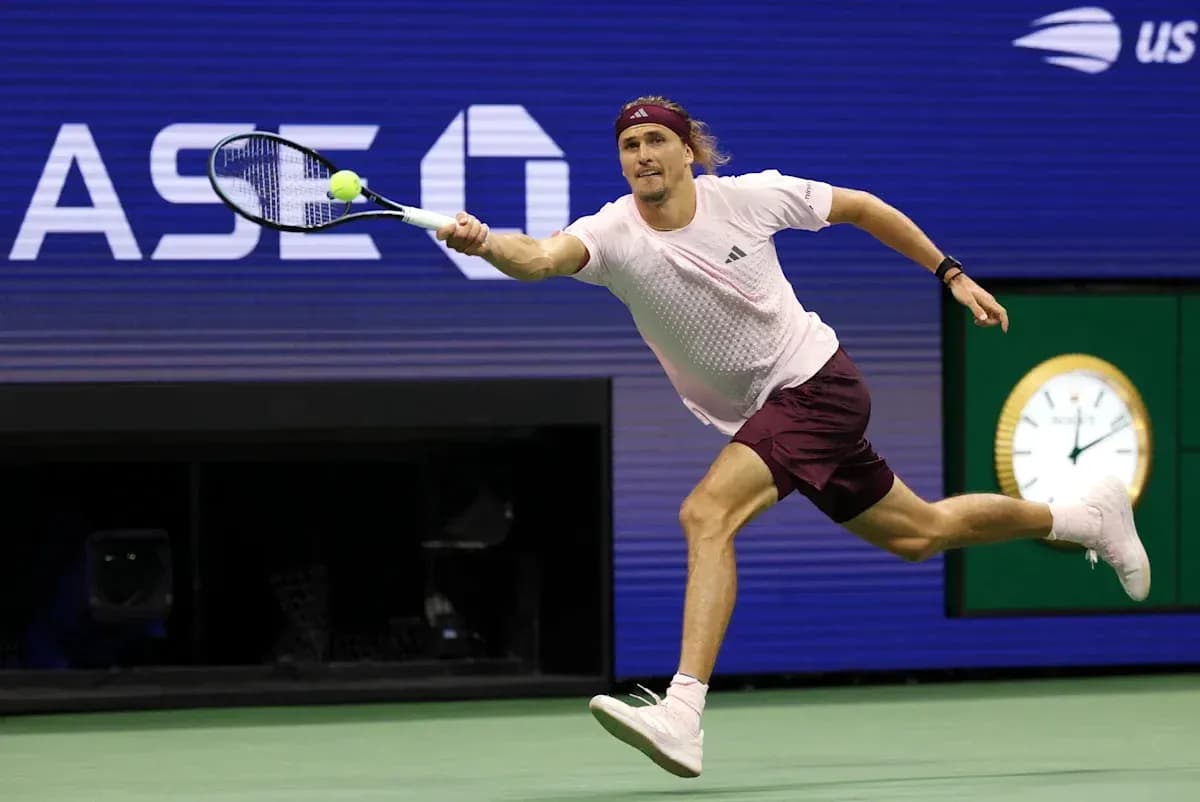
Alexander Zverev has spent all year marching toward nights like this. Under the lights of Arthur Ashe Stadium on Wednesday, the No. 1 seed steps into the final US Open quarterfinal with the air of a man who finally knows how to finish the job.
Across the net waits Botic van de Zandschulp, unseeded, unrelenting, and coming off one of the most punishing marathons in tournament history. One of them will leave with a place in the semifinals. The other may leave running on empty.
Zverev’s year of reckoning
For years, Zverev’s résumé carried a strange contradiction: one of the game’s elite talents, but a man who kept walking away from Grand Slams with the wrong trophy. Three times a runner-up at the Majors, he spent season after season circling the prize without quite seizing it.
That changed in June.
At Roland Garros, the 29-year-old German finally broke through, lifting his first Grand Slam title on the Paris clay. He didn’t drift after that moment; he doubled down. At Wimbledon, he put together another deep run, all the way to the final again, confirming that Paris wasn’t a one-off surge but the new standard.
Now he’s trying to put a hard underline beneath 2026 in New York.
No one on the ATP Tour has won more matches this season. Zverev’s 50 victories lead the field, and he stands alone as the only man to reach at least the quarterfinals at all four Majors this year. His record at the Slams in 2026 is a statement in itself: 22 wins, just 2 losses. That kind of consistency doesn’t just hint at dominance; it screams it.
The start of this US Open, though, was anything but straightforward. Zverev had to grind through five-set battles in each of his first two rounds, a reminder that even top seeds can be dragged into the trenches. Once he survived those early scares, the switch flipped. His last two matches have been clinical, straight-sets wins that suggest he’s found his rhythm and, crucially, conserved some energy.
He’ll need it.
Van de Zandschulp’s long road
If Zverev has been marching, Van de Zandschulp has been clawing.
The Dutchman arrives in this quarterfinal without a seed next to his name, but not without pedigree in New York. This is his second trip to the US Open last eight, a tournament that clearly brings out something extra in him.
His summer laid the groundwork. A fourth-round run in Montreal, a quarterfinal in Winston-Salem – not headline-grabbing results, but the kind of steady form that quietly builds belief. He carried that into Flushing Meadows.
The pattern of his fortnight has been the mirror image of Zverev’s. Van de Zandschulp breezed through his first two matches in straight sets, looking fresh, sharp, and composed. Then the storm hit.
His last two rounds have both gone the distance, five sets each, testing not just his tennis but his reserves of will. The round-of-16 clash with France’s Arthur Gea turned into an epic. Van de Zandschulp stared down a match point, refused to fold, and dragged the contest into a fifth hour. When it finally ended after five hours and 13 minutes, he had secured a place in history: the fourth-longest match ever played at the US Open.
He also left a piece of himself out there.
That’s the question hanging over Wednesday night. How much does he have left? Legs that heavy don’t always respond kindly to another night under the Ashe lights, especially against a player who knows how to stretch rallies and squeeze opponents mentally and physically.
First-time meeting, high-stakes stage
For all their time on tour, Zverev and Van de Zandschulp have never shared a court in a competitive match. No head-to-head baggage. No old scars. Just a clean slate and a brutal prize: a US Open semifinal.
On paper, the numbers tilt heavily toward Zverev. Top seed. French Open champion. Wimbledon finalist. Fifty match wins this year. A 22-2 record across the four Majors this season. He has turned 2026 into a campaign of control.
On the other side stands a man who refuses to go quietly. Van de Zandschulp has already stared down elimination in New York and walked away the winner. He has history at this tournament, belief on these courts, and nothing to protect. That can be a dangerous mix.
The contrast is stark. Zverev, cruising now after early turbulence, looks like a man building toward another Sunday. Van de Zandschulp, bruised but unbowed, arrives with momentum born from survival rather than dominance.
One player is chasing the perfect capstone to a defining season. The other is trying to rip up the script and write his own. Under the lights at Arthur Ashe, we find out whose story has more pages left.