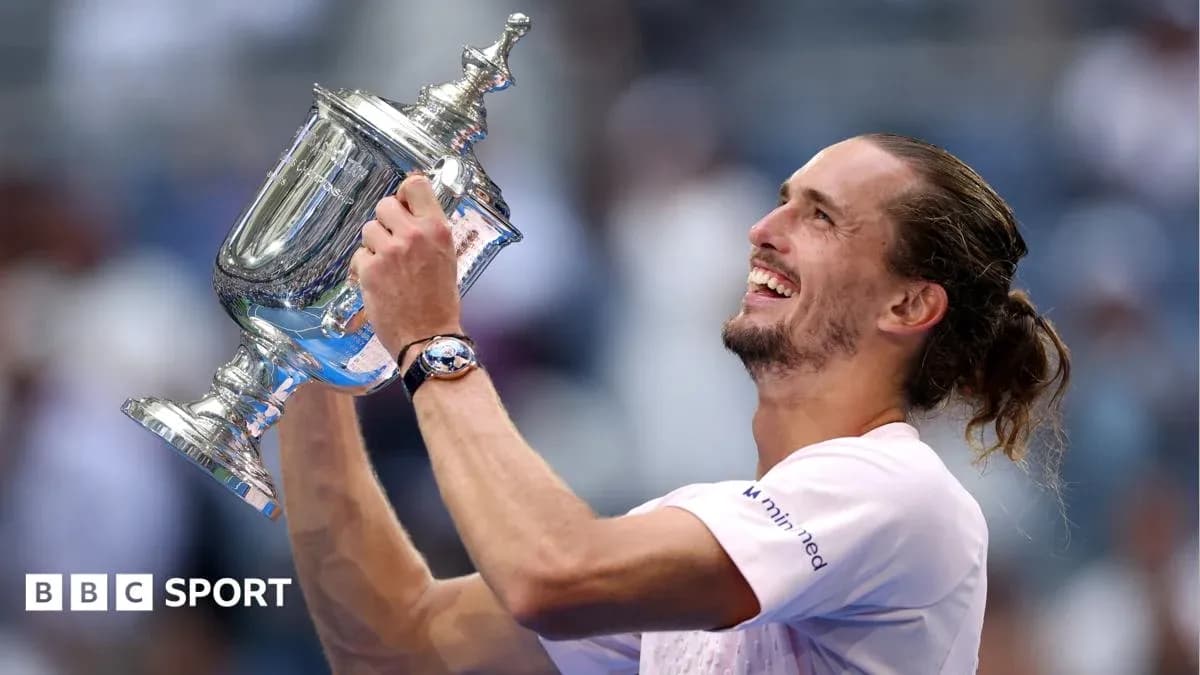
Alexander Zverev walked into Arthur Ashe Stadium with the weight of expectation on his shoulders and walked out with something far heavier in his hands: a second Grand Slam trophy and a silence only the very best can command.
The German top seed, already liberated by his long-awaited breakthrough at Roland Garros, cut through home favourite Ben Shelton and a fiercely partisan New York crowd to win the US Open final 6-3 7-6 (7-2) 5-7 6-2. The noise was American. The night belonged to Zverev.
Experience over electricity
Shelton came in as the lightning bolt – big serve, big personality, big stage. The 21-year-old had been marked out for this level, the sort of talent tipped to drag American men’s tennis back to the top. On Sunday, he ran into a man who has spent a decade learning the hardest lessons the sport can offer.
Zverev, 29, has been questioned, doubted, written off as the nearly man. Three major finals lost, a career that seemed to stall just when it should have exploded. At the start of the season, few would have put him down for one Slam, let alone two.
He now leaves 2026 with both the French Open and US Open in his pocket, and a very different reputation.
The path opened when Jannik Sinner and Carlos Alcaraz – who had carved up the majors between them in 2024 and 2025 – were taken out of the picture by injury. Alcaraz missed Roland Garros and Wimbledon. Sinner was ruled out of New York. The door creaked open.
Zverev kicked it down.
A brutal start for Shelton
Any hope of an early American surge evaporated almost instantly. Serving first, Shelton double-faulted on break point in the opening game. The crowd groaned; Zverev didn’t blink. That was the kind of gift he does not return.
From there, the top seed went to work. The first serve pinned Shelton back, the rallies were constructed with cold precision. Zverev repeatedly dragged the American into backhand exchanges, probing the weaker wing, forcing errors, dictating the tempo.
Shelton, who had spoken all fortnight about embracing the moment, looked tight. Another double fault on set point handed Zverev the opener. The German did not need a roar. A nod, a clenched fist, and back to the baseline.
The pattern was clear. Shelton brought the power; Zverev brought the plan.
Tie-break tells the story
The second set was tighter, more representative of the final many had hoped for. Shelton began to land more first serves, to swing more freely off the forehand. The crowd tried to drag him into the contest with every hold, every big strike.
Zverev refused to yield. He earned just one break point in the set, in the fourth game, and this time Shelton held firm. That should have given the American a foothold.
Instead, it sent the match into Zverev’s favourite territory.
His tie-break record is one of the strongest on tour, and he showed exactly why. No panic, no rush, just a series of solid first serves, deep returns and measured aggression. Shelton blinked first. Zverev raced away 7-2, and with it took a two-set lead that carried an echo of his painful 2020 US Open collapse.
This time, the composure held.
Shelton finally swings – and lands
Down two sets, Shelton had a choice: shrink or swing. He chose the latter, and for a spell in the third set, Arthur Ashe felt like it might witness something extraordinary.
The American began to lean into his returns, step inside the baseline, and attack Zverev’s second serve. The German’s level dipped just enough. The rallies stretched. The crowd sensed blood.
Shelton carved out three break chances. On the third, he finally broke through, hammering away until Zverev’s resistance cracked. The roar from the 24,000 inside Ashe was the loudest of the night, a release of 21 years of waiting for a homegrown men’s champion since Andy Roddick in 2003.
Shelton rode that wave to the set, 7-5, and for a moment the script looked like it might flip. Zverev had been here before in New York, two sets up and then undone. Old scars hovered in the air.
Champion’s response
This version of Alexander Zverev is not the one who faltered six years ago.
He came out for the fourth set with a clarity that cut straight through the noise. The serve tightened. The depth returned. The errors vanished. Shelton, having spent so much to haul himself back into the contest, suddenly found himself under siege again.
Zverev struck early, breaking to reassert control and, crucially, quieten the stadium. The American dream began to fade with every heavy first serve, every controlled backhand down the line. Shelton kept swinging, but the target kept shrinking.
By the time Zverev surged to a double-break lead, the match felt inevitable. The German was no longer just hanging on to his advantage; he was imposing it.
Then came the curious, almost comic, ending. On championship point, Shelton’s return sailed long. Zverev didn’t immediately react, unsure of the score in the cauldron of the moment. Only when his team signalled from the box did the realisation hit.
The smile that followed was broad, almost disbelieving. Not of the result, but of the journey.
From nearly man to serial champion
This fortnight in New York had not started like a champion’s procession. Zverev looked vulnerable early, grinding through late-night marathons, scraping by in matches that stretched into the small hours. He did not face a top-20 opponent until Shelton in the final.
But as the tournament wore on, he sharpened. The serve steadied. The forehand, long a source of tension in tight moments, held up. The doubts that once surrounded him began to shift towards his opponents.
By the time he stood on the podium, flanked by his father Alexander Sr and brother Mischa, he could finally speak from the other side of the struggle.
“We went 30 years without winning a Grand Slam title and now won two in the span of three months,” he said, turning to his box. “I think God has seen how hard we have work, how hard we have suffered and how much pain we went through. I think 2026 is the outcome of all the years that happened before.”
For Shelton, this was a harsh but invaluable education in what it takes to win a major final. For Zverev, it was something else entirely: confirmation.
He is no longer chasing the biggest prizes. He is collecting them. The question now is not whether Alexander Zverev can win a Slam.
It’s how many more this version of him is going to take.