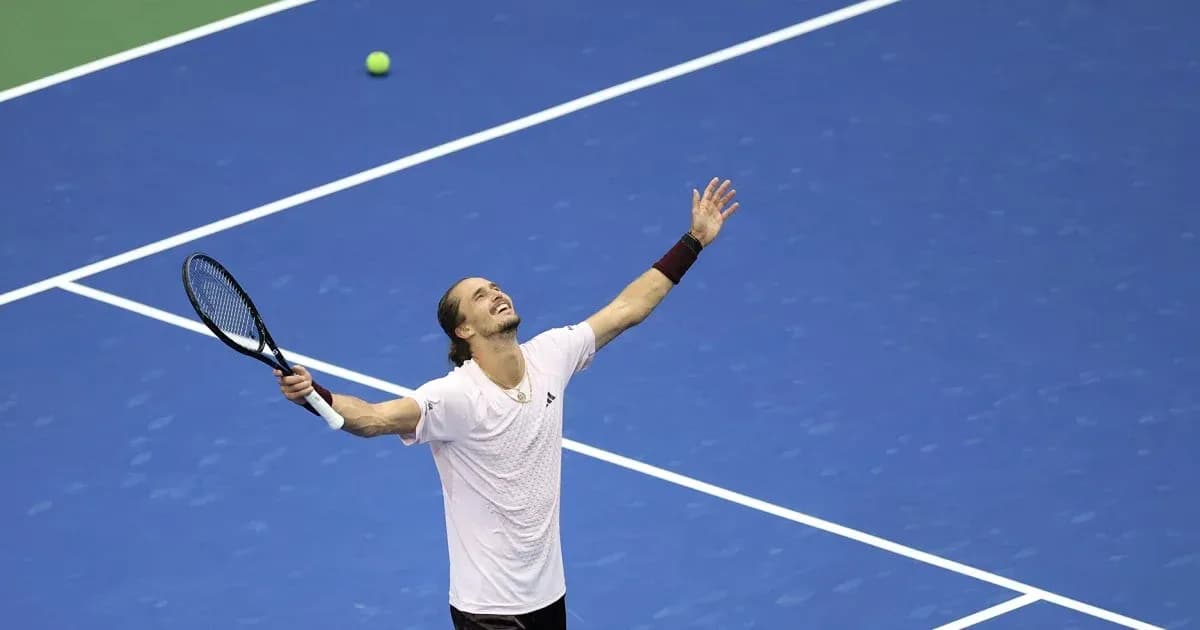
Alexander Zverev walked into Arthur Ashe Stadium on Sunday with the look of a man who has been here before and plans to stay a while. Four sets later, he walked out a two-time Grand Slam champion, the Tiffany & Co. trophy in his hands and a raucous American crowd suddenly very, very quiet.
The German beat Ben Shelton 6-3, 7-6 (2), 5-7, 6-2 to win the U.S. Open, snuffing out the hope that an American man would finally lift this trophy for the first time since Andy Roddick in 2003.
For Shelton, 23 and electric all fortnight, this was his first taste of a major final. For Zverev, 29, it was his sixth. That difference told in the biggest moments.
Zverev’s steel, Shelton’s surge
The final began with Zverev in control and Shelton chasing shadows.
Zverev’s serve landed with the dull thud of inevitability. He pinned Shelton behind the baseline, dragged him wide, and cleaned up the short balls with clinical precision. The first set went 6-3, and it felt even more straightforward than the score suggested.
Shelton needed time to breathe, to find the rhythm that had carried him through a brutal draw. Once he did, the match changed shape.
The American started stepping into returns, taking bigger cuts at Zverev’s second serve, and suddenly the rallies had bite. His forehand, so often the exclamation point of this run, began to sting. He forced Zverev into a second-set tiebreak and had Arthur Ashe Stadium on its feet.
Then Zverev shut the door.
He tightened his patterns, cut out the errors, and rolled through the breaker 7-2. Two sets to love up, the German looked as if he might run away with it.
Shelton refused to let him.
The third set turned into a test of nerve. Shelton dug in, hung on to service games that had started to wobble, and kept swinging. Each big hold drew louder roars from a crowd desperate for history, for the first Black American man to win the U.S. Open since Arthur Ashe in 1968, on the court that bears his name.
Shelton finally broke through, snatching the third set 7-5 and sending a jolt through the stadium. Zverev, so composed all evening, suddenly looked rattled. The comeback was on.
Time violation, no derailment
The fourth set opened with tension thick in the New York air. Shelton had momentum, the crowd, and the sense that Zverev had been here before—and let a major final slip.
Then came a moment that could have flipped everything: Zverev received a time violation. He argued, protested, but the decision stood.
It might have been the spark Shelton needed. Instead, it sharpened Zverev.
He reset, bore down on his service games, and broke Shelton early to go up 3-1. The German’s ball-striking turned ruthless again, his depth pinning Shelton back and blunting the American’s aggression. When Zverev broke again to lead 5-2, the noise in the stadium dropped to a murmur.
Serving for the championship, he didn’t flinch. One more authoritative hold, and it was over.
A champion’s arc, a contender’s arrival
Zverev’s victory completes a summer that has shifted his place in the sport. He arrived in Queens riding the high of a French Open title in June, then ground his way through a tricky first week. After two tough early matches, he didn’t drop a set from the second round through the final.
This was not a bolt from the blue. This was a seasoned campaigner finally converting momentum into dominance.
Shelton’s path could not have been more different. He came through a brutal half of the draw, surviving a 4-hour, 28-minute war with two-time U.S. Open champion Carlos Alcaraz in a quarterfinal that stretched deep into the New York night, ending at 3:33 a.m. Wednesday. He pushed Alcaraz, still feeling his way back from a wrist injury and visibly struggling—at one point appearing to vomit into a towel—to the edge.
Then he turned around and took out fellow American Frances Tiafoe on Friday, 4-6, 6-3, 6-3, 7-5, in a performance that underlined his staying power and shot-making under pressure.
By the time he reached the final, Shelton had already carried a heavy load for U.S. men’s tennis. He walked onto Ashe as the first Black American man to contest the men’s final in more than 50 years, since the days when Ashe himself was breaking barriers. The symbolism wasn’t lost on anyone.
Faith, family, and a crowd that believed
When it was done, the emotions were raw on both sides.
Zverev accepted the trophy from Jimmy Connors, another American icon whose name echoes through the history of this tournament, and collected $5.5 million in prize money. In his remarks, he went back to the beginning—to his diabetes diagnosis at age 4, and to the person who refused to let that define him.
“If he wants to be a tennis player, he’ll be a tennis player,” he recalled his mother saying. “My mother is the most important and strongest person I know.”
Shelton, beaten but unbowed, leaned on his faith and his perspective.
“My successes are a gift, the failures are a gift, and being here playing in front of you guys is a gift,” he told the crowd, insisting the experience was positive regardless of the scoreboard.
In the stands, his girlfriend Trinity Rodman, the Washington Spirit forward and one of American soccer’s brightest young stars, wore a Shelton shirt. She had started in a 3-0 home loss to the Boston Legacy earlier in the day, then made it to New York in time to watch him chase history.
A night that reached beyond the lines
This final was more than a match for many inside Arthur Ashe Stadium.
Fans traveled from across the country to see whether Shelton could become the first American man to win here since Roddick beat Juan Carlos Ferrero in 2003—and only the second Black man ever to claim the title.
Tracie Saundera, in the stands before the first ball was struck, spoke to what it meant just to see Shelton out there.
“He just plays with so much passion and energy,” she said. “He’s so fun to watch play, and he’s young and enthusiastic. ... I’m old. Most of my players are retiring, so it’s good to see some of the young kids coming in and just being powerhouses.”
Junior Pulayya, a University of Florida fan who drove from Florida to New York to support the former Gator, saw something bigger than a single result.
There had been, he said, a drought of “really solid” American men’s players. Shelton’s surge, in his eyes, can light a path for the next wave: “It gets that new generation of kids that follow tennis, that get involved in tennis, that want to get involved in tennis. It does so much just for today, but long term for the sport.”
From Maryland, longtime tennis fan Shameka Littles tried to wrap her mind around what it must feel like for Shelton to stand on Arthur Ashe Court as the first Black man in the final in over half a century. She kept coming back to the broader American surge at this year’s tournament.
“To have so many of the top seeds, you know, make it to the semifinals, the quarterfinals — that was exciting in and of itself,” she said. “Hopefully, it just kind of gives, you know, a big boost of energy and excitement for each other.”
On Sunday night, the trophy went to Alexander Zverev. The roar, the hope, the sense of a door cracking open for American men’s tennis—that belonged to Ben Shelton, and to everyone already wondering how soon he’ll be back on this stage, with the script flipped.