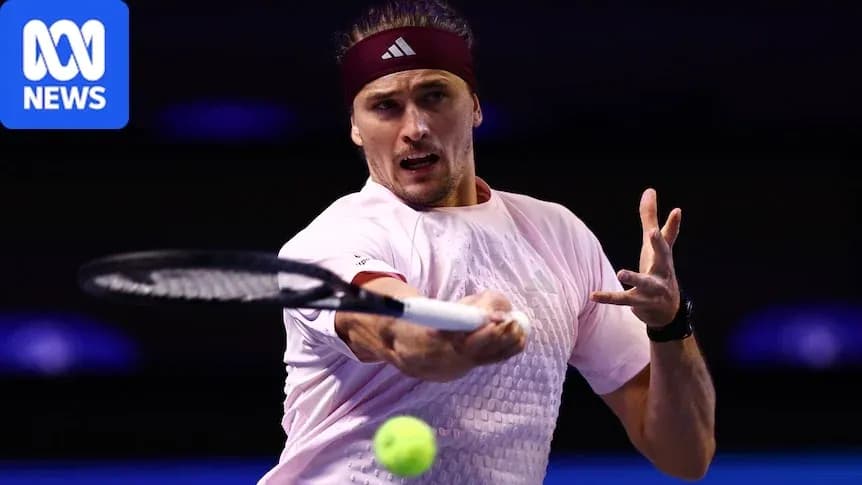
Alexander Zverev spent a decade staring up at a mountain that refused to move. First it was Roger Federer, Rafael Nadal, Novak Djokovic and Andy Murray blocking the view. Then, just as the “Big Four” finally began to loosen their grip, a fresh wave – Carlos Alcaraz and Jannik Sinner – surged past him.
Now, at 29, Zverev is finally standing on the summit.
On Monday he will be officially crowned world No 1, the 30th man to top the ATP rankings since they were introduced in 1973, taking over from Sinner and completing one of the more circuitous climbs to the top the sport has seen.
“It’s incredibly special,” Zverev said. “It’s something I’ve worked towards for years and you have to show great tennis the whole year to be in this position.”
A talent delayed, not denied
Zverev’s rise was supposed to happen earlier. He was the prototype of the post-Big Four star: tall, explosive, already a two-time ATP Finals champion and Olympic gold medallist by his mid-20s. Yet when it came to the grand slams, the stage that defines legacies, he kept finding the door locked.
While he faltered deep in majors, Sinner and Alcaraz ripped through that same door, collecting 12 slam titles between them as the old guard faded. Zverev, once tipped as the natural heir, became the nearly man of his generation.
The breakthrough finally came this season. With Alcaraz’s year disrupted by a wrist injury and Sinner battling a knee problem, Zverev’s durability and consistency turned from background traits into defining weapons. He seized the French Open at Roland Garros, backed it up with the US Open at Flushing Meadows, and added a Wimbledon final for emphasis.
This was not a ranking handed to him by default. It was ground out, month after month, over the long haul of the season.
The injury that almost broke the climb
The summit had been within reach once before. At the 2022 French Open, Zverev went toe-to-toe with Nadal in a brutal semi-final, only for his ankle to give way in horrific fashion. The injury shredded his momentum and his confidence. Grand Slam titles stayed out of reach. The new kids started winning everything.
“I’ve had a lot of difficult moments in my career: the lost grand slam finals, the injury in 2022,” he said. “But I always somehow kept believing, kept going. This year I also took the step of changing my game a little and rebuilding it, at 29. The way this season has gone is a dream.”
Rebuilding at 29 is not a cosmetic tweak. It is an admission that what once looked good enough, no longer is. Zverev sharpened his aggression, adjusted his patterns, and trusted that his body – one that has been managing type 1 diabetes since childhood – could handle the load.
A generation’s outlier
Zverev’s ascent carries a curious footnote. He will be only the second world No 1, after Daniil Medvedev, from the group of players now in their late 20s and early 30s who came of age in the shadow of Federer, Nadal, Djokovic and Murray but never truly displaced them.
For years, that cohort seemed destined to be remembered as the lost generation. Now one of them has finally planted a flag at the top, albeit later than expected and in an era already being shaped by Sinner and Alcaraz.
Even so, the numbers leave room for argument. Zverev’s 3–8 record against top-10 opponents this season is not the typical profile of a dominant No 1. But as coach Patrick Mouratoglou pointed out, rankings reward something beyond highlight wins.
“A player is not only performing on court, it’s also being healthy, managing your body,” Mouratoglou said. “If someone is never injured and others are often injured, the one that’s not injured will probably end up having a higher ranking … staying healthy when you’re a professional athlete is a real skill.”
In a season where his rivals broke down, Zverev simply kept showing up – and winning enough – while the calendar did the rest.
Shadows off the court
His journey has not played out in a vacuum. Allegations of domestic abuse have followed Zverev for several years, which he has repeatedly denied.
A German court closed a case involving his former partner Brenda Patea in 2024 after a settlement, without a finding of guilt. The ATP, after a separate investigation into allegations by Olga Sharypova, ended its inquiry in 2023 citing insufficient evidence.
Those episodes have formed a stark counterpoint to his on-court success, adding complexity to any discussion of his status as the new face of men’s tennis.
The weight of number one
For Zverev, the timing of this breakthrough matters. He believes arriving at No 1 later in his career has left him better equipped for what comes with it.
“The number one position brings a lot with it,” he said. “You have to be a good role model, do a lot of things right and on court that means more than returning and serving well.”
He is Germany’s second men’s world No 1 after Boris Becker, who last held the top spot in 1991. That history carries its own pressure, but the more immediate challenge stands across the net, not in the record books.
“I still have Carlos and Jannik,” Zverev added. “Hopefully, I can keep competing with them over the next few years.”
The mountain he chased for so long is finally beneath his feet. The real question now is simple: how long can he hold his ground with Sinner and Alcaraz already plotting their next assault on the peak?