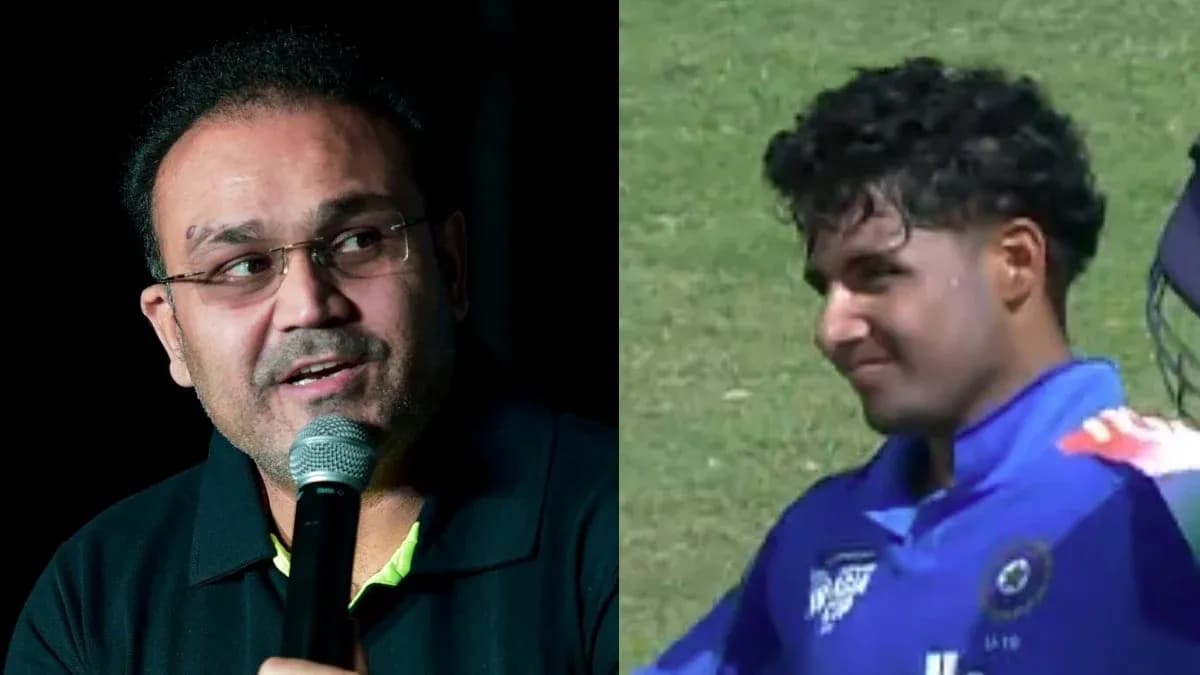
In Al Amerat’s dry heat, with India under pressure and a famous surname on his back, Aaryavir Sehwag found his own way to silence the noise.
Not with a song, like his father once did. With a mantra.
“Sita Ram. Sita Ram.” Ball after ball, all the way to his first hundred for India in Youth ODIs – and well beyond, to a towering 160 that dragged India’s U19 Asia Cup campaign firmly back on track against UAE.
A famous name, a fresh method
India needed this. Badly. A bruising defeat to Pakistan had rattled an otherwise confident dressing room, and the conditions in Al Amerat were offering no favours to batters who chased the game.
Sent in after losing the toss, Aaryavir walked out to open knowing the script could not afford an early collapse. The start reflected that awareness. No wild swishes, no desperate attempts to impose himself. He dug in, watched the new ball carefully, and let the innings breathe.
The tempo changed slowly, then decisively. What began as a patient, almost studious stay at the crease swelled into a commanding 160 – the highest individual score of this U19 Asia Cup so far, and the spine of a convincing Indian victory over the hosts.
Behind the numbers, though, sat a routine shaped in long conversations at home.
From humming to chanting
Virender Sehwag terrorised new balls across the world with a bat in hand and a tune in his head. He famously hummed songs at the crease, using melody as a shield against pressure, as a way to stay present and unbothered by the weight of the moment.
His son has borrowed the idea, not the soundtrack.
“When I talk to my father about the mental aspect of batting, he tells me something that helps me stay in the present moment,” Aaryavir explained after his match-winning knock. For Virender, that reset button was often a song. For Aaryavir, it is the steady, internal repetition of “Sita Ram.”
There is nothing ornamental about it. It is a tool.
“So, when I'm batting, I keep repeating 'Sita Ram' in my mind so that no other thoughts come in. I focus only on the ball,” he said. The method is simple: clear the clutter, see the ball, react. No overthinking about milestones, no mental calculations about whether this is the over to push for a fifty or a hundred.
The result against UAE was a masterclass in that clarity. He allowed himself dot balls early, refused to panic when the scoreboard stalled, and trusted that the runs would come if he stayed long enough. Once set, he accelerated with authority, turning a cautious beginning into an innings that broke the game open.
A promise kept
The story of the hundred began the night before. Aaryavir had spoken to his father and, in the casual way that often hides deep intent, promised him a big score in the tournament.
This was the delivery of that promise – his first hundred for India in Youth ODIs, and one that carried added emotional weight.
“The plan was simply to bat for 45 overs,” he said. The coaches had echoed the same message: occupy the crease, anchor the innings. So when the dots piled up, he did not flinch. “Initially, when I played dot balls, I didn't mind because I had the belief that I would cover that later. I'm glad I could get a big score and help India win.”
The scoreboard vindicated the plan. The manner of the innings hinted at something more: a young opener who already understands pacing, responsibility and restraint, even as he carries the attacking genes of one of India’s most destructive Test and ODI openers.
Chasing his father’s praise
For all the runs, one verdict mattered most. How would Virender react?
For Aaryavir, his father’s approval is not a background detail; it is a rare currency.
“Whenever he texts me saying 'well played' after a good knock, it means more to me than anything else,” he admitted. It is not a message he receives often. “It's a big moment for me, and I've always loved it when my dad praises my batting because he doesn't do that very often. Whether I score a hundred or not, he doesn't praise me much.”
That scarcity makes every compliment feel like a medal. It also fuels him.
He smiled as he spoke of his mother, who sits at the other end of the emotional spectrum. “She expresses her emotions well,” he said, hoping she would be delighted with the innings, the hundred, the promise fulfilled.
“So, I hope he's happy, and I hope my mum is happy too. I hope my dad is happy and proud of me as well.”
Eyes on a bigger badge
For all the warmth around his first Youth ODI hundred, there was no sense of arrival in Aaryavir’s words. No suggestion that this was a finish line.
Despite the 160, despite steering India back to winning ways, he sounded almost restless.
“But it's a long journey, and I'm not satisfied. I'm not done with my cricket yet,” he said. The target is clear: the senior Indian team, the full blue jersey, the emblem that has defined careers and changed lives.
“I'm looking forward to scoring many more hundreds and winning many more matches. I want to wear the senior Indian team badge.”
That is the horizon he sees when he walks out to open now. Not just another age-group fixture, not just another score, but a step on a path he has already mapped in his mind.
And somewhere on that path, he imagines a moment that will matter as much as any international cap.
“Hopefully, when I wear the senior Indian team badge, my father will be able to praise me openly. Until then, the hard work will continue.”
A father once hummed songs and dismantled attacks. His son now whispers “Sita Ram” between deliveries and builds long, disciplined hundreds. The surname is familiar. The journey, very much his own.