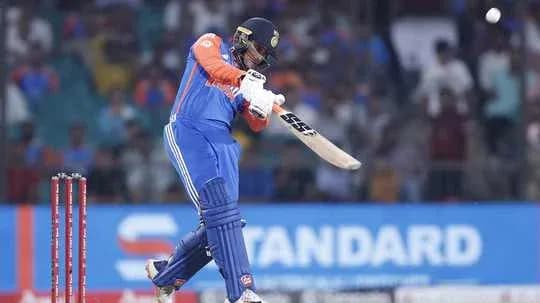
Abhishek Sharma walked out in Delhi with numbers that invited questions and a reputation that demanded answers. By the time he walked back, he had silenced both.
India’s chase of 156 against Afghanistan in the T20I series opener was never supposed to be a cliffhanger. A flat deck, short boundaries, and a deep batting line-up tilted the evening heavily in the hosts’ favour. Abhishek turned that advantage into a demolition, a 32-ball assault that stripped the contest of any suspense and left a quality attack looking ordinary.
The first scoring shot set the tone. Fazalhaq Farooqi went wide, Abhishek went inside-out, and the ball sailed over extra cover for six. No sighters, no gentle easing in. Just intent, pure and uncomplicated.
He truly took charge when he lost his opening partner at the start of the third over. Some batters reset in that moment. Abhishek accelerated. Azmatullah Omarzai’s introduction to the game doubled as an introduction to Abhishek’s mood: lofted straight for six into the long-off stands, then rocked back and pulled through square leg in the same over. The message was blunt. Afghanistan’s seamers would not be allowed to dictate.
Farooqi bore the brunt next. The fifth over turned brutal, 26 runs ripped off it. Abhishek marched onto the front foot to a slower short ball and muscled it over the leg side for six, then carved a flat-batted four through the off side. The left-armer’s variations, usually his strength, turned into predictable offerings against a batter picking length early and swinging with conviction.
Afghanistan’s pace unit had no surprise left, no bouncer that hurried, no yorker that cramped. Abhishek sensed it and went harder. By the time Ibrahim Zadran turned to spin, India were already surging and Abhishek was in that rare zone where muscle memory takes over and the bat seems to know before the bowler does.
Mohammad Nabi, so often the one to restore control, found none. Abhishek finished the Powerplay by drilling him for back-to-back fours, dragging India to 82/1 after six overs. He had 41 of those, off just 15 balls. Rashid Khan came on and was greeted with another imperious inside-out boundary over covers. This was not slogging. It was targeted, repeatable, and ruthless.
Noor Ahmad briefly broke the rhythm. A couple of sharp deliveries forced Abhishek into something almost unfamiliar in his T20 repertoire – the forward defence. It was a tiny pause, a reminder that there was calculation behind the carnage. The half-century arrived with a nudge to the leg side off Rashid, and in the very next breath he flipped the switch again: down the track, six over midwicket; then a fierce blow to deep cover to turn Rashid’s over into a 15-run setback.
Afghanistan ran out of answers. They also ran out of safe options.
Noor, having earned that moment of respect earlier, soon felt the other side of Abhishek’s range. A short ball disappeared over deep midwicket. The fuller one that followed was launched high over deep extra cover, a towering 83-metre statement that showcased both timing and raw power. Every adjustment the bowlers made seemed to arrive one ball too late.
By the time the dust settled, Abhishek had plundered 82, laced with seven sixes and seven fours. He became the second-fastest batter to 6000 T20 runs and logged his 14th fifty in under 25 balls – a mark no one else in the format’s history has matched. The next best, Suryakumar Yadav, sits at nine.
The numbers tell one story. The method tells another.
This was not a wild swing through a low-pressure chase. Abhishek dismantled Afghanistan’s plans layer by layer. Against pace, he thrashed 28 off nine balls at a strike rate of 311.1. Against spin – the heart of Afghanistan’s identity – he carved 54 off 23 at 234.78. He advanced down the pitch, he rocked back, he opened up the off side, he cleared midwicket. Anything remotely loose disappeared; anything good enough to survive was logged, processed, and often punished the next time it appeared.
Crucially, this came at a time when he needed it.
Abhishek arrived at this series under scrutiny. India’s T20 cupboard at the top of the order is overflowing: Sanju Samson’s experience, Vaibhav Sooryavanshi’s fearless strokeplay, and others waiting in the wings. His lean run made the competition feel even tighter. His T20 World Cup at home had started with three consecutive ducks before a late surge salvaged his campaign, but the runs since then had thinned again.
Across his previous six T20I innings, he had only two scores in double figures, with a best of 16. Across 10 T20Is in this World Cup cycle, just 191 runs. India, though, had stayed with him, backing the eye test over the spreadsheet, trusting the ceiling over the current form.
Nights like this are why.
From the balcony, Varun Chakaravarthy, who has endured his own share of Abhishek punishment in domestic cricket, watched with a mixture of admiration and empathy for Afghanistan’s spinners. “I have personally bowled against them, I know how hard it is. I feel for their spinners,” he said later, distilling in one line what 32 breathless balls had already made clear.
For India, it felt like confirmation that their faith had not been misplaced. For bowlers around the world, it sounded like a warning that Abhishek Sharma’s lean patch might have ended in the most emphatic way possible.