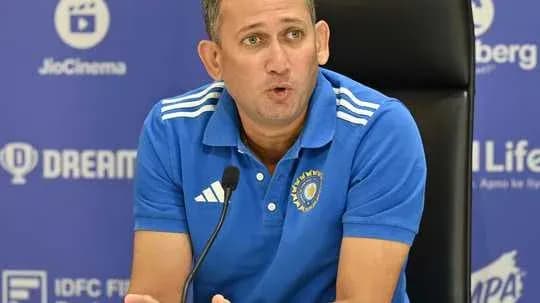
In Mumbai, where Ajit Agarkar grew up and where his cricket story truly began, his absence on Thursday said more than any statement could.
The Board of Control for Cricket in India convened a high-profile review meeting in the city, a gathering important enough to spark instant chatter across the game. The chairman of selectors, though, was nowhere to be seen.
The BCCI moved quickly to douse the flames.
“Today, he was out of station, so he could not be a part of the meeting. The meeting was called at very short notice, and our chairman of the selection committee, Ajit, was not in town. So he could not join the meeting, and he was in an area where he could not join online either, despite our best efforts,” BCCI secretary Devajit Saikia said.
On paper, that should have been the end of it. A logistical issue. A late call. Poor connectivity. These things happen.
Yet the timing, and the context, refused to let the story rest.
Only a few days earlier, Agarkar himself had chaired an online selection committee meeting to pick the T20I squad for the three-match series against Afghanistan. The same man who could comfortably oversee a crucial squad announcement virtually was, on Thursday, unreachable even via video link.
Saikia insisted the Mumbai meeting had nothing to do with selection.
“Today, we did not have any selection meeting. There was no such discussion in today’s meeting,” he said, leaving no room for ambiguity.
The clarity of the statement did little to slow the noise outside. Social media timelines filled the gaps with their own narratives. Some accounts went as far as to suggest that Agarkar was on his way out as chief selector, treating his absence as the first visible crack in the system.
Inside the BCCI corridors, the line remains consistent. When the secretary speaks with that level of certainty, those in the room argue, it is premature to sketch out alternative scenarios. Yet curiosity clings to this story, because it arrives on the back of a delicate episode that put the selection committee under an uncomfortable spotlight.
Questions around Agarkar’s position have lingered since the Rohit Sharma saga, when selectors reportedly told the former captain to retire, only for the BCCI to step in. That moment altered perceptions. It suggested fault lines between the selection panel and the board’s top brass, and it turned every subsequent development into a potential clue.
For now, the official word is simple. Agarkar is overseas. Multiple sources maintain that no change is expected to the selection committee. He is expected to complete his term, which runs until next July. Some within the ecosystem even talk of the possibility of an extension through to the World Cup scheduled for October–November 2027, though that remains unconfirmed and unverified.
Saikia, for his part, refused to fuel the drama.
“I do not want to give any fodder to the speculators,” he said, drawing a clear line in the sand.
The calendar offers its own immediate test of those assurances. Agarkar is expected to be in Chennai for the Duleep Trophy final starting September 6, a five-day red-ball fixture that traditionally gives selectors a closer look at the domestic talent pool. He is likely to be joined there by a couple of his colleagues, while two other selectors are set to be on duty in Delhi for the T20I series against Afghanistan.
Those assignments, if they unfold as indicated, would signal business as usual for the panel.
Agarkar has hardly been a background figure in recent weeks. During the just-concluded Test series in Sri Lanka, television cameras picked him out repeatedly in the stands, tracking his reactions as India navigated the challenges of red-ball cricket away from home. His presence there underlined his hands-on approach, his visibility a reminder of the scrutiny that comes with the role.
On Thursday, he was just as central to the conversation, even without a single frame on screen. His absence dominated a meeting he did not attend, and turned an ordinary administrative gathering into a flashpoint of speculation.
The next time he walks into a ground in Chennai or a box in Delhi, the focus will not just be on the players he is watching, but on the man doing the watching—and what his continued presence says about where Indian cricket is heading.