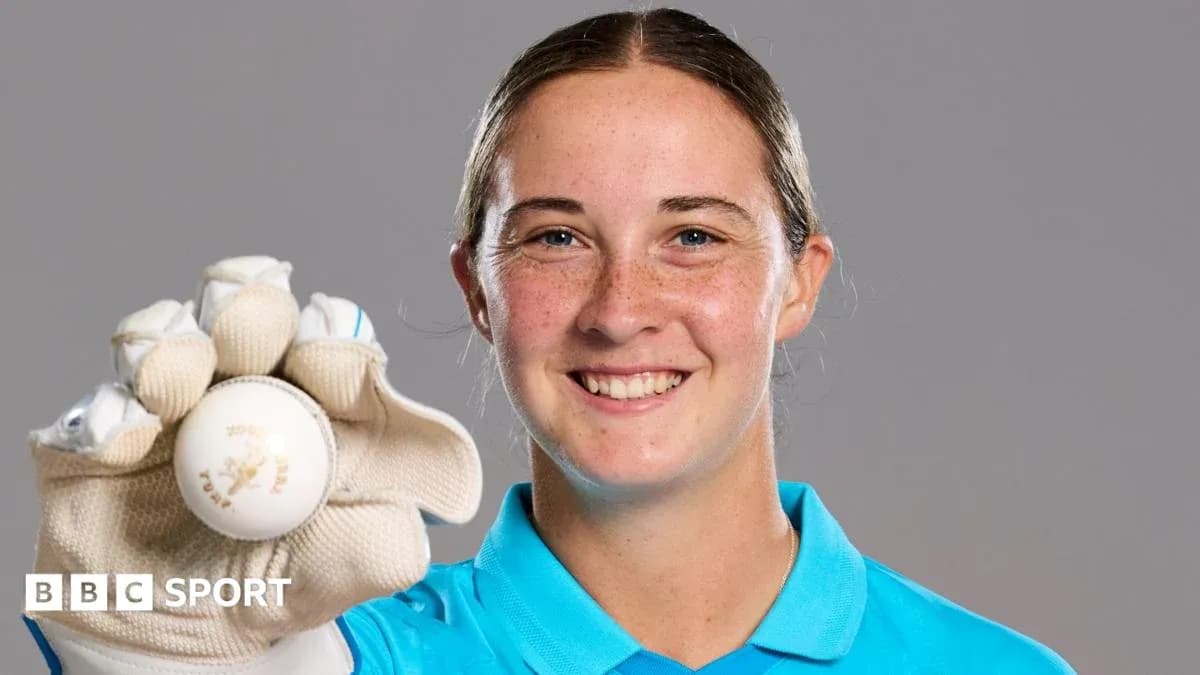
Alice Capsey stepped in for England’s pre-series photo shoot this week with one extra item in her kit bag. Bat, pads, helmet… and, tucked under her arm, a pair of wicketkeeping gloves.
She has already batted, bowled and patrolled the field for her country. At 22, she is spoken of as a future captain and one of England’s most reliable all-round cricketers. Now she is about to add another job title to the list: England’s wicketkeeper for the one-day international series against Ireland.
There is a twist. She has done it in a professional match only once – a 50-over game for South East Stars back in 2020.
“Realistically, it is a bit of an unknown,” she admits. “In games, I have not done it a huge amount. But the work I have done off the pitch, I know I am putting a lot of hard work in. It gives me a lot of confidence.”
This is not some wild experiment. Charlotte Edwards does not deal in hunches and hope.
Back to her roots
England first floated the idea during their pre-season camp in South Africa. Capsey kept for much of her junior career at Surrey’s academy before shelving the gloves when she moved up an age group that needed an off-spinner more than a keeper. The skill never vanished, it just went into storage.
“Who knows if I hadn't played up whether I would have just kept on keeping, but it is really cool going back to the roots and where I started,” she says.
With options thin and Capsey’s game maturing, she was quietly pencilled in as back-up to Amy Jones for this summer’s T20 World Cup. She never got the call in the tournament, but the conversations behind closed doors were serious. When Nat Sciver-Brunt returned from injury for the semi-final, one scenario had Sophia Dunkley retaining her place, Jones missing out and Capsey taking the gloves.
It did not happen. The idea did not go away.
At the start of the summer, the prospect of standing behind the stumps for England made even Capsey shrink a little.
“Especially at the beginning of the summer, I was pretty nervous to do it,” she says. “I went into my shell a little bit and was quite internal. It was awesome to have Sophie Ecclestone and those characters who are outgoing, jokey and keep everything relaxed.
“Everyone has seen me train so much now over the course of the summer it is second nature.”
Taylor’s shadow and the keeper’s grind
If Capsey needed a model for how to reinvent herself with the gloves, she did not have to look far. Her school days at Bede’s in Sussex overlapped with Sarah Taylor’s stint there as a sports coach. Taylor, one of the finest wicketkeepers the women’s game has produced, later returned to the professional circuit and now works with England’s men.
Capsey was 12 when she sat in the stands at Lord’s and watched Taylor help England win the 2017 World Cup. Years later, she got to work with her hero.
“The way she went about it, did it her way and brought an X-factor to it was really cool,” Capsey says. “She has been on my shoulder for the last four or five years saying I need to get back to keeping.
“It has been awesome to touch base with her, especially this summer to be able to message her and say ‘I am back.’”
The romance of returning to her roots quickly met the reality of the job. The bruised fingers. The endless squats. The balls that dart down the leg side and make a fool of even the sharpest hands.
“The amount of times you take blows on the fingers, or one goes down the leg side and you miss it…” she says. “But those are the bits you enjoy, working to get better and better.”
Her training schedule has been rebuilt around the role. Extra drills behind the stumps slotted between batting, bowling and out-fielding sessions. Time in the gym shifted towards strengthening her legs and, in particular, her abductors to cope with the physical strain.
“I have pulled up, touch wood, after all of it so far,” she says. “Come back to me at the end of the week.”
Quiet auditions, louder consequences
Capsey’s last official outing as a keeper might be six years ago, but England have already tested the idea away from the cameras. Before the T20 World Cup, she kept in a behind-closed-doors warm-up against India.
She stood up to seamer Dani Gibson and plucked a rising catch. She completed a stumping off spinner Linsey Smith. She did not concede a bye.
“It was awesome,” she says. “I loved the experience. Keeping up to Gibbo was a really nice challenge.
“That catch was one of the highlights but also it is the little things, whether in the first over stood back to [Lauren] Filer and getting one cleanly in the hands, there were a couple of leg-side takes as well.”
This week in training, she has been standing up to Issy Wong, one of England’s quickest bowlers. That is not a drill you give to someone you do not trust.
The potential knock-on effects are significant. For now, Capsey is cover for a rested Jones, 33, whose absence has opened a temporary vacancy. But if the experiment works, it offers England something more than just insurance.
Jones endured a lean T20 World Cup with the bat, five single-figure scores in seven innings. Capsey, by contrast, has already nailed down a place in the side as a batter alone. If she can keep competently at international level, England suddenly have room to squeeze another power hitter into the top order without losing balance.
“There is going to be nerves and pressure around, but more internal pressure than anything,” Capsey says. “As a professional athlete you don't want to do it badly and you are representing England.
“It is an international series, there are ICC points on the line. To be trusted to have the gloves for England has got to give you confidence as well.
“I am not the finished article by any means but I did it for a long time growing up. Regardless of the challenges presented this week I know I have a bit of experience to fall back on which is nice.”
So Capsey walks into this Ireland series as batter, bowler, fielder and keeper, a modern cricketer asked to stretch herself one step further. If she pulls it off, England may discover their future wicketkeeper was in their top order all along.