The laptop or the cricket ball?
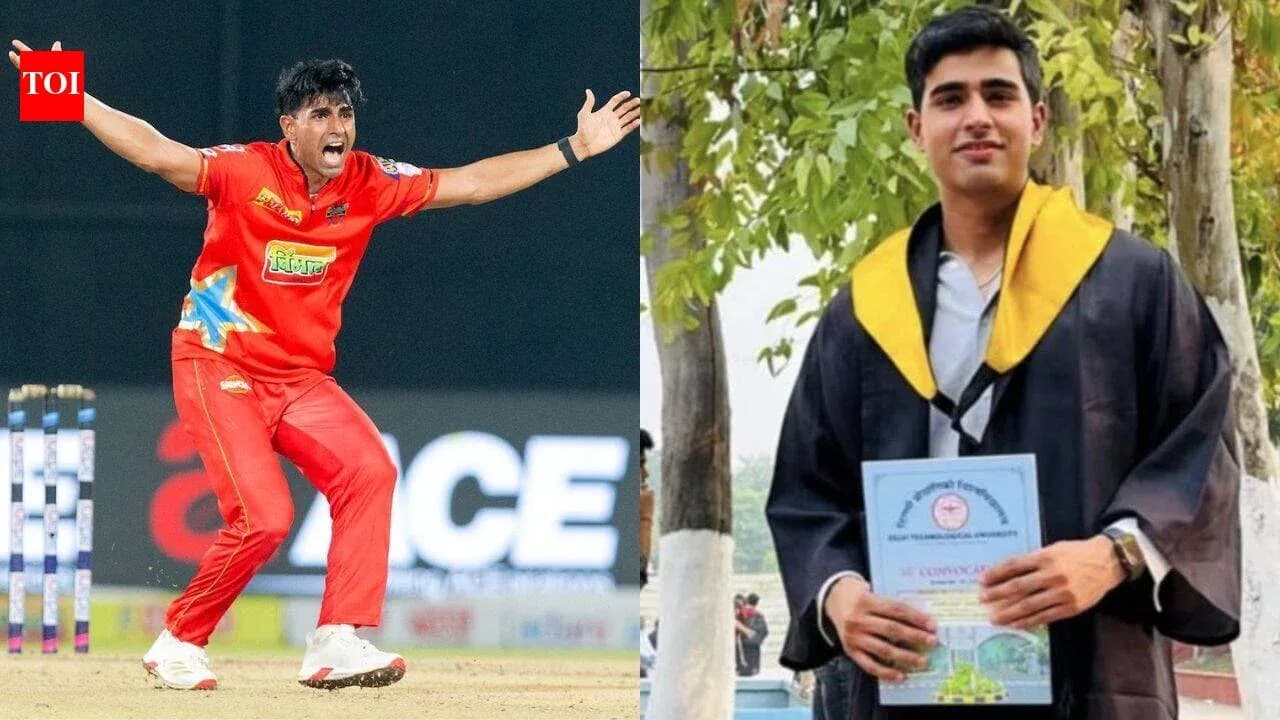
Ask Anshuman Hooda that, and the answer comes back with a laugh and no hesitation. The 25-year-old engineer from Delhi Technological University, now employed at EY, doesn’t even pretend there’s a dilemma.
“My cricket ball is my best friend,” he tells TimesofIndia.com.
That “best friend” fetched him 22 wickets in the third edition of the Delhi Premier League, the Purple Cap, and a title with South Delhi Superstarz. It also dragged him back from the brink of quitting the game altogether.
A fast bowler who almost walked away
Not long ago, Hooda had decided cricket was done with him.
Two failed attempts at Delhi’s Under-23 trials. No age-group pedigree. No junior cricket in the DDCA system. No schoolboy headlines. For a city where the conveyor belt usually runs from under-14s to Ranji Trophy, he wasn’t even on the belt.
“I tried for Under-23 for two years, but I couldn’t make it,” he recalls. “I thought it would be very difficult because I hadn’t played any professional cricket or age-group cricket. It would have been very difficult to directly get selected for the Ranji Trophy or first-class cricket.”
So he did the sensible thing. He finished his Production and Industrial Engineering degree from DTU in 2023, picked up a campus placement at a multinational, and prepared to move on.
“So at that time, I thought I should quit cricket and pursue my career in engineering or something.”
His family understood. His elder brother, Vikram, had walked the more familiar route: science, engineering, stability. Their mother, Prem Lata Singh, a primary school teacher with the Municipal Corporation of Delhi, wanted the same security for Anshuman.
“Earlier, they used to say that he needed a job. Now that he has one and is doing well, she is happy,” Vikram says.
Then his coach refused to let him go.
The coach who said “one more year”
In 2019, at university, coach Harish Dagar spotted something most others had missed. Not a finished product. A frame. A rhythm. A hint of pace.
Anshuman was playing tennis-ball cricket when Dagar, who runs the Delhi Cricket Hub academy in Paschim Vihar and also trains youngsters at DTU, asked him to try medium pace with the leather ball. The early attempts were wild. The raw material was not.
“His body alignment was natural. His strength was natural, and his pace was natural. But he didn't have enough strength in his body initially. That's why I told him that if you don't maintain your fitness along with your natural pace, you will face problems,” Dagar says.
By 2023, degree in hand and job secured, Anshuman was ready to shelve the dream. Dagar stepped in.
“It was in 2023. He had just graduated. He had got the job through campus placement and was ready to move on with his life. I pleaded with him to give it one more year. I asked him to come to my academy four days a week for a year, and if nothing would pan out, I would let him pursue his corporate job,” the coach remembers.
The sessions were squeezed into a life already packed. Work-from-home at the multinational helped, but not much. Late evenings at the academy. Gym work. Recovery. Repeat.
“He was also busy with his job. He couldn't always take proper sessions. He would come at night, then have to go to the gym and take practice sessions. It was very hectic,” Dagar says.
So the coach went to work on the one area he felt would decide everything.
“I worked on his mind 80-85 per cent. I made him mentally strong. I told him never to think that he was tired or burdened. Once I worked on his mindset and the roadmap was clear in front of him, he knew what he had to do. At one point he had to focus on fitness, at another he had to do his job, and then he had to come to me for his sessions.”
From roller skates to the Purple Cap
Hooda is a late bloomer by cricket’s timelines, but his story starts even further away from the usual script.
Before he learned to hit a length, he learned to glide.
Growing up, Anshuman was a national-level roller skater. Cricket was background noise, not destiny. His elder brother had played, and in most things, Anshuman followed Vikram’s template: science, engineering, a respectable profession.
Cricket broke that pattern.
“I just started playing in college, and that’s when I got into leather-ball cricket professionally, playing for the college team and all. That’s when I fell in love with bowling fast, getting wickets and the aggression that comes with it. I just loved bowling fast.”
Fast bowling is not kind to the body. He learned that quickly.
“Fast bowling is not a very comfortable activity for the body. You accelerate, then your whole body has to absorb the impact before you bowl. It definitely takes a toll on the body,” he says.
The niggles came. The soreness stayed. But the motivation stayed longer.
“It was just the love for the sport and the love for bowling fast that kept me motivated and helped me come back stronger every time.”
Building a fast bowler, not just a fast ball
Once the decision was made to give cricket that “one more year”, Dagar tightened the screws. This was no longer about casual nets. It was a professional build-out.
Periodisation. Rest. Strength work. Workload management. Diet. Physiotherapy. Technical refinement.
Anshuman had to develop a stock ball he could trust and then layer on the leg-cutter, the off-cutter, the subtle changes of pace. All of it had to sit on top of a body that could withstand repeated sprints to the crease and heavy landings.
“The objective was never simply to produce a fast delivery. It was to produce a fast bowler,” is how Dagar frames it.
The DPL became the proving ground.
In 2024, South Delhi picked him up. Opportunities were limited at first. He waited. Then came one spell that changed how teammates, opponents and selectors looked at him. The following season, he grabbed a five-wicket haul. Suddenly, his name was on lists.
IPL franchises began tracking him as a potential net bowler, a trial option. For a player who had never worn a Delhi age-group jersey, this was a different universe.
The validation arrived in person when team owner Shikhar Dhawan walked up after one of his performances.
“Shikhar Dhawan himself, the team owner, surprised me. He came and we had a little conversation. He gave me some very good tips and a direction to work towards from here,” Anshuman says.
Dhawan later praised him on Instagram. For Hooda, it was more than a social media mention. It was a signal that the grind was being noticed.
Pace on tap, accuracy in progress
Right now, Hooda operates around the 140 kmph mark. That, on its own, is currency in modern cricket. Dagar believes there is more speed in the tank. So does the bowler.
“Definitely, speed is what I want. If I can, I will definitely look to bowl even faster and build the strength and skills to do that, while making sure there is no compromise on accuracy and line,” Anshuman says.
That last part will decide how far he goes. Pace opens doors. Accuracy keeps them open.
For Hooda, the next phase is about sustaining that speed across long spells, not just short bursts, and doing it with the red ball as well as the white.
“These are the things we prepare for. Who bowls in a four-day or five-day game and bowls long spells with the same effort? That is what I am preparing for. If I get an opportunity, I will definitely do that.”
His ambitions are unambiguous. The ladder is clear in his mind.
First, break into Delhi. Then cement a place in first-class cricket. Then the IPL. Then India.
“The eventual goal is to play and win matches for the country. That is my ultimate goal,” he says.
Security vs the dream
For now, though, the tug-of-war in his life is not between formats or franchises. It is between certainty and risk.
On one side, a DTU degree, a solid job at a reputed company, and even a promotion before the latest DPL season. A life with structure, salary slips and predictability.
On the other, a career that can explode overnight or vanish just as fast.
“Currently, I have joined back,” he says of his corporate role. “But as I have seen some substantial progress in my cricket in recent months and in this tournament, I might, in the coming times, shift my whole focus to cricket and give it my all.”
It is a significant shift in tone from a man who once considered walking away from the game. The engineer who learned to juggle competing demands may soon be forced to drop one ball and hold on to the other.
His mother, once anxious about a job, now watches a son who could swap the comfort of a promotion for the uncertainty of a run-up. His coach sees a bowler still only at the start of his physical peak. His brother sees a pattern-breaker in a family that chose the safer road.
Anshuman knows what he wants.
“I will give it my all. Let’s see what happens ahead.”
The choice, sooner rather than later, will no longer be between a laptop and a cricket ball. It will be between the life he has built and the one he now believes he can bowl his way into.