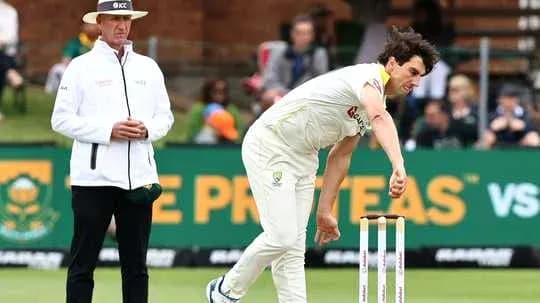
St George’s Park has been part of Arno Jacobs’ life for almost three decades. First as a player. Now as the quiet figure in the middle, making the calls that decide Test matches.
He walked into the ground for the first time in October 1997, a young batter turning out for North West in a List A game. Six years later he was back, this time in Eastern Province colours, for a four-day match against Boland. His last outing there as a player came in February 2013, in whites for the Warriors against the Lions.
Across a career that took him to 28 first-class venues in South Africa, England, Ireland and Scotland, nowhere featured more than this place. St George’s Park gave him 30 first-class caps, more than any other ground. Add 32 List A appearances and 14 T20s, and you understand why he talks about it almost as a second home.
Then there’s the view from the other side of the boundary rope.
Before October 18 this year, Jacobs had already stood as an umpire in 45 matches at St George’s Park, worked 17 more as television official and served as fourth umpire in another 14. One hundred and fifty-two games at the same ground. Every blade of grass familiar. Every corridor and corner part of his working life.
“Knowledge of the playing surface helps,” he told Cricbuzz. “It’s also about being comfortable in the environment; knowing your surroundings, knowing the groundsman, knowing the staff who work there. That goes a long way to making you feel more at ease.”
On this October morning, he arrived as the fourth umpire. Nothing glamorous about that job. You fetch replacement balls, manage light meters, handle paperwork, step in when needed. The spotlight sits firmly on the two in the middle and the one in the TV booth.
The appointments were clear. Richard Illingworth and Chris Gaffaney on the field. Richard Kettleborough on the technology. Jacobs as the reserve.
Then the script flipped.
Gaffaney fell ill on the first morning. Under normal protocol the television umpire moves out to the middle and the fourth umpire climbs into the DRS chair. This time, the pattern broke. Kettleborough stayed with the screens. Jacobs was told to pull on the hat and walk out for his first Test as an on-field umpire.
In South Africa. At his home ground. Against Australia.
Social media rushed to fill the gap in understanding. The story went that Jacobs had never done TV duties, so he couldn’t be thrown into that role mid-Test. The numbers say otherwise. He had already been television official in two first-class games, eight List A matches and 44 T20s, including four internationals and 21 franchise fixtures. He knows his way around the gizmos.
So why send him out?
“It’s happened before that they’ve taken the TV guy to on-field and the fourth umpire to TV, and it’s created an issue because the fourth umpire might not be as experienced as the original TV guy,” Jacobs explained. “The TV role can be tricky. There’s a lot you need to keep an eye on, and you need to communicate on air with the TV director. It can be an overwhelming thing to get your head around.
“And, you know, for umpires our home is in the middle. That’s what we’re used to. If they had asked me to do TV that would have been fine. But I think I was more comfortable going out to the middle.”
In his mind, the future is clear enough: “The TV role could become a specialist function. I can definitely see that happening in future. Especially for the longer formats. In T20s sometimes not much happens from a third umpire’s perspective. You play on a flat track so you don’t have many referrals. You’re basically timekeeping. A Test match can be much more involved with a lot of decisions to make and a lot of timekeeping to take care of.”
All of that made practical sense. One problem remained. Neutrality.
Modern international cricket guards the idea of neutral umpires fiercely. Now, in the middle of a Test involving Australia and South Africa, a South African was suddenly taking charge on the field at his home ground. His last first-class game there had featured Simon Harmer and Ashwell Prince in his own Warriors side and Temba Bavuma for the Lions.
What would the Australians make of that?
“I understand there was a bit of pushback initially,” Jacobs said. “But it’s not to my benefit to give the South Africans an advantage. I mean, I’m trying to further my own career. If you think of it from the perspective of ‘this guy’s just trying to make his way’, [bias] couldn’t be an issue.
“It is a thought at the back of your mind; that you don’t want to be seen as favouring one side and so you almost go the other way. But you make a decision based on how you see a situation play out in front of you, and DRS is there to assist if you do make mistakes. I just try and make the best decision I can. And whatever happens from there happens.”
This wasn’t his first Test assignment at St George’s Park. In December 2024, when Sri Lanka visited, he was also the fourth umpire. On that occasion he stayed in that lane from first ball to last. The Australia Test refused to follow such a tidy line.
“I didn’t really have time to process it properly. It was a case of, ‘Get on the field, go and do your thing.’ There wasn’t much thought that, geez, this is a big thing. But it was great, and to do it at home was fantastic.”
The call came early.
“The match referee [Javagal Srinath] phoned me at about half-past-seven on the first morning. I had just got out of the shower. He said, ‘Listen, one of the on-field guys has taken ill. You need to take his spot. And can you please also find a fourth umpire?’ I arranged a fourth umpire, and then I started getting myself mentally ready to go out in the middle.”
The man he found was Dan van der Merwe, no stranger to this sort of emergency. St George’s Park had seen a similar shuffle in March 2018, again with Australia in town. Then, too, Gaffaney was on the original team sheet, alongside Kumar Dharmasena. He completed the first day but illness ruled him out of the second morning. S Ravi left the TV booth to stand on the field, Bongani Jele moved into the DRS chair, and Van der Merwe was hurriedly drafted in as the new fourth umpire.
History seemed to circle back.
“I could see he was there in body, but he didn’t look great to me,” Jacobs said of Gaffaney this time. “So I prepared myself for the eventuality that I might go back onto the field. During lunch, when I went out to supervise the marking of the creases and the sweeping of the pitch, I was called back in and told to ready myself to go back onto the field.”
The decision from Srinath and the ICC office was to keep him out there for the rest of the match. One umpire, one rhythm, no further disruption.
“The match referee, along with the people at the ICC office, decided to keep me as the on-field umpire for the rest of the match for continuity. I think it made sense rather than have somebody else come on or have Chris come back on, and then he doesn’t feel well and he has to go off again.”
The best compliment for an umpire is anonymity. No theatrics. No drama. Just the game.
Jacobs blended into the contest exactly that way. Three of his decisions went upstairs. Two came back unchanged, one each for South Africa and Australia. The only overturned call arrived in the 10th over of Australia’s first innings. Marco Jansen rapped Travis Head on the pad, the ball then flicking the bat a fraction of a moment later. Jacobs ruled that Head had hit it. Replays showed the pad was struck just before the bat. A marginal, understandable error in real time.
The bigger test lay in the relentless nature of the occasion.
“The intensity is so different compared to provincial level, where sometimes there’ll be a lull,” he said. “With this there’s no off period. So you constantly feel like you’re in the game. The nature of the pitch was that there was something for the bowler all the time. That also contributed to that. It was a great experience. I loved it.”
It helps that Jacobs has lived all sides of this sport. As a left-handed middle-order batter he scored 17 first-class centuries and 48 fifties, averaging 38.08. In T20s he moved up the order and went hard. He bowled off-spin, but could switch to seam. When needed, he pulled on the wicketkeeping gloves. Now, when he isn’t umpiring, he coaches.
The transition from player to full-time official came through Cricket South Africa’s 12‑month retainer system, introduced in the late 1990s for a small group of umpires. It gave him security and time to grow into the role. Life away from cricket offered stability, too: his wife, Chantal, has carved out a strong career in the fruit exporting business.
“I’ve never worked an actual job in my life, like a real person,” he said, half-joking. After earning a financial accounting degree at Potchefstroom University, he even tried to steer clear of that path by starting a telecommunications business.
He signed off one conversation with a line that undersells him badly: “Thanks for your interest in a boring Dutchman from Potch who moved to GQ.”
On the evidence of his journey, and those calm days in the cauldron of a home Test against Australia, he is anything but boring. Cricket, and Test cricket in particular, has gained an umpire who knows the middle as well as any player ever did.
The next time illness, circumstance or simple planning puts his name on a Test team sheet, nobody will be wondering why he is there.