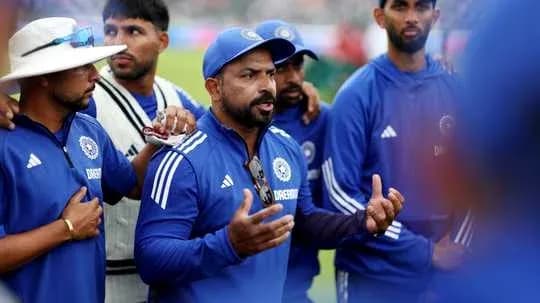
T Dilip has spent the last four years living in the shadows of India’s stars. Not in the dressing-room speeches or the viral clips, but in the half-steps before a ball is struck, the angle of a fielder’s hands, the way a bowler bends to pick up and throw after a 10-over spell.
For him, fielding is not an add-on. It is a craft with layers, angles and decisions, too often reduced to a simple stat: catch taken, run-out made.
The science behind a simple catch
Ask Dilip about catching and he doesn’t talk first about the ball. He starts with the body.
Where is the fielder standing? How early does he pick up the trajectory? Does his head stay still? Do his hands move in sync with his body or fight against it?
A slip catch, a steepler on the boundary and a flat chance inside the circle might all end in the same column – “caught” or “dropped” – but to him, they are completely different skills.
Ground fielding, he insists, starts before the bat meets the ball. The fielder must anticipate, stay balanced and make an efficient first movement. Simply reaching the ball is not the goal.
“He should ideally arrive under enough control,” Dilip says, “to complete a clean pick-up and prepare the throw.”
That is where the separation happens: the difference between a desperate dive and a controlled intervention that saves runs and sets up a dismissal.
Throwing, in his view, is another misunderstood art. Raw power is only one part. Speed of release, accuracy and decision-making matter just as much. A fielder’s match role dictates his training. A slip catcher, an inner-ring specialist and a boundary rider do not – and should not – train on the same programme. The fundamentals connect them, but the drills must mirror the situations they will actually face.
Why multi-sport kids move differently
Dilip lights up when he talks about children who grow up playing more than one sport. They learn to solve different “movement problems”. The ball in cricket does not always arrive at the same height, speed or angle. A body that has been challenged by football, hockey or basketball tends to adapt better when fielding throws up something unexpected.
That, however, is only a base. “Playing other sports alone will not make someone a complete fielder,” he points out. Cricket brings its own demands: reading the bat, judging the flight of a cricket ball, understanding how different surfaces behave, picking up cleanly and throwing with precision.
Adaptability helps, but it does not replace the specific work.
IPL: the great accelerator
On one subject, Dilip is unequivocal: the IPL has changed Indian fielding.
“Without any doubt,” he says, the league has had a positive influence. It has shifted the importance attached to fielding and raised the standards young players see up close.
A teenager can walk into an IPL dressing room and suddenly find himself training alongside some of the best fielders in the world.
He watches how they prepare. How seriously they treat every ball. How they stay locked in even when they have not batted or bowled. That kind of proximity can fast-track development in a way no academy drill can.
Recent data may show fluctuations in catching efficiency. Dilip accepts that and believes it deserves deeper analysis. But he refuses to blame the IPL.
For him, the league has expanded the pool of capable fielders and hammered home a simple message to an entire generation: fielding can swing a result just as decisively as batting or bowling.
The numbers barely scratch the surface
Cricket has numbers for almost everything. Swing, seam, bat speed, wagon wheels. Fielding, though, still lives in the dark.
Dilip finds that gap striking. Public data rarely tells you how quickly a fielder reacted, how far he had to travel, or how efficiently he ran his line to the ball. Catches and run-outs only show the tip of the iceberg.
He wants a more complete picture. Where was the fielder when the ball was hit? How long did he take to react? Did he choose the best route? How quickly did he move from pick-up to release? On throws, what was the velocity and accuracy – and did he even choose the correct end?
Even catching percentage, a seemingly simple number, can mislead. A highly athletic fielder might reach a ball that very few would get near, get a hand to it, and be marked down for a drop. Another player, slower off the mark, never gets close. No drop recorded. No blame attached.
Ideally, every chance should be graded by difficulty. Reaction time, distance covered, ball speed, direction of movement, position near the boundary – all tied to the player’s athletic ability. The same logic applies to runs saved. If a fielder cuts off a shot that would normally bring two and holds it to a single, that invisible contribution needs to be captured.
Across a tournament, these margins stack up. They decide games, and sometimes trophies.
Bowlers who began to love the chase
When Dilip looks back on his tenure, he hesitates to claim ownership of anyone’s improvement. A player may work with the national side, his state team, his IPL franchise and several different coaches. The fielding coach, he says, is one part of a much longer journey.
Still, one area gives him clear pride: the transformation of India’s bowling group as fielders.
It was not just about cleaner techniques. It was about mindset. The bowlers began to take genuine pride in saving a run, backing up a teammate, finishing a tough catch after a draining spell. They started to see fielding not as a chore between overs, but as another way to influence the game.
Dilip resists naming individuals. He prefers to credit the entire bowling unit for the way they embraced fielding with energy and selflessness. For a coach, that shift in ownership is as satisfying as any highlight reel catch.
The most important step you don’t see
At the elite level, Dilip does not believe any fielding skill is truly underestimated. Players arrive with awareness and experience. Still, he circles back to one phase that often escapes attention: the preparation before the ball is struck.
Not the dive. Not the catch. The moments before.
Anticipation, he stresses, is not guesswork. It comes from game awareness, understanding angles, and staying mentally engaged before every delivery. A sharp first step can turn a half-chance into a comfortable stop. A poor first movement can make a routine ball look impossible.
He does not call it an underrated skill. He calls it a universal opportunity – something players from junior cricket to the international stage can keep refining, inch by inch.
T20 isn’t the villain, the calendar is
Dilip refuses to paint T20 cricket as a problem. In many respects, the shortest format has dragged fielding standards upwards. Players move quicker across the turf. Boundary catching has become more inventive and assured. Pick-up and release speeds have jumped significantly.
The real challenge, in his view, lies in the modern schedule. Matches, travel, recovery – the cycle barely pauses. Under that pressure, players naturally prioritise their primary skills: batting or bowling. In franchise cricket, fielding sessions might be optional on certain days, tailored to individual workloads and recovery needs.
That is where something subtle but important can slip. A player can lose the sheer volume and “feel” of catching work. The first few catches in a match then become his practice. That, Dilip says plainly, is not ideal.
The answer is not to drag players through marathon fielding sessions. It is to protect a small, consistent block of high-quality catching, even on optional days. Players must take ownership of that preparation, not just during tournaments but in pre-season and off-season as well.
Consistent catching, he says, comes from consistent effort.
Touch, confidence and the coach’s real job
Even the best in the world need help finding their rhythm when they enter a new series or tournament. Catching is about touch and confidence as much as technique.
Conditions change. The ball might carry differently at a new venue. Wind and lights can alter the flight. A player may find himself in a new position or standing to a different type of bowler. A handful of focused repetitions can reset the hands and body to those specifics.
In those moments, the coach is not always a fixer. Sometimes, Dilip’s job is simply to prepare the player for the exact demands of the tournament in front of him – to tune the radar, sharpen the first step, and let the game take care of the rest.
Because when the ball goes up under lights and 50,000 people hold their breath, nobody sees the hours that went into that one clean catch. But the scoreboard does. And in modern cricket, that might be the quietest revolution of all.