The lights were on before lunch at Edgbaston, and so was the writing on the wall.
Barely 45 minutes into the Test, Pakistan were three down, the sky a slab of charcoal drifting over the ground, rain teasing in the air. Ollie Robinson bustled in with the keeper standing up and five slips crouched in a jagged cordon. From the other end, Jofra Archer was only four overs into his work, loosening the shoulders, the menace still building.
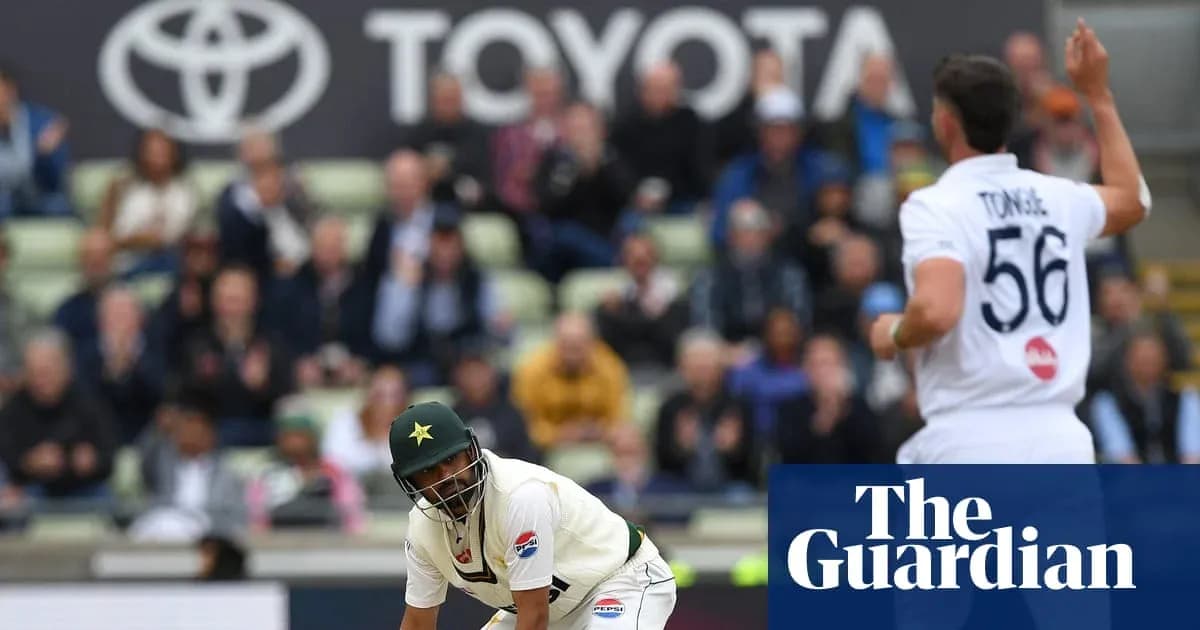
Into this walked Babar Azam. Once the man who made these situations feel survivable. Now, part of the problem they symbolise.
From standard-bearer to symptom
Not long ago, Babar stood shoulder to shoulder with the best in the game. In 2022 he played the kind of year that anchors reputations. A monumental 196 against Australia in Karachi. A controlled 119 in Galle. A fluent 136 against England in Rawalpindi. A commanding 161 against New Zealand back in Karachi. He closed that year with a Test average of 49, ranked third in the world, crowned ICC Men’s Cricketer of the Year.
That version of Babar has vanished.
Since then, the numbers have turned on him. No Test hundred since 2022. Across his last 20 Tests, a top score of 88, an average of 29. The decline is not a blip now; it is a trend line.
Still, muscle memory lingers – for him and for those watching. Close your eyes and you can almost see him batting Pakistan out of this, as he once did with poise and patience. Then you open them again.
A brief, uneasy stay
He set himself for Robinson’s first ball. Half-committed, half-withdrawn, he dragged the bat inside the line at the last heartbeat. The next delivery whistled past the outside edge. The third he clipped neatly through square leg for a couple, a small reminder of the old timing.
Then came Archer. Short, wide, tempting. Babar slashed, missed. The feet weren’t quite there, the decision-making a beat late.
Gus Atkinson followed. Twice he beat Babar, then the Pakistan captain squirted an edge away for four. A boundary on the scorecard, but not on his terms.
Josh Tongue finished it. Fourth over of Babar’s innings, a full ball, the stumps splayed. Seven runs. Eighteen balls. Another failure in a series of them.
The dismissal felt less like a shock and more like the next step in a grim sequence.
Pakistan’s scores in this series tell their own story: 171, 135, 110, 194 and now 133. If they fold again under 200 in the second innings, they will become the first side since the 19th century to be bowled out for under 200 in every innings of a three-Test series in England.
This is not a team merely out of form. It is a team broken.
And Babar, notionally a selector as well as captain, is trying to lead a side he barely recognises. Seven new players arrived for this Test. He said he did not even know they were coming.
“It was news to me,” he said. “I found out after.”
Impossible job, meet impossible circumstances.
Out of chaos, another quick
From that chaos, a new name appeared later in the day, sprinting in from the City End with the ball in hand.
Razaullah.
To most in the ground, he was a stranger. To know him already, you had to be steeped in Pakistan’s domestic game. Just 21, he only played his first major match last November, debuting for Peshawar in the Quaid-e-Azam Trophy. Seven first-class games, nine List A matches, seven T20s. That was the sum of his experience before this sudden call-up, a flight to England, and a Test cap.
He did not ease into it. He attacked it.
The first thing he revealed was that he can hit the ball hard. The second, more important, was that he is seriously quick. The third was the one that matters most at this level: he is gifted.
His first three deliveries to Joe Root hurried England’s former captain, forcing rushed movements, cramped strokes. The fourth was the kind that makes reputations. It screamed in, Root dropped the bat late in defence, and the ball thudded into the front pad, dead in front of middle.
Root reviewed, almost on instinct. The technology only confirmed what everyone on the field already knew. Plumb. LBW. Again.
Razaullah had his first international wicket. Edgbaston had its first real jolt of the day.
In that moment, he gave the crowd a flash of what Pakistani cricket still does better than almost anyone: raw pace, fearless intent, a touch of swagger, even the immaculate hair.
Later he struck again. Emilio Gay this time, undone by a 90mph delivery that took the inside edge as he drove and cannoned into the stumps. Another wicket, another surge of hope.
Talent without a map
Pakistan never run out of fast bowlers. Even when everything else appears to be unravelling, another one appears, sprinting in from somewhere – Peshawar, Rawalpindi, Lahore – and making the ball talk.
That conveyor belt is both blessing and accusation.
If your memory stretches back just a few years, you might recall Naseem Shah and Shaheen Shah Afridi on their first tour of England in 2020, thrilling with the same youthful speed and daring. You might also notice they are not here now, and ask why.
What has the system done with all that fast-bowling talent in the last decade? How has it managed to turn Babar from a world-leading batter into a man searching for his game in real time?
Razaullah is the newest answer to an old question. Bright, fast, full of possibility, thrown into a team that cannot bat 200.
You look at him, at the joy of that first wicket, the roar, the embrace of his teammates, and you wonder what the next five years will do to him. Where he will be. What he will become inside this structure.
And the uncomfortable part is this: deep down, you suspect you already know.