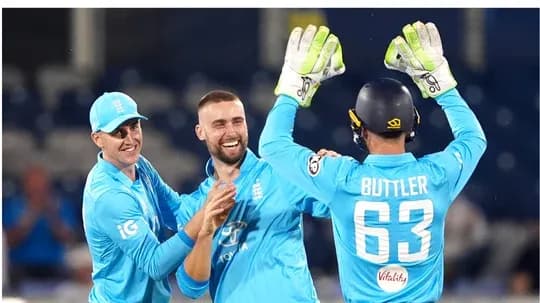
On the flattest pitch of the series, with Pakistan desperately needing their captain to cash in, Babar Azam walked straight back into the same ambush.
England’s short-ball ploy, telegraphed from a mile away and executed by Josh Tongue, claimed him again. A prime chance for a statement hundred turned into another chapter in a mounting red-ball crisis.
A Flat Track, a Big Chance, and a Familiar Ending
Pakistan, bruised and behind in the final Test, finally showed some resistance on a docile Edgbaston surface. They pushed past 400 in the second innings, a rare show of backbone in a series that has largely belonged to England’s bowlers and batters.
Babar was central to that fightback. He moved to 76, looked set, and for a while, appeared to have the time and space to build the kind of long, commanding innings his team craved. Pakistan still trailed England’s first-innings 453 by 42 runs, but the platform was there. The situation screamed for a captain’s hundred.
Then came the now-familiar pattern. Tongue, who had already removed him for seven in the first innings, went short again. Fielders were set, the plan was obvious, and yet the response from Pakistan’s marquee batter was anything but.
He hung in that no-man’s land between options. Pull? Hook? Sway? Leave? In the end, he did none of them decisively. Tongue wheeled away, England celebrated, and Pakistan’s dressing room watched their best player walk off having squandered what many saw as an “easy hundred for the taking.”
Nasser Hussain Calls It Out
The reaction was immediate and unforgiving.
On commentary, former England captain Nasser Hussain cut straight to the heart of the problem, contrasting Babar’s muddled approach with the clarity of his partner at the other end.
“You bowl short to Saud Shakeel, and he goes down straight away. You bowl short to Babar Azam, and he doesn’t know whether to pull, hook, or leave,” Hussain observed. “At the moment, Saud Shakeel is giving him a masterclass.”
On a surface described as road-like, with almost nothing in it for the quicks, the dismissal felt worse than a simple mistake. It looked like a technical flaw wrapped in a mental block, and Hussain’s words only sharpened that perception.
Fans Turn on Their Captain
The online reaction was just as brutal.
Supporters and pundits piled in, accusing Babar of throwing away his wicket despite more than a decade of international experience and repeated exposure to the same bowler and the same plan. One fan summed it up bluntly: Babar had been “trapped in the short ball plan and gifted his wicket after playing a fine knock.”
Another called it “ANOTHER EMBARRASSING WAY TO GET OUT, BABAR AZAM – Literally threw his wicket away,” capturing the exasperation of a fanbase that has seen this mode of dismissal too often.
There was disbelief that a player of his calibre, and Pakistan’s captain, could keep falling into what many called the most basic trap in Test cricket. “You’d have thought that Babar Azam would be too experienced to have repeatedly fallen into England’s short ball trap,” one fan posted, echoing the wider mood.
The pitch only intensified the criticism. “Babar Azam missed out on big runs. Flattest pitch of the year. He had an easy hundred for the taking. And possibly more,” another lamented, the sense of waste hanging over every word.
One supporter even pointed to the numbers, joking that debutant Razatullah Raza would finish the series with a better average than Babar, a stinging comparison that underlined how far expectations and reality have drifted apart.
A Technical Flaw That Won’t Go Away
Strip away the emotion, and the pattern is stark.
When England’s quicks bang the ball in short with men waiting on the boundary, Babar’s game seems to jam. His feet stall, his decision-making lags a beat behind, and the indecision leaves him neither defending nor attacking with conviction.
This isn’t just a lean patch anymore. It looks like a chronic weakness that opponents are queuing up to exploit. Tongue, in particular, now has a clear hold over him, dismissing him repeatedly with the same method.
With England needing only 130 runs to win the third Test and complete a whitewash, Babar’s failure to anchor Pakistan’s innings looms large. On a pitch made for batting, his exit felt like a turning point handed to the hosts.
Until he confronts this short-ball issue head-on – technically, tactically, and mentally – captains around the world will keep circling the same plan on their whiteboards and watching Pakistan’s best batter walk right into it.