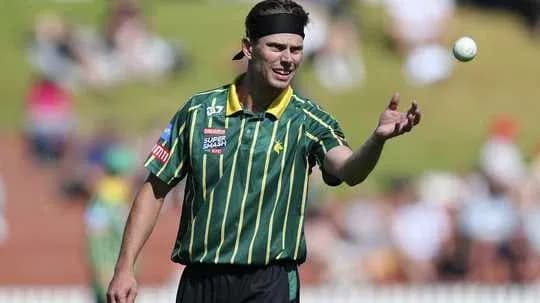
Brett Randell’s long wait is over.
The 31-year-old seamer has been handed his first New Zealand call-up for the fourth and fifth ODIs against India, capping years of steady work on the domestic circuit and a recent stint in the County Championship with Derbyshire. After a career built largely away from the spotlight, he now walks into a series against one of world cricket’s heaviest hitters.
For Randell, this is not a bolt from the blue. He has been a dependable presence in New Zealand’s domestic game, the kind of bowler coaches trust when conditions are flat and the ball has gone soft. That reliability, sharpened by a season of hard overs in England, has finally forced the selectors’ hand. New Zealand Cricket confirmed his inclusion on Thursday, and he is expected to debut at some point over the final two matches.
Head coach Rob Walter underlined the significance of the moment, calling it “always a special time when a player earns their first international call up” and praising Randell as “a consistent performer in domestic cricket for some time now” who has “earned this opportunity.” This is not a punt. It is a reward.
Injuries open the door
New Zealand’s pace stocks have taken a hit through the series, and the selection sheet has reflected it. The fast-bowling group has been shuffled repeatedly, with niggles and injuries biting into the depth chart. Out of that disruption, chances have emerged.
Josh Clarkson is the other beneficiary. The powerful all-rounder returns for the fifth ODI, recalled to the squad after last featuring for the Black Caps in April against Bangladesh. He has six ODIs to his name and offers a hard-hitting middle-order option with useful seam-up overs, a profile that becomes especially attractive when the frontline quicks are under strain.
“There’s been a few movements throughout the series so we’re fortunate to be able to bring in Brett and Josh,” Walter said, hinting at the juggling act behind the scenes. With India pressing hard and the series demanding fresh legs, New Zealand have turned to players they believe can handle the intensity straight away.
Santner’s side takes shape
Mitchell Santner continues to lead a squad that has evolved with each game. For the fourth ODI, New Zealand have named:
- Mitchell Santner (capt)
- Finn Allen
- Michael Bracewell
- Kristian Clarke
- Jacob Duffy
- Matt Fisher
- Dean Foxcroft
- Mitch Hay (wk)
- Matt Henry
- Kyle Jamieson
- Nick Kelly
- Brett Randell
- Tim Seifert (wk)
- Will Young
It is a group built around a strong seam core, with Matt Henry and Kyle Jamieson offering height and hostility, and Randell adding another right-arm option who can hit a disciplined length. Finn Allen’s aggression at the top, Will Young’s composure, and the all-round versatility of Santner and Bracewell give the side a layered look.
For the fifth ODI, the shape shifts again. Clarkson comes in, Jamieson and Henry drop out, and Blair Tickner joins the attack:
- Mitchell Santner (capt)
- Finn Allen
- Michael Bracewell
- Kristian Clarke
- Josh Clarkson
- Jacob Duffy
- Matt Fisher
- Dean Foxcroft
- Mitch Hay (wk)
- Nick Kelly
- Brett Randell
- Tim Seifert (wk)
- Blair Tickner
- Will Young
Tickner’s inclusion, alongside Duffy and Fisher, suggests New Zealand want a battery of hit-the-deck seamers to close out the series. Clarkson’s presence deepens the batting and offers Santner another seam option, giving the captain flexibility if conditions change or early wickets don’t come.
A chance to finish on a high
The backdrop to all this is a demanding series against India and a schedule that has tested New Zealand’s resources. Walter pointed to the forecast as a rare piece of good news, noting that “the weather looks promising this weekend” and expressing hope that the side can “end the series on a high.”
For Randell, that “high” would mean more than a result. It would be the first cap, the first huddle in a New Zealand shirt, the first time his name goes up on an international team sheet. For Clarkson, it is another opportunity to cement a role in a side that is constantly refreshing itself ahead of future global tournaments.
Injuries have forced New Zealand to improvise. Now the question is whether these late-series additions can turn disruption into a springboard.