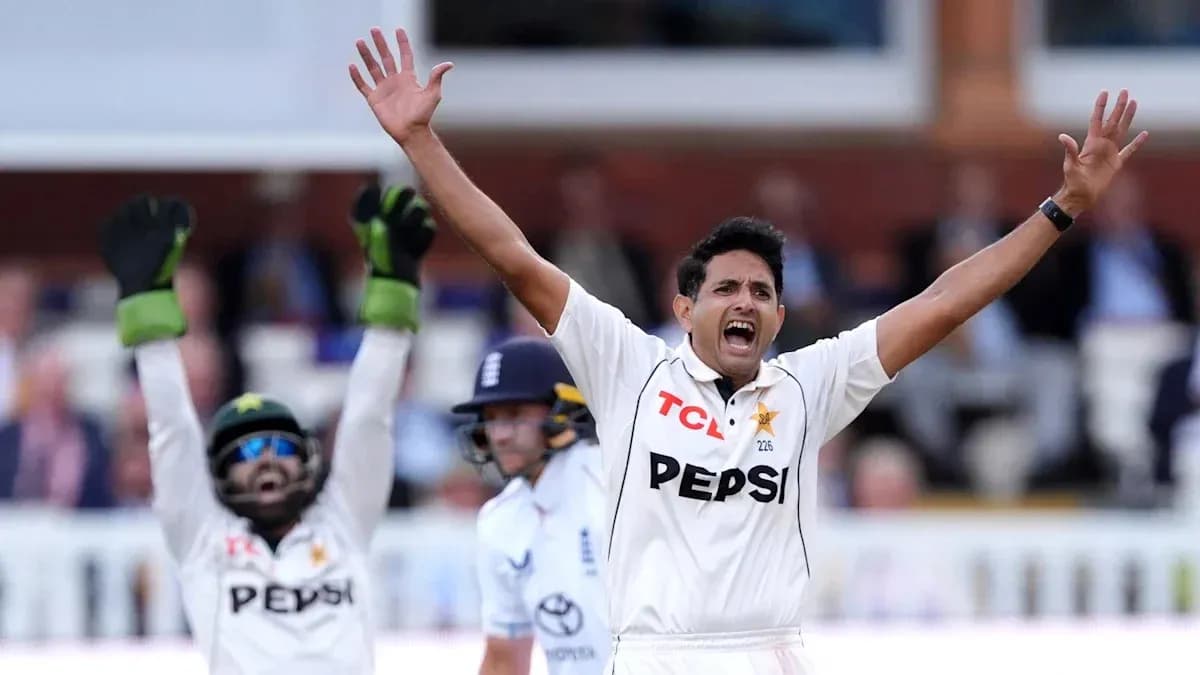
At Lord’s, where cricket usually drowns out everything beyond the boundary rope, politics barged straight through the Grace Gates.
On the first day of the second Test between England and Pakistan, an interview broadcast by Sky Sports with Suleiman and Kasim Khan – the sons of Imran Khan – briefly dragged the match to the edge of crisis. Behind the scenes, the Pakistan Cricket Board was understood to have raised the nuclear option: cancel this Test and the rest of the tour if the interview went to air.
It did. The players came back out anyway.
By the end of the second day, with England 81-3 in their second innings and 261 runs ahead, Pakistan head coach Sarfaraz Ahmed insisted his dressing room had been insulated from the storm.
“I don't know anything. I'm just focusing on the match,” he said when asked about the controversy. “You're talking about the interview? We don't know about the interview.”
Had there been any suggestion the Pakistan players might not return after lunch on day one?
“All are OK. We were having lunch at that time,” Sarfaraz replied, keeping his answers as tight as his team’s defensive fields.
A political fault line at the Home of Cricket
The flashpoint came during the lunch interval on Thursday, when Sky aired Michael Atherton’s interview with Suleiman and Kasim Khan. Their father, Imran Khan – Pakistan’s World Cup-winning captain in 1992, former prime minister and still the most iconic cricketer the country has produced – has been in prison for the past three years on corruption charges he denies.
In the interview, Imran’s sons voiced concern over his treatment and security and criticised the UK government’s response to his situation. Before the segment aired, Sky received a complaint about the plan to broadcast it. From Pakistan’s side, the reaction escalated quickly, with the PCB understood to have threatened to pull the plug on the Lord’s Test and the remainder of the three-match series if the interview went ahead.
The stakes were high enough for the England and Wales Cricket Board to seek advice from the UK government, consulting the Foreign, Commonwealth and Development Office as tensions rose around a fixture that had started in traditional, sedate Lord’s fashion.
In Pakistan, the match is being shown by public broadcaster PTV, which takes Sky’s world feed. PTV carried the cricket. It did not show the interview.
Sky stands firm, play goes on
Despite the pressure, a version of the Atherton interview went out during the interval. There was no walk-off, no on-field protest, no repeat of the chaos that engulfed The Oval in 2006 when Pakistan, furious at ball-tampering accusations, refused to take the field after tea on the fourth day and were adjudged to have forfeited the Test – the only such instance in Test history.
This time, the players simply reappeared after lunch and the match rolled into the afternoon session. The second day came and went with the cricket reasserting itself and Sky, it is understood, receiving no further complaints on Friday related to the broadcast.
Hovering over it all is the unusual overlap of power in Pakistan’s corridors of state and sport. PCB chairman Mohsin Naqvi also serves as the country’s interior minister, a dual role that underlines how sensitive any public discussion of Imran Khan has become.
Back home, former Pakistan captains have already called for “proper medical care” for Imran in jail. At Lord’s, his sons used the platform to underline those concerns. The PCB, protective of both political stability and its own position, reacted sharply. The ECB, wary of diplomatic fallout, moved cautiously. The players, according to their coach, kept their heads down and batted on.
History, tension and another tour looming
This series sits in a long, complicated relationship between these two cricketing nations. England are due back in Pakistan in October for a one-day tri-series with the hosts and Sri Lanka, their fourth separate visit in four years after a 17-year absence because of security concerns.
That looming trip adds another layer. Boards and governments on both sides know how fragile hard-won trust can be. They also know how quickly a broadcast decision, a political grievance or a perceived slight can threaten months of planning.
For two days at Lord’s, the game has survived the noise, England’s lead has grown, and the immediate crisis has eased. The question now is whether the calm holds when England next step into Pakistan, or whether this episode proves to be an early warning of rougher tours to come.