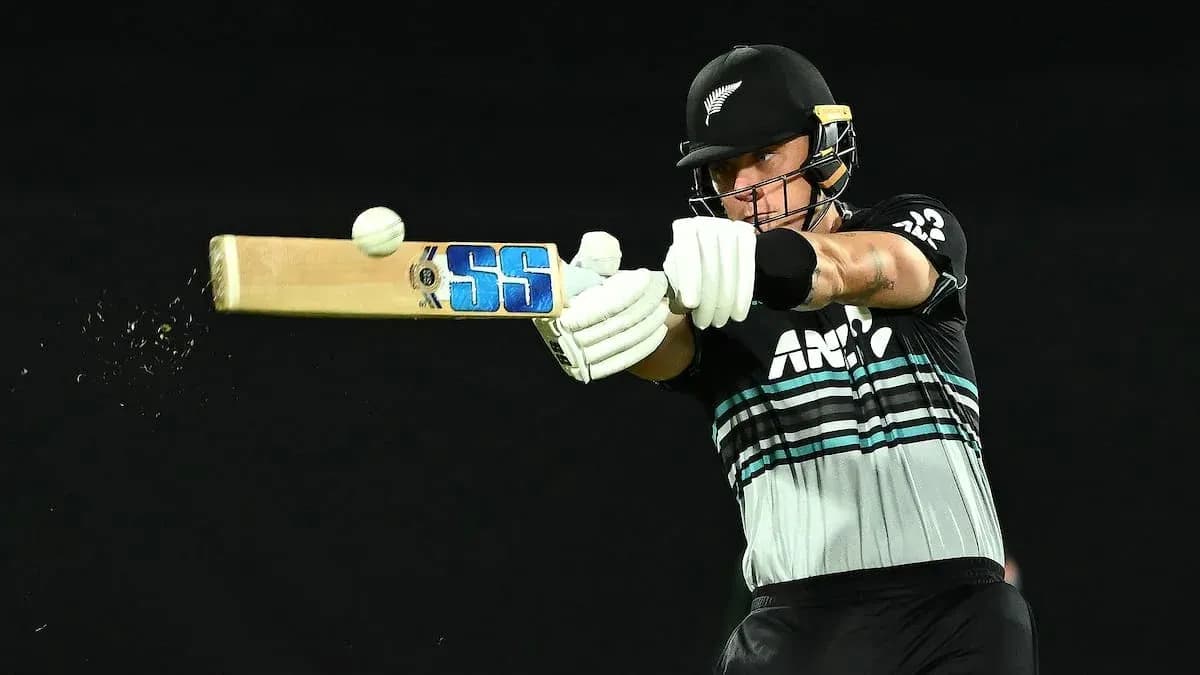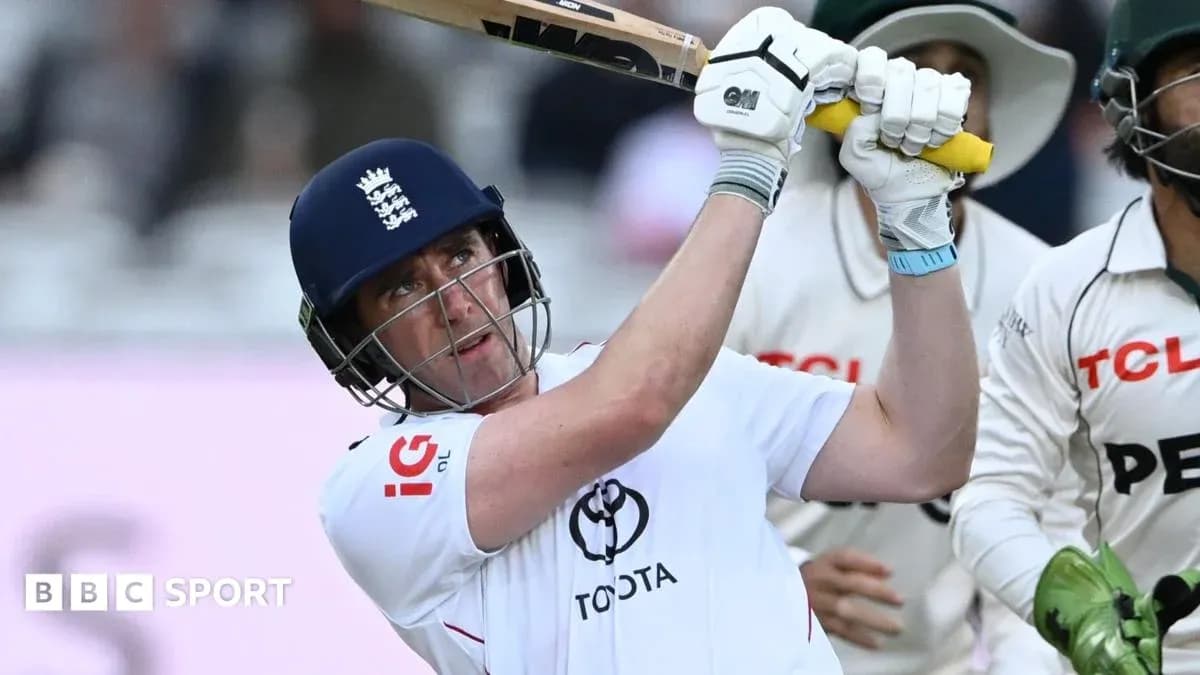
Dan Lawrence walked out at Headingley as the man asked to do the impossible: replace Ben Stokes. Not in aura, not in legend, but in role. A middle-order batter who could send down some overs, balance the side, free up the quicks.
It looked a gamble. It doesn’t feel like one now.
Lawrence seizes his moment
Fifty-one in the first Test set the tone. On day three of the second Test against Pakistan, in conditions that made batting feel like a lottery, Lawrence turned that early promise into something far more persuasive.
England were 83-4 in their second innings, the ball jagging, the bounce unreliable, the game tilting. Lawrence walked in, took guard, and chose intent over survival. By the time rain dragged the players off with England 177-7, he was 50 not out from 66 balls, with six fours and two sixes carved, driven and whipped through his “scoring areas”, as Michael Vaughan put it.
This wasn’t a pretty, textbook half-century. It was a statement. He countered excessive seam movement with decisive footwork and a willingness to hit bowlers off their lengths. The technique is quirky, the method unorthodox. The effect was exactly what England needed.
“He seems to read the game,” Vaughan told BBC Test Match Special. “It was the right way to play at that moment.”
The former captain likes what he sees. Enough to say Lawrence should stay in the XI even when Jacob Bethell’s knee heals.
A recall with an edge
Lawrence is 29 now, back in the England shirt after almost two years away. His first stint brought 14 Tests at an average of 26.84, including time as a makeshift opener. There were flashes, but never a permanent seat at the table.
This recall has come with a different brief and a different balance. England have deliberately gone without a frontline spinner, instead loading up with four pace options and trusting Lawrence’s part-time off-spin to plug the gaps if required.
So far, the quicks have done almost all the work. Ollie Robinson, Jofra Archer, Gus Atkinson and Josh Tongue have dominated, leaving Lawrence to send down just one over in the series. His value has come with the bat, not the ball, but Vaughan is convinced the off-spin will matter in time.
“I think in time his off-spin will come in very handy indeed,” he said. The suggestion is clear: this is not a short-term patch. This is a player who can grow into the role.
Lawrence himself is trying not to look too far ahead.
“It's pointless looking to the future because it hasn't happened yet,” he said. “I'm just trying to contribute every Test I can and give a good showing of myself. Thankfully, so far, I think I have done.”
There is honesty in what follows. He admits he has not yet nailed down an England place across his career, that the desire to “establish myself in an England shirt” sits front and centre in his mind. The key, he says, is to enjoy the occasion, not be strangled by it. To “have fun, play the cricket that's got me here this summer.”
On this evidence, that cricket travels.
Selection squeeze on the horizon
For now, England’s balance works. At home, where pitches often favour seam, the four-strong pace attack and Lawrence as a flexible sixth option make sense. The same template could hold in South Africa and Australia this winter, where fast bowlers tend to decide series.
Bangladesh in the new year is another story. Spin will be non-negotiable there, and England know it. But that problem sits a little further down the road. Lawrence’s immediate challenge is closer: holding his place when Bethell is fit again.
Bethell, like Lawrence, offers runs and part-time spin. He could come straight back in for Lawrence. Or he could reclaim his spot from Jordan Cox, who has responded to his own call-up with two fifties at number three.
The permutations don’t end there. Cox has opened earlier in his county career, Bethell is England’s current 50-over opener, and Emilio Gay’s position at the top could come under scrutiny if the selectors want to reshuffle. One option would be to push Cox or Bethell up to open, then slide Cox down later in the order to take the gloves from Jamie Smith.
Smith, for his part, has hardly gone quietly. His 61 in the first innings here was important, his keeping sharper after a poor Ashes behind the stumps. Every time someone looks vulnerable, they respond.
The pressure is constant. The choices are real.
Vaughan nails his colours to the mast
Amid that traffic, Vaughan’s view is blunt: Lawrence has shown enough to stay.
“I think it is a really good selection,” he said of the decision to bring him back earlier this summer. “He will have a period in the England side that we will enjoy watching him bat… He is clearly a better player than when he played for England last time.”
The numbers back that sense of growth, if not yet in volume, then in context. Fifty-one in the first Test. An unbeaten 50 in a crisis in the second. Both knocks shaped by the match situation, not detached from it.
Lawrence’s highest Test score remains 91. On this form, that mark looks vulnerable. More importantly, he is starting to look like a player who understands his role, his strengths, and the tempo of the modern England side.
He knows this run in the team is no guarantee of permanence. He knows Bethell, Cox, Gay and Smith are all jostling for the same limited space. But he also knows something else now: when the game asked for clarity and courage at 83-4, he had both.
If this is the start of the “period in the England side” Vaughan predicts, then the real question is not whether Lawrence survives the next selection meeting.
It is how far this version of Dan Lawrence can push his ceiling before anyone dares to leave him out again.