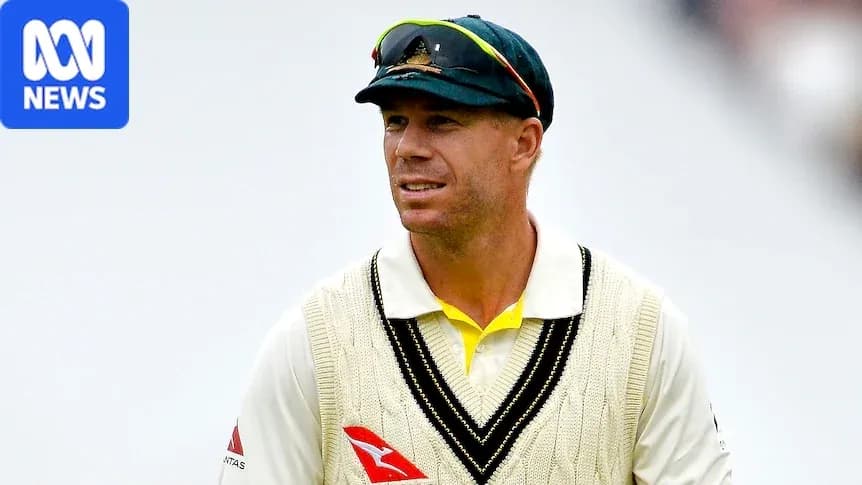
David Warner has reignited the Cape Town ball-tampering storm, accusing Cricket Australia of running a “shoddy” investigation with a pre-determined outcome and suggesting the governing body is clinging to a “false narrative” to protect others.
His latest broadside came only minutes after Pat Cummins completed a long press conference on Friday, during which the Australia captain publicly rejected Usman Khawaja’s claim that more people were involved in the 2018 scandal than the three men who were banned: Warner, Steve Smith and Cameron Bancroft.
Warner, watching on, did not like what he heard.
He told Fox Sports that Cummins had “thrown [Usman Khawaja] under the bus”, and then took his criticism several steps further on social media, directly challenging the integrity of Cricket Australia’s original probe.
Warner turns up the heat
Warner, banned for a year and stripped of any leadership prospects after the Newlands Test, has never fully made peace with how the fallout was handled. In public, he largely stayed silent for years. Not anymore.
“As far as I am aware, CA did not interview Josh Hazlewood, Mitchell Starc or Nathan Lyon in their 2018 investigation. If that's correct, then how can CA push the idea that the bowlers didn't know?” he wrote.
“It looks like they had decided who they wanted to blame from the very beginning, ran a shoddy investigation to serve the purpose and now they want to maintain the false narrative that bowlers had no idea.
“That stinks of a cover-up.”
Those lines cut straight at the heart of Cricket Australia’s long-held position: that responsibility for the sandpaper plot rested squarely with Warner, Smith and Bancroft.
Warner has thrown his weight behind Khawaja’s version of events, which suggests the circle of knowledge was wider than officially acknowledged. He has repeatedly described the inquiry as “botched”, and on Friday he spelt out why he believes players were boxed in from the start.
“The way it was handled in the first place, it was hard for us to go back and give more evidence,” he said on Fox Sports before the ODI between Australia and England.
“I feel like it was a botched investigation. It was a quick one to get it over and done with. Some of the questions were quite challenging in the way it was being planted on us [Warner, Steve Smith and Cameron Bancroft] and we had to move on and just accept responsibility.”
CA stands its ground
Cricket Australia, under pressure once again to explain how one of the most infamous episodes in the country’s sporting history was managed, pushed back.
“As we have stated previously, all players were given the opportunity to speak at the time of the initial investigation and have had the ability to come forward with new evidence in the eight years since,” CA said.
“Subsequently, CA has respected every player and former players right to provide their own version of events.”
The governing body’s stance is clear: the door has always been open, and if there was more to say, players have had almost a decade to say it.
Yet Khawaja’s new book claims he was never even spoken to, despite sitting next to Bancroft during discussions about using sandpaper on the ball. That detail has poured fresh fuel on an old fire, forcing current and former players to revisit ground they thought was settled.
Cummins, who was part of that 2018 side and is now the face of the Test team, said on Friday he had spoken to investigators at the time and stressed that public calls were made back then for anyone with more information to come forward.
Bowlers back under the microscope
The fast bowlers, once again, find themselves in the crosshairs of public suspicion and private frustration.
On Tuesday, Mitchell Starc became the first of the attack to be quizzed directly about Khawaja’s claims. His answer underlined how deeply the episode still divides opinion.
“There were differing opinions of eight years ago,” Starc said. “We were heavily grilled through the process at the time and since.
“I won't speak on behalf of the bowlers but, from where I stand, my opinion hasn't changed, and my recollection hasn't changed from what we said in 2021.”
That reference to 2021 is crucial. Three years ago, Bancroft hinted in an interview that the bowlers “probably” knew what was going on.
“Obviously what I did benefits bowlers and the awareness around that, probably, is self-explanatory,” Bancroft said then, a line that instantly reopened the debate.
Starc, Cummins, Lyon and Hazlewood responded with a rare joint statement, defending their integrity and insisting they had no knowledge of the sandpaper until the images flashed up on the Newlands big screen.
“We did not know a foreign substance was taken onto the field to alter the condition of the ball until we saw the images on the big screen at Newlands,” they wrote.
That remains their story. Warner is now openly challenging the process that cleared them.
Six years on from Cape Town, the bans have been served, careers rebuilt, trophies lifted. Yet the central question refuses to go away: did Australian cricket truly confront the full truth of Newlands, or just the most convenient version of it?