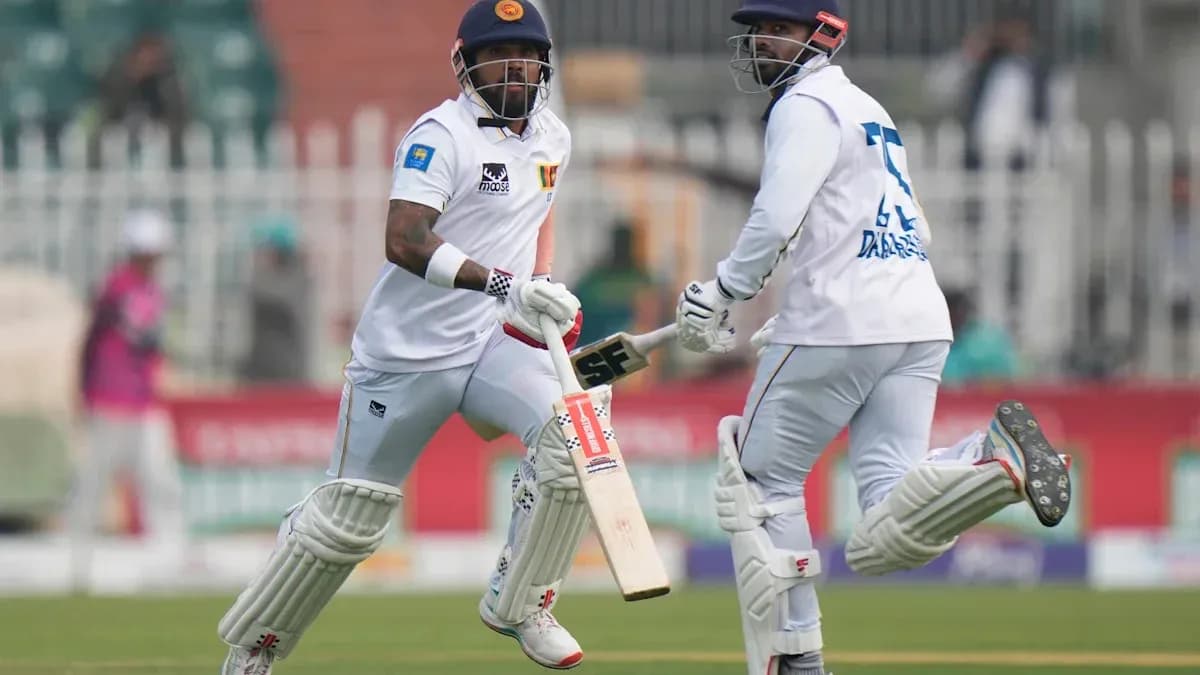
RAWALPINDI, Pakistan — Dhananjaya de Silva walked out on the third morning with Sri Lanka still wobbling and walked back at lunch very much in control of the contest.
Unbeaten on 87, the former captain dragged his side from the brink of a follow-on into a position of quiet authority, steering them to 221-4 in reply to Pakistan’s 434-9 declared in the first test on Wednesday.
This was a rescue act built on nerve and stubbornness. It also needed a slice of fortune.
On 38, de Silva flashed at a wide ball and offered a straightforward chance to first slip. Saud Shakeel spilled it. Pakistan had their moment, and let it go. From there, the right-hander hardened, tightened his game, and began to dictate terms to an attack that looked increasingly toothless as the ball aged on a green-tinged surface.
At the other end, the new captain watched and learned. Kusal Mendis, who took over the reins from de Silva in October, settled into a supporting role, unbeaten on 21 at the interval. He turned over the strike, trusted his senior partner, and let the innings breathe again after two days of pressure.
Pakistan had started the day with a chance to rip through the middle order. Sri Lanka resumed on 114-3, still 320 runs behind and with the follow-on looming. The early overs carried that tension. Mohammad Abbas, the metronome of this attack, probed away and eventually found a way through.
Kamindu Mendis, who had played with composure for his 58, feathered an edge behind. Abbas, operating with his familiar relentless discipline, drew the mistake and Ghazi Ghori accepted the catch for his third dismissal of the innings. The stand for the fourth wicket ended at 90, and for a brief spell Pakistan sensed a door opening.
It shut quickly.
De Silva refused to let that wicket shift the rhythm. He reset, found fresh support in Kusal Mendis, and the pair began to chip, nudge, and drive Sri Lanka out of danger. They ran hard, used the gaps, and kept the scoreboard alive rather than allowing the bowlers to settle into long, suffocating spells.
The pressure that Pakistan had built over two days began to leak away with every single and every firm stride down the pitch.
Saqib Khan, so impressive with the new ball late on Day 2 with his sharp pace and impeccable line, felt the change most. As the ball softened, his speed dipped and the menace went with it. Figures of 2-82 told the story of a debutant who started brightly but ran into the hard reality of test-match grind with an old ball on an unresponsive surface.
Razaullah toiled without reward. The seamers searched for movement that simply wasn’t there. Abbas, with 2-33, remained the only bowler to make a dent in the session.
Sensing the drift, Babar Azam turned to spin. Arafat Minhas, on debut, was handed a long look in the latter half of the session. The left-armer tried angles, changed his pace, and hunted for any hint of grip from the greenish pitch. De Silva and Kusal stepped out to him, literally and figuratively, using their feet to smother the turn and knock him off his lengths.
The fifth-wicket stand moved to 66 by lunch, unbroken and increasingly authoritative. Every over they survived, every run they added, pushed Sri Lanka closer to the safety of avoiding the follow-on and further away from the crisis that had loomed at the start of the day.
By the interval, Pakistan’s “inexperienced bowling attack” tag felt more than just a line on the teamsheet. It looked real. The hosts had their chance when Shakeel shelled de Silva. They had their breakthrough when Abbas removed Kamindu. But they never found the sustained surge that test cricket demands.
Sri Lanka, anchored by a former captain and guided by the current one, had wrestled back control. The next session will decide whether this becomes a mere act of survival or the launchpad for something far more disruptive to Pakistan’s plans.