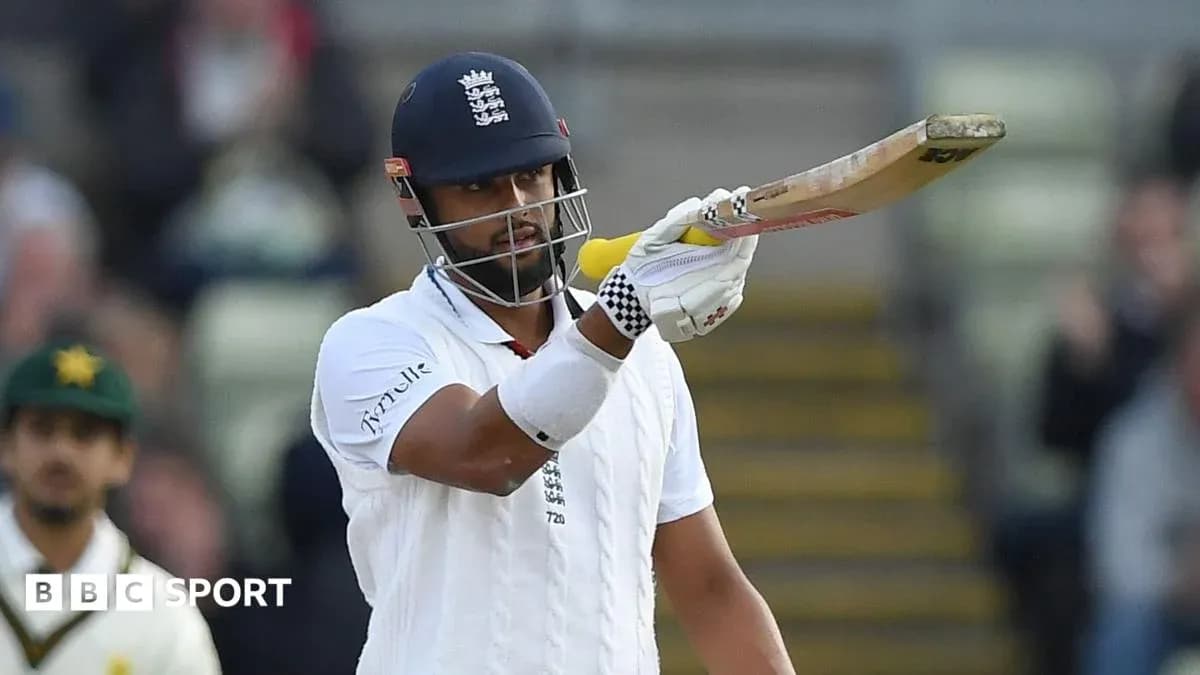
Emilio Gay’s Edgbaston statement has come at exactly the right time, and Sir Alastair Cook wants England to listen.
On a day when Pakistan’s attack probed, the pitch nibbled and batting once again felt like an exercise in survival, the 26-year-old left-hander carved out a hard-nosed 60 from 114 balls. It was not a headline-grabbing hundred. It was something more valuable in this England summer: control.
Cook backs a new opener for South Africa
Cook, who knows the art of opening better than any Englishman in history, has seen enough.
“I think Emilio Gay's played really nicely. I would say he's confident and intense,” he told Test Match Special, his words carrying the weight of almost 12,000 Test runs at the top of the order. “He is definitely a run-getter when he gets in. He seems to have that real stubborn and strong will to make it count if he can.
“He has done enough for me to take him to South Africa to continue the progress of a player where the pitches will be slightly easier to bat on and he should open the batting.”
That is not a throwaway endorsement. England are still searching for stability at the top, still trying to find someone prepared to do the ugly work when the ball is new and the bowlers fresh. Cook hears the noise around averages and aesthetics. He is looking at character.
Gay’s numbers this season do not jump off the page: 261 runs at 26.1. On paper, ordinary. In context, significant. Across six home Tests, only Ben Duckett has reached three figures for England. Bat has been second-best to ball all summer, and the Durham left-hander has been one of the few willing to dig in when conditions demand it.
A different kind of intent
What impressed Cook most at Edgbaston was not the flourish, but the refusal.
According to CricViz, Gay has left or defended 61% of the pace deliveries he has faced since his debut against New Zealand in June. The last England opener to show that level of restraint in a home summer was Dom Sibley in 2020, at 68%. In an era obsessed with tempo, Gay is showing a different kind of intent: the intent to survive long enough to cash in.
On Wednesday, he left or defended 65 balls. Cook “likes how late he defends the ball”, a tiny technical detail that tells a bigger story. Gay started slowly, his first 12 runs taking 43 deliveries. Then he shifted gears, the next 38 coming from 52. The foundation came first, the strokeplay later.
When he did attack, he did it with authority. Nine fours, crisp and decisive. Remarkably, 68% of his Test runs have come in boundaries, the joint-highest proportion of any England batter with at least 250 runs in the format. This is not a blocker masquerading as an opener. This is a player who earns the right to score quickly by first refusing to give his wicket away.
“If you take Gay's innings, and what I've seen of him, he's not hunting that drive too often. He waits for it to come into there,” Cook said. “He scores off the back foot through the off side as well. He scored through the leg side and timed them through mid-wicket so he does have an all-round game. He's not limited to the off side.”
The picture is of a rounded, modern opener who still respects old-fashioned virtues.
A chance missed, a point made
Not everyone in the commentary box saw the day as unqualified success. Michael Vaughan admired the innings but could see the regret coming the moment Gay dragged on to Razaullah Khan, 40 runs short of a first Test hundred.
“Emilio Gay found his balance early. He had it hard at the start and then he found his flow,” Vaughan said. “He'll be really disappointed to get out for 60. He'll be desperate to get his first Test match century and I thought it was on today.
“That extra little bit of pace from Razaullah and a little lack of concentration at the end of the day has cost him.”
That dismissal will sting. It should. England want top-order batters who hate getting out, who wear missed opportunities as a scar rather than a shrug. In that sense, the frustration is part of the education.
Yet by the time he walked off, Gay had already tilted the match. On a tricky surface, against an attack that rarely relented, he had given England a platform. The kind of innings that does not always make the highlight reels but often decides Test matches.
Built in the nets, proven in the middle
Inside the England dressing room, there is no surprise at what Gay produced.
Seamer Josh Tongue pointed to the work behind the scenes.
“The one thing I've seen in Emilio is he trains really hard in the nets. He'll bat for ages, putting a lot of hard work in, and it's shown on the pitch,” Tongue said. “Even last week at Lord's, he had two quite horrible dismissals, but I felt today he batted unbelievable on a tricky pitch.
“He was obviously really disappointed with how he got out. It's not a nice feeling, chopping on, but he's put the team in a really good position for tomorrow.”
Those “horrible dismissals” at Lord’s could have dented a less resilient player. Instead, Gay turned up at Edgbaston and chose to fight. He left well, defended late, waited for his scoring options, and when they came, he cashed in just enough to swing the day England’s way.
Cook has seen that journey before: the grind, the learning, the stubborn refusal to be defined by early failures. That is why his verdict carries an edge of certainty. In a summer where opening the batting for England has once again felt like a job interview in a storm, he believes Gay has done enough to earn a ticket to South Africa — and, crucially, another long look at the top of the order.
The next question is no longer whether Emilio Gay belongs at this level. It is how quickly he can turn these hard-earned 60s into the hundreds that define a career.