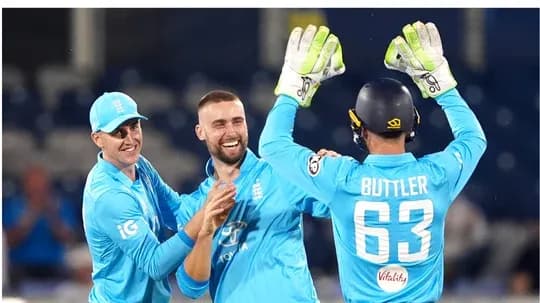
The numbers on the Lord’s scoreboard were brutal. Pakistan, 109 all out on the second morning of the second Test, blown away by an England pace attack that did not exist in this form a few months ago.
Strip away the caveats and the picture is still striking. Yes, Pakistan’s batting has looked flimsy. Yes, these are helpful English pitches in early summer. But in the space left by Ben Stokes’ retirement as a frontline seamer, England have stumbled onto something that feels more than a stopgap.
Ollie Robinson, Jofra Archer, Josh Tongue, Gus Atkinson. Four quicks, four very different threats, one attack that suddenly looks like it belongs in the conversation about the next Ashes.
Variety with venom
Joe Root hinted at it after the first-Test win at Headingley. His quicks, he said, “do not know how good they can be” and offer a variety he never quite had when his new-ball options were James Anderson, Stuart Broad, Chris Woakes and Stokes – all right-arm seamers from a broadly similar mould.
This version of England’s attack does not just change ends. It changes questions.
The most obvious contrast is pace. England came out of last winter’s Ashes defeat determined to prioritise high speed. At Lord’s, that policy roared into life.
At one end, Archer was touching 95mph, delivering the fastest opening spell of his Test career. At the other, Robinson ambled in at around 78mph, the ball landing again and again on the same maddening length. Tongue, across the series, has actually operated at a higher average speed than Archer, while Atkinson sits just behind that pair, close enough to keep batters permanently hurried.
Archer, sharing the load in a four-man unit rather than as the sole enforcer, even allowed himself a joke: at this rate, he said, he could play until he is 40.
Michael Vaughan, watching on, liked what he saw. “It is a good attack,” the former captain said. “They can all get better and that is a really good sign. This batting line-up is possibly the easiest I have seen to bowl to but this attack, bowling the way they are doing, will challenge better batting line-ups. They will challenge the Australia line-up quite nicely if they bowl like this.”
That is the key. Pakistan may be fragile, but the skills on show will travel.
Robinson the metronome
If Archer provides the crackle, Robinson brings the chokehold.
What he lacks in raw speed, he is more than compensating for with relentless accuracy and subtle movement. Four more wickets on Friday took him to 17 for the summer at a scarcely believable average of 8.84 across three Tests.
The conditions help. English pitches with life in them allow Robinson to lean fully into his greatest strength: control of line and length. Against Pakistan, 70% of his deliveries have landed on a good length. No other England quick in this series is close; Atkinson’s 52% is the next best.
The result? Pakistan’s batters have been pinned in their crease, starved of release. On Friday, Robinson sent down 31 balls in a row without conceding a run. His 13 overs cost just 11 runs – the most economical analysis by a pace bowler sending down at least 10 overs in England for 13 years.
“Ollie Robinson is an extraordinarily skillful bowler,” Vaughan said. England’s coaches want to nudge him up to 81mph more consistently. If he gets there, Vaughan believes he will trouble “all batting line-ups in all conditions.”
For now, he has become the tone-setter England “were crying out for in the winter.” The one who starts the squeeze, before the others twist the knife.
Archer’s angle, Tongue’s target, Atkinson’s balance
Archer’s value goes beyond the speed gun. His natural angle into left-handers has always made him a nightmare for southpaws. The numbers back it up: he averages 23.9 against left-handers, compared with 31.3 against right-handers.
That matters, because Tongue and Atkinson flip that pattern almost exactly. Tongue averages 21.5 against right-handers but 35.7 against left-handers; Atkinson 19.9 against right-handers and 31.7 against lefties. Root has, almost by accident, a jigsaw that fits.
Tongue brings something else: a relentless assault on the stumps. His position on the crease drags the ball back into the pads and the timber. Across this series, 22% of his deliveries would have gone on to hit the stumps. At Headingley, where he took eight wickets in the first Test, that figure rose to 29% – the highest by an England bowler in a home Test for 15 years.
The impact is immediate and brutal. With two more wickets on Friday, Tongue’s strike-rate stands at a wicket every 39.8 balls, placing him 12th among all bowlers to have taken 30 Test wickets. No wonder Jonathan Agnew has picked him out: “Tongue is the one who is really developing the best of them.”
Atkinson, meanwhile, is the glue. His pace sits just under Archer and Tongue, his good-length percentage second only to Robinson. He is not yet the headline act, but every attack needs someone who can hold an end, ask questions, and still threaten. Atkinson is quietly ticking each box.
Eyes on Australia
Strip away the romance of Lord’s, the novelty of new faces, the frailty of Pakistan. What remains is a group of fast bowlers with complementary skills, different angles, different speeds, and a shared sense that this is only the beginning.
A home Ashes series is less than a year away. Australia know these conditions. They know this ground. What they do not yet know is how it feels to face an England pace attack shaped like this, with Archer at full tilt, Robinson painting the top of off stump, Tongue hunting the stumps, and Atkinson snapping away in support.
England have spent years wondering what comes after Anderson and Broad.
They might just be watching the answer.