England’s new era did not creep into life. It roared.
On a flat Leicester pitch and under a sky that never threatened, a remodelled England batting order hunted down 282 with a swagger that turned what looked a contest into a statement. Ireland’s 281-5 had felt competitive at halfway. By the 39th over of England’s reply, it looked 50 short.
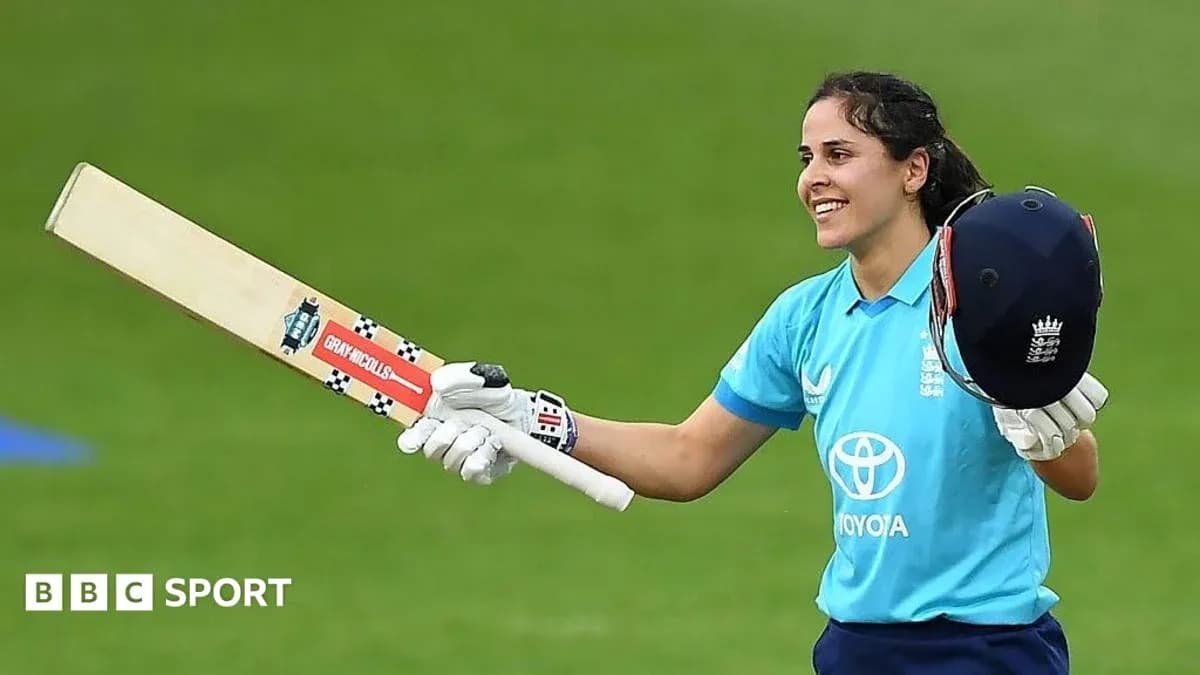
At the heart of it all stood Maia Bouchier.
Bouchier’s day, at last
For years, Bouchier has hovered around England’s white-ball sides: in squads, on tours, in conversations. Not quite indispensable, never fully discarded. This time, with Heather Knight and Tammy Beaumont retired from ODIs and Nat Sciver-Brunt injured, the vacancy in the top order was real, not theoretical.
She seized it.
Her 104 from 95 balls was not a blaze from ball one. She crawled to eight from her first 19 deliveries, feeling out the surface, the occasion, the responsibility. Then came the sixth over, and with it a shift. Jane Maguire dropped just short and just wide too often; Bouchier cashed in. A flurry of boundaries broke the inertia and, with it, Ireland’s early discipline.
From there, she controlled the chase. Not alone, and not always centre stage, but with the composure of someone who understood that this was an audition she could not afford to botch.
Dunkley’s fury, Ireland’s fade
If Bouchier was the anchor, Sophia Dunkley was the storm at the other end.
Ireland’s bowlers, already guilty of offering width and missing their lengths, found no mercy. Dunkley drove on the up, cut hard, and punished anything remotely short. Her fifty came from just 47 balls, the fastest of her ODI career, and by the time she miscued a return catch to Cara Murray on 73 from 61, the damage had been done.
The opening stand of 143 set the tone and effectively broke the chase. England thundered to 72-0 in the powerplay, exposing the gulf in experience and execution. Misfields crept in. Lines wavered. Lengths disappeared. Ireland, so composed with the bat, unravelled with the ball.
They never really recovered.
New faces, same ruthlessness
This was not a full-strength England. No Knight. No Beaumont. No Sciver-Brunt. No Lauren Bell or Sophie Ecclestone with the ball. It did not matter.
After Dunkley’s departure, Bouchier shifted gears again. She took ownership of the innings while Jodi Grewcock, on debut, scratched around for nine and wore every dot ball on her face. When Grewcock fell, the tension might have crept in. Instead, Alice Capsey walked out and blew it away.
Capsey’s intent was immediate. She ran hard, punched gaps, and refused to let the rate drift. Bouchier moved through the nineties with minimal fuss, then reached her hundred with the air of someone ticking off a task rather than chasing a dream.
Perhaps that was why the dismissal stung. On 104, with just 59 needed, she holed out to long-on after a rare lapse of concentration. Her frustration was obvious. England’s was not. They were already home.
Capsey finished unbeaten on 41, striking the winning boundary to complete a 54-run stand with Freya Kemp that came in just 38 balls. Kemp’s 36 from 22 was brutal and emphatic, a reminder of the depth now lurking in England’s middle order. Five batters from last year’s World Cup semi-final XI were missing; the scoring rate never blinked.
Ireland’s bright start, blunt finish
Ireland will leave Leicester with mixed feelings. Their bowling and fielding were ragged, but their batting deserved more support.
Gaby Lewis and Amy Hunter were excellent. After the early loss of a wicket, they stitched together a 136-run stand for the second wicket that gave the innings its backbone. Lewis’ 69 from 89 balls and Hunter’s 62 from 90 were built on patience and placement rather than raw power, but on a docile surface they did exactly what their side needed.
The real surge came late. Rebecca Stokell’s unbeaten 54 from 48 balls injected the tempo Ireland had been missing. She drove straight, swept clean and picked off an England attack that, without Bell and Ecclestone, lacked bite in the middle overs. The hosts went through long stretches without threatening, and Ireland’s total of 281-5 looked, for a time, like a serious ask.
On another day, against a less polished chase, it might have been.
But once England’s openers settled, the contest tilted sharply. Only Orla Prendergast, with her pace and hostility, hinted at the kind of threat England’s top order will face against the world’s elite. Against the rest, the ball sat up, the fielding sagged, and the pressure evaporated.
Edwards’ blueprint takes shape
For head coach Charlotte Edwards, this was close to the ideal start.
She is building towards next summer’s Ashes with a top order suddenly stripped of two modern greats. The question is not whether England can score heavily on good pitches – they always have – but who will do it, and how consistently, in the post-Knight, post-Beaumont era.
On day one of that journey, Bouchier and Dunkley answered as emphatically as the conditions allowed. The caveat is obvious: sterner attacks are coming, and Ireland’s bowling, aside from Prendergast, sits some distance from that level.
But form still matters. So does confidence. So does the feeling, walking off with 11.5 overs unused after a record chase, that this is not a side in transition so much as a side reloaded.
The series moves to Derby on Thursday. Ireland must find accuracy and steel with the ball. England will want their bowlers to match the authority of their batters.
If this is the first glimpse of England’s next chapter, the question now is not whether they can live without their old guard.
It is how high this new version can climb.