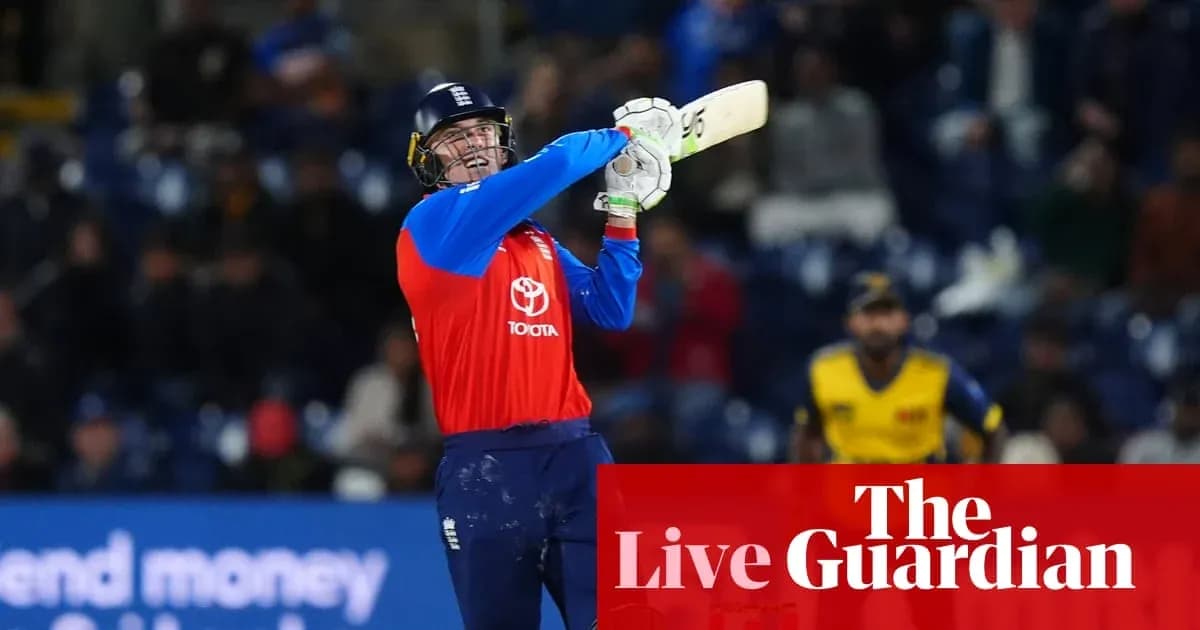
Harry Brook walked out at No 3 with England needing barely a run a ball and still managed to turn a routine pursuit into a statement. By the time he departed, having launched Wanindu Hasaranga into every corner of the ground and one small part of the river, the contest had long since stopped resembling a chase and started to look like a public flogging.
The target was 146. England made it look like a warm-up drill.
Dawson’s spark, Archer’s finish
Sri Lanka’s innings began brightly enough. They were 55 without loss, the openers moving smoothly, the surface true, the outfield quick. Then Liam Dawson came on in the fifth over and the match turned with the quiet brutality that often defines England’s white-ball cricket these days.
Dawson’s left-arm spin strangled the tempo and snapped the early rhythm. He removed Shanaka for 4, the Sri Lanka captain heaving high into the leg side. Tom Donald, who had already shelled one in the over, steadied himself under the second chance, juggling his way to a catch that felt like a release – for him, and for England. Dawson’s spell never lost its grip: another over of just four runs and that wicket underlined how quickly Sri Lanka’s innings had stalled.
From 55-0 they disintegrated to 142-8. Adil Rashid, summoned at the squeeze point, did what Adil Rashid does. His control at the death on a small ground was a luxury most captains can only dream of. Charith Asalanka, who had been forced into the anchor role, finally tried to break free and paid for it, failing to clear Craig Overton at long-off and falling for 31. The moment Rashid struck, the last hint of a late surge evaporated.
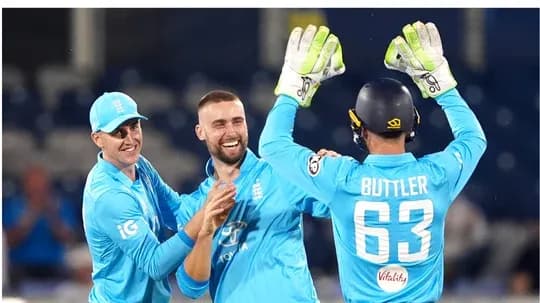
Around him, England’s seamers hunted as a pack. Overton’s clever change of pace accounted for Kusal Mendis, cramped by a cutter as he tried to run the ball down and instead chopped it back into his off stump for 12. Gus Atkinson’s stand-in, Baker, was superb: pace off, back of a length, constantly teasing the splice. His four overs cost just 15 and included the key dismissal of Hasaranga, who skied a huge miscue to cover. Dawson again took responsibility, waving away teammates and clutching the swirling ball as it plummeted from the clouds.
By the time Jofra Archer returned at the death, Sri Lanka were hanging on rather than launching. Archer’s response was merciless. He speared one full and straight to send Dushmantha Chameera’s middle stump cartwheeling for 0, then finished with another smart plan: mid-on up, pace on, and Ratnayake obligingly picked out Brook for 4. Sri Lanka staggered to 145-9, a total that felt 20 light even before England picked up a bat.
Buttler’s landmark, Donald’s homecoming
If Sri Lanka needed early breakthroughs to make a game of it, they never got close. Jos Buttler and Donald walked out with intent, the captain armed with a looming personal milestone and his partner drinking in a home-ground occasion he will remember for a long time.
The first over from Madushanka brought only four, but the signs were already ominous. Buttler was seeing it early, dabbing and turning, while Donald settled himself with a splice-y single. Any sense of quiet disappeared the moment Chameera took the ball.
Donald had punished him in the warm-up and wasted no time doing it again. He stepped away and flipped the first delivery over his own head for six, a shot that screamed both confidence and calculation. Chameera went short, Donald went again – this time over the bowler’s head for four. Another mis-hit still found the midwicket rope. Sixteen off the over, Sri Lanka’s lengths shredded, and the tone brutally set.
From there, Buttler took over. Against Madushanka he was a step ahead, leaning into a classical clip for four, then reading the bowler’s attempt to out-think him. Expecting the scoop, Madushanka pulled his pace back. Buttler simply reverse-scooped him instead, the ball racing away to third man. The speed of eye, the speed of hands, the certainty of decision – it all felt unfair.
He shimmied down for a crisp cover drive, then muscled another blow over deep backward. One more clean strike over wide long-off and Sri Lanka looked short at least 300 fielders. Eighteen came from the over, all to the most softly spoken assassin in the format.
By the time Hasaranga entered the attack, England were 48-0 and cruising. Buttler immediately greeted him by rocking back to a short ball and launching it out of the ground and into the river, a moment of “beautiful violence” that underlined the gulf between the sides. A single to finish the over nudged him closer to a landmark that has been stalking him for a while.
The next over brought it. Against Malinga, Buttler dabbed to point for one, moving to 15,000 T20 international runs and stepping clear as the format’s highest run-scorer. No fuss, no celebration, just another small note in a career that has quietly rewritten the record books.
Donald, meanwhile, matched the mood. He cuffed a slower ball, top-edged a bumper between converging fielders, and kept the tempo high. His 21 from the top was exactly what his captain needed and exactly what his home crowd wanted.
Brook detonates, series sealed
When Donald finally fell – flaying a wide slower ball from Malinga straight to Hasaranga at mid-on – England were 51-1 and unbothered. Buttler followed soon after for 30, top-edging a skiddy pull off Chameera to short third, where the keeper called it and held on. At 55-2, Sri Lanka had the faintest sliver of hope.
Brook crushed it.
He began by swaying back to his first ball from Malinga and easing a ludicrous touch shot to third man for four. No sighters, no caution, just instant authority. The label “freakish genius” has followed him around for a while; strokes like that explain why.
At 50-2 after six overs, England needed 91 from 88 balls. For most sides that would be a gentle canter. For this one, it was a chance to flex.
Hasaranga’s seventh over became the defining passage of the chase. Brook waited, then hauled him over square leg for six – England’s third of the innings, one more than Sri Lanka had managed in their full 20 overs. After a dot, he moved his feet, cleared his front pad and sent another six arcing over wide long-on. The pressure that Sri Lanka had briefly threatened to build simply evaporated.
Then came the shot that broke them. Brook stayed still this time, almost statuesque, and dematerialised a third six over midwicket. Three blows, three different methods, same outcome. The contest, such as it was, ended there. The description from the press box felt apt: “this is a violation now”.
Banton, at the other end, did what was required – a handful of runs, plenty of strike given to the man in form, no unnecessary risk. England were not interested in nurdling their way home in singles. They were interested in sending a message.
They got there with time, wickets and swagger to spare, wrapping up the three-match series and underlining just how far this white-ball group has come. Brook captained with a sharp, inventive feel – setting the fields, pulling the right levers, backing Dawson and Baker at crucial moments – then finished the job with the bat in the way only he can.
It is England’s misfortune that there is no global T20 prize on offer until 2028, because this looks a side built for tournament cricket: depth with the bat, variety with the ball, intelligence in the field, and a captain who seems to relish the chaos.
On nights like this, when 145 feels a formality and a series is tucked away with something close to disdain, the real question is not whether they’re good enough now – it’s how much better they can get by the time the next World Cup finally comes around.