The storm from Australia’s 2018 tour of South Africa refuses to blow itself out. Every time it seems to drift into the distance, another voice drags “sandpapergate” back into the spotlight.
This time, it is Graeme Hick.
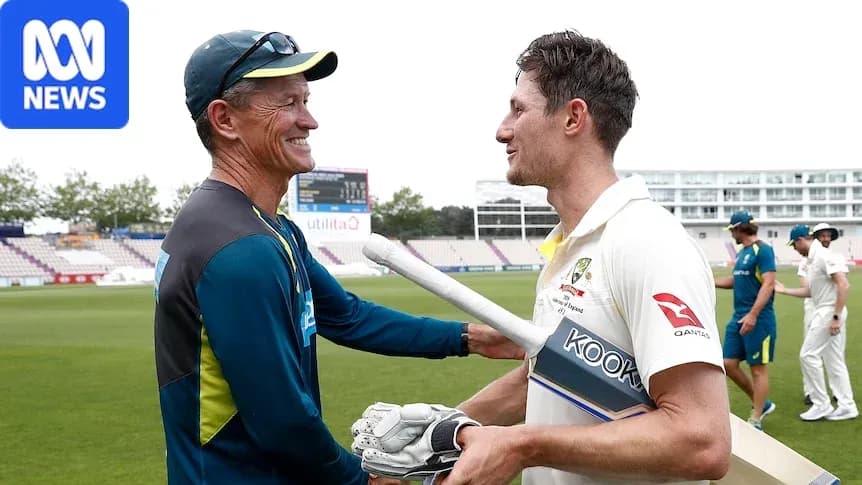
The former Australia batting coach has hit back hard at Usman Khawaja’s explosive claim that “all of us” in the team knew about the plan to use sandpaper on the ball during that infamous series. Hick, who was on Justin Langer’s staff from 2016 to 2020, has branded the suggestion “absolutely false”.
Speaking to the Sydney Morning Herald, the Zimbabwe-born former England star made his position clear. He said he was “very disappointed” with the sweeping nature of Khawaja’s allegations and rejected outright the idea that the entire dressing room and staff were across the plot in Port Elizabeth or Cape Town.
“In regard to any discussions around the ball-tampering in Port Elizabeth or Cape Town, I will say in true honesty that I did not hear or know anything,” Hick said, explaining that his first awareness of the scandal came, like so many others, when the images appeared on the big screen at Newlands. He recalled sitting on the outside balcony as the footage that would shake Australian cricket flashed up in front of a global audience.
Hick’s intervention adds his name to the growing list of figures disputing Khawaja’s version of events, alongside Mitchell Starc and former head coach Darren Lehmann, both of whom have already rejected the idea of collective knowledge.
But if Hick hoped his comments might steady the narrative, they had the opposite effect on one of the central figures of that Cape Town catastrophe.
David Warner logged back on.
The former opener, banned and then eventually farewelled as one of Australia’s greats, has been vocal in his support of Khawaja since the release of his former teammate’s book. Warner had already endorsed Khawaja’s account of the saga, declaring: “It’s 100 per cent accurate what you’ve said. Now everyone knows the truth.”
Hick’s denial lit the fuse again. Warner’s response was not about the detail of ball-tampering this time, but about the politics and priorities of Cricket Australia.
“Let’s get the facts straight,” he wrote, launching into a pointed critique of the circumstances that brought Hick into the Australian set-up in the first place.
Warner claimed Hick was only appointed as batting coach because Cricket Australia “was unwilling to pay Michael Di Venuto what he deserved”. In a stinging aside, he said the players rated Di Venuto so highly that they even offered to chip in from their own salaries to keep him on board during the New Zealand tour.
“As players, we valued Michael so highly that we even offered to contribute from our own salaries to retain him,” Warner wrote. “These discussions were taking place during the New Zealand tour. That alone speaks volumes about how highly we regarded him and how determined we were to keep him involved. Adds to why Graeme has spoken!!”
The implication was clear: in Warner’s eyes, Hick was never truly at the heart of the team’s inner circle in the way his predecessor had been, and that colours how his denials should be read.
So the lines are drawn again. On one side, Khawaja and Warner, insisting the full truth of 2018 has never been properly owned. On the other, senior figures from that era – Starc, Lehmann, Hick – pushing back against the suggestion of a wider conspiracy.
Eight years on from Cape Town, the bans have been served, the careers reshaped, the trophies won and lost. Yet the question that once tore through Australian cricket still hangs in the air, sharper now with every new revelation: who, exactly, knew what?