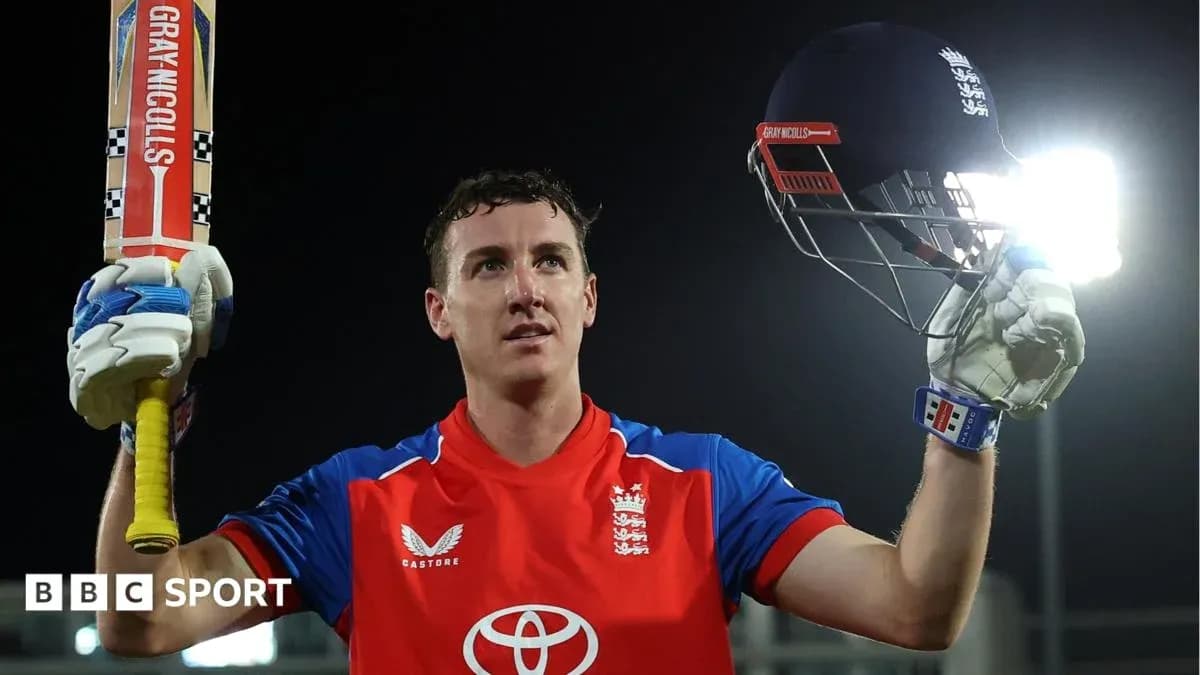
Harry Brook didn’t just light up Southampton. He ripped the place apart.
On a warm night at the Ageas Bowl, with Kevin Pietersen watching from England’s backroom staff, Brook produced an innings so savage, so audacious, that the comparisons wrote themselves. By the time he walked off, unbeaten on 114 from 49 balls, England had piled up 254-4 and Sri Lanka were staring at a mismatch rather than a chase.
They never got close. England won by 119 runs. The margin felt about right.
Brook, the TikTok-era Pietersen
Brook arrived at the crease with England already ticking along, but what followed was something else. Ten fours. Six sixes. Balls dragged, whipped, carved and flat-batted to every corner of the ground. It was the kind of hitting that once made Pietersen the most feared batter in world cricket, only now updated for a new generation.
The likeness is not in the trick shots. Pietersen gave the game the switch hit; Brook barely touches it. His trademark is that tumbling scoop over his own head and the keeper’s – not even needed here. The real echo lies in how both men read length. Good balls from spinners suddenly became short, wide or overpitched as Brook rocked back, cut, pulled and smeared them into gaps that didn’t seem to exist a moment earlier.
His running matched his ball-striking. Singles stolen, twos turned into threes, fielders harried into mistakes. There was nothing lazy or one-dimensional about it. This was not slogging. This was control with menace.
Watching on television, Ben Stokes could barely contain himself. “I don't even think the genius of KP could come close to what Harry Brook has talent-wise,” he said, calling his former team-mate “an absolute freak”. It sounded wild, but in the context of this innings, it didn’t feel outlandish.
Brook grew up on Pietersen highlights. He was six when Pietersen’s 158 at The Oval dragged England over the line in the 2005 Ashes decider. Fourteen when the relationship imploded and England cast him aside after the 2013-14 Ashes. Those images, those shots, sank in.
“I used to love watching him bat when I was younger,” Brook has said. “He always looked to take the attack to bowlers and put them under pressure. In that aspect, I'm quite similar.” On this evidence, it’s hard to argue.
Buttler burns, Brook explodes
Jos Buttler played a captain’s hand and still ended up a support act. His 80 from 44 balls would normally dominate any scorecard. Here, it felt like the platform.
After debutant Aneurin Donald scratched his way to 12, Buttler and Brook took control, adding 128 with a mix of clean hitting and calculated risk. Buttler went aerial early, forcing Sri Lanka’s seamers to retreat into defensive lines. Once they did, Brook took over.
The acceleration was brutal. England were 82-2 after 10 overs. They finished on 254-4. Brook’s tempo barely dipped: he shifted gears without ever looking frantic, dismantling spin and pace alike. Sri Lanka’s bowlers ran through their options and found only punishment.
It was the sort of partnership Pietersen used to thrive in – one destroyer feeding off another, bowlers trapped with nowhere to hide. And somewhere on that dressing-room balcony, the original maverick must have recognised a familiar streak.
Pietersen’s shadow and Brook’s ceiling
Debates about Brook versus Pietersen will belong to pubs and podcasts for years, but the numbers at this stage are already close enough to be intriguing.
At 27, Pietersen’s Test average sat at 49.55. Brook’s is 53.08, though Pietersen had two more hundreds. In one-day internationals, Pietersen holds the edge: 47.87 with six centuries against Brook’s 37.43 and three. Yet in T20 internationals, Brook’s second century on the south coast takes him past Pietersen, who never managed one.
Where Brook trails is in the scrapbook moments. Pietersen’s 158 at The Oval in 2005 effectively won England the Ashes in his fifth Test. Eighteen months later, he repeated the number – another 158 – in Adelaide against Shane Warne and Glenn McGrath. Four Ashes series wins, an era-defining presence, and a catalogue of innings that shaped series, not just matches.
Brook’s Test best is a colossal 317 in Pakistan, a monument to endurance on a flat pitch. His highest Ashes score is 85. He hasn’t yet lifted the urn. The stage is still being built.
But his trajectory in T20 cricket is frightening. Since moving to number three at the World Cup earlier this year, he averages 95.20 in the format with a strike-rate of 200.84. He has scored 288 T20 international runs since he was last dismissed. That’s not a purple patch. That’s domination.
Former seamer Steven Finn put it starkly: “Harry Brook has today cemented himself as maybe the best all-format batter in the world.” He name-checked Travis Head and Shubman Gill as rivals, but the point was clear. Brook is no longer a promising talent. He’s a central figure.
Maverick with the armband
There is one arena where Brook already outstrips Pietersen: leadership in the shortest format. Overlooked for the Test captaincy, he has quietly built a formidable record in T20s. He has won 18 of his past 20 matches as England captain.
Pietersen’s own spell in charge of England was brief and turbulent, over in five months. Brook’s reign, by contrast, has been calm, assured and relentlessly successful. Here, he marshalled his attack with clarity and backed youth at key moments.
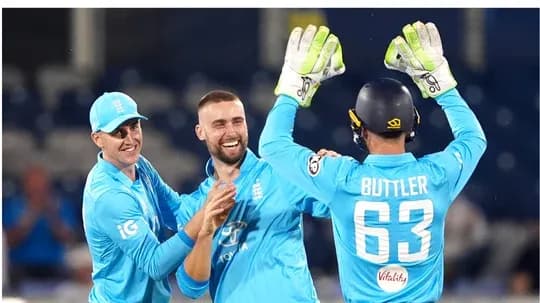
Sonny Baker, the young seamer, responded with the best figures of his England career: 3-12 from four overs. On a night when batters dominated the headlines, Baker’s spell sliced through Sri Lanka’s resistance and ensured the contest never flickered back to life.
Sri Lanka’s target of 255 always looked fanciful. Without Jofra Archer or Sam Curran, England still hunted them down with ruthless efficiency, rolling them for 135 in 19 overs. Brook called the performance “near perfect”. It was hard to find anyone who disagreed.
A new standard to chase
England have brought Pietersen back into the fold with one eye on next year’s 50-over World Cup, hoping his sharp edges and attacking instincts can sharpen a squad that wants to stay ahead of the curve. On this evidence, he has walked into a dressing room that already thinks in his language.
Brook embodies that mindset. Unapologetically aggressive. Willing to fail in pursuit of something extraordinary. Stokes captured it in a social media post, urging people to stop berating players like Brook and Pietersen for doing things mere mortals cannot even imagine. Just watch. Just appreciate.
The arguments about who was better will come later, if they come at all. For now, Pietersen is the legend in the tracksuit, Brook the man in the middle rewriting what an England innings can look like.
If this is the standard Brook sets at the start of a home T20 series, the real question is not how high he can go. It’s who, anywhere in the world, can keep up.