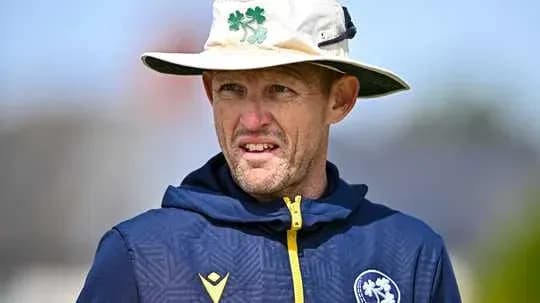
Heinrich Malan walks away from Ireland on a high, not a low. That alone tells you plenty about the man and the project he has just brought to a close.
A day after Ireland completed a 2-0 T20I series win over India, the reigning world champions, the head coach with a contract through to 2027 told the board he was done. No sacking, no crisis, no dressing-room revolt. Just a firm, calculated decision that the road he wanted to travel no longer ran in the same direction as Irish cricket.
A parting shot: India beaten, questions answered
For most national coaches, a series win over India is the sort of result you frame and hang on the office wall. For Malan, it became the full stop.
"It was a fantastic series for us," he told Cricbuzz, pleased not just with the result but with how his players absorbed and executed plans under pressure. Beating India 2-0, he admitted, was “as best as you could have asked for” as a final act.
The twist is that the decision to walk away had been brewing for a while. Conversations after the New Zealand Test earlier this year turned reflective, then strategic, then decisive. What did the future look like beyond 2027? Who wanted what? And how?
By the end of those talks, Malan and the hierarchy reached an uncomfortable but clear conclusion: philosophies and direction no longer matched. With “new people” in key positions came “new ideas and ways of doing things,” as he put it, and the natural friction that follows. Eventually, both sides accepted it was time.
A coach leaving on his own terms after a marquee series win is rare. It underlined that this was not about short-term form. It was about the bigger picture.
Wins on the field, limits off it
Strip away the emotion and Malan’s four-and-a-half-year tenure looks like one of the most productive eras in Ireland’s short history as a Full Member.
They toppled England at the 2022 T20 World Cup in Melbourne. They finally claimed a first Test victory, beating Afghanistan in 2024. They followed that with a first home Test win, against Zimbabwe in Belfast. Then came India, beaten in a T20I series to close the chapter.
Those are the headline moments, the type that go into presentations and annual reports. Malan, though, kept circling back to a more stubborn theme: Ireland, in his view, simply did not play enough cricket.
“Very proud of what we achieved,” he said, before quickly pointing to the “very challenging” reality that the team’s calendar remained too thin. Ireland showed they could compete with anyone, he argued, which means the talent is there. The issue is repetition. To be truly consistent, you have to live in the rhythm of competition, “day in and day out.”
For Malan, the biggest structural problem sits in plain sight: a lack of regular cricket, both domestically and internationally. Training blocks stacked up. Matches did not.
There is always a place for training, he acknowledged, but at some point players must stress-test new methods in real games, under lights, with points and reputations on the line. Without that, development stalls. The hope, from his vantage point, is that future schedules tilt towards more cricket, not more nets.
Building an environment, not just a fixture list
Ask Malan what he is proudest of and he doesn’t start with Melbourne or Belfast or that India series. He goes back to the daily grind.
He talks about the environment: what it means to be a professional cricketer in Ireland, what daily actions and behaviours look like, how senior players began to own the standards rather than wait for coaches to impose them. He believes that culture piece, the “holistic programme” as he calls it, will outlast any single result.
That, in his mind, is the real legacy: a dressing room where leaders drive the tone, where younger players step into a structure that already understands what high performance should feel like. Scoreboards fade. Habits stay.
The money problem that won’t go away
Behind all of this sits a blunt financial reality. Malan doesn’t dress it up.
“The biggest challenge… is the financial side of things which impacts the whole structure and system,” he said. Ireland’s ability to schedule more domestic and international cricket, especially in the red-ball space, remains tied to budget lines and broadcast deals, not just ambition.
He sees more domestic cricket as the key to unlocking the next phase: more exposure for top youth players, particularly in first-class cricket, and a broader pool of internationals pushing each other. Depth, competition for places, genuine selection headaches – those are the hallmarks of a healthy system. Ireland, in his view, still sits on the edge of that, not inside it.
He also welcomes the growing European cricket landscape, with new competitions giving players a chance to mix with high-level teammates and coaches. The real value, he stresses, lies in the volume of matches. More games, more learning, more resilience.
A coach moves on, but not away from the international stage
Malan has already moved back to New Zealand, taking over as head coach of Central Stags. It is a shift back into domestic cricket, but not a retreat from the international game.
He admits he will miss the intensity and scope of international cricket. He still sees that arena – and the T20 franchise circuit – as central to where he wants to grow as a coach. The aim is simple: keep evolving, keep adding value, keep building successful environments.
Ireland, for their part, inherit a squad that has taken down England at a World Cup, won Test matches home and away, and just toppled India in a series. They also inherit the same structural questions Malan wrestled with from day one.
The coach has gone. The fixture list, and the finances that shape it, will decide what Ireland can become next.