The Arun Jaitley Stadium is used to noise. This was different.
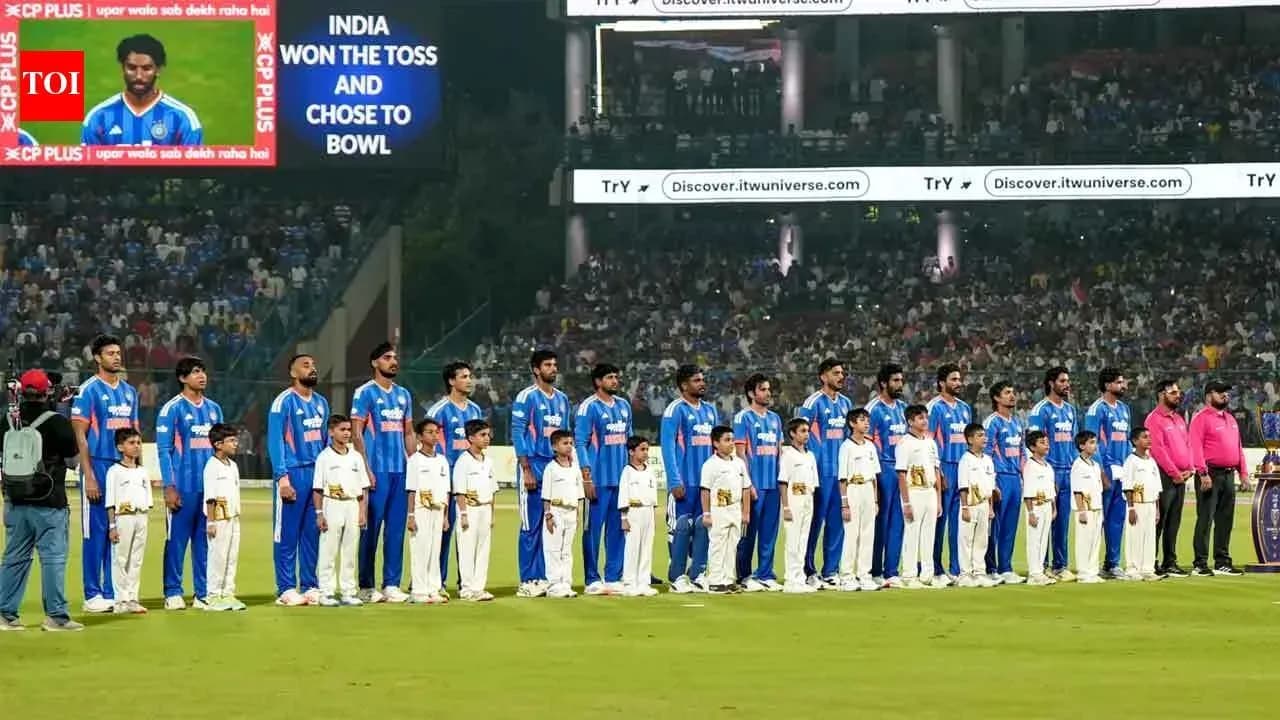
As the teams lined up for the first T20I between Afghanistan and India in New Delhi on Sunday, the usual pre-match routine took an unprecedented turn. Before the National Anthem rang out, the stands rose to a full-throated rendition of the National Song, Vande Mataram — a first at an international cricket match.
The two pieces were performed back to back, Vande Mataram followed by Jana Gana Mana, as players from both sides stood in line on the outfield. It turned a routine toss-day build-up into something closer to a ceremonial occasion, the kind more often associated with a national commemoration than a series opener.
The moment came in the wake of a Ministry of Home Affairs directive, issued on January 28, which set out formal protocols for singing the National Song. The notification specified that all six stanzas of Vande Mataram should be rendered at official functions, a recital that runs for about 3 minutes and 10 seconds. It also listed the types of events where the National Song must be sung alongside the National Anthem.
Sporting events did not figure in that list. Yet here, on a cool Delhi evening, cricket became the stage.
Vande Mataram and Jana Gana Mana had previously been sung together in full on August 15, 2026, after Prime Minister Narendra Modi’s Independence Day address. Sunday’s pre-match ceremony carried a similar weight, even as it unfolded in front of a crowd waiting for powerplays and yorkers rather than parades and speeches.
Once the last notes faded and the formalities ended, the cricket took over.
India, designated the away side in this series despite playing in Delhi, won the toss and chose to bowl against Afghanistan, who are the official home team. Shreyas Iyer did not hesitate. Conditions, he said at the toss, made the decision straightforward.
“We are going to bowl first. Whenever you come to Delhi, you know what the pitch has got to offer; it usually is a bowl-first wicket,” Iyer explained, pointing to the surface and the team’s recent confidence. He referenced the positives from the Zimbabwe T20I series and turned quickly to the biggest name on his team sheet. “We know Bumrah is a match-winner.”
Jasprit Bumrah’s return to the T20I side, his first appearance in the format since IPL 2026, added steel to India’s attack and a buzz to the stands. Every warm-up delivery he sent down drew its own murmur. For a bowler of his pedigree, just walking back into the XI changes the feel of a contest.
There were selection talking points too. Vaibhav Sooryavanshi, impressive in Zimbabwe, missed out, with Sanju Samson coming into the side. Iyer confirmed at the toss that “Vaibhav is not playing, Washington is not playing, and two more,” underlining that recent form alone was not enough to guarantee a place in a squad packed with options.
Samson took the gloves and a batting slot, while India’s middle order carried a distinctly contemporary look: Abhishek Sharma, Ishan Kishan, Tilak Varma, Nitish Kumar Reddy and Shivam Dube surrounding their captain. Axar Patel added balance, with Arshdeep Singh, Bumrah and Varun Chakaravarthy rounding out a varied attack.
Across the line, Afghanistan named a familiar, battle-hardened core. Ibrahim Zadran led the side, with Rahmanullah Gurbaz as wicketkeeper and top-order enforcer. Sediqullah Atal and Darwish Rasooli offered support, while Azmatullah Omarzai and Gulbadin Naib brought all-round depth. Experience ran deep in the lower middle order, with Mohammad Nabi, Rashid Khan, Mujeeb Ur Rahman, Noor Ahmad and Fazalhaq Farooqi forming a spin-heavy, canny bowling unit.
On paper, it was a contest loaded with storylines: Bumrah’s comeback, Samson’s opportunity, Sooryavanshi’s omission, Afghanistan’s spin armoury. But even before a ball was bowled, the night had already etched its own place in the game’s memory.
Cricket has long been a mirror for the country’s mood. In Delhi, as Vande Mataram and the National Anthem rose together over a packed stadium, the sport briefly stepped beyond the boundary ropes and into the language of ceremony and identity. The series will be decided by runs and wickets, but it began with a song.